










































Covering the Last Mile for Vaccination: Feasibility and Acceptability of Traditional Birth Attendant-Based Referral System in Hard-to-Reach Areas in Rural Pakistan
Isra University Hyderabad (Sahito); Government of Sindh (Ahmed); Aga Khan University (Fatmi)
"With the right training, female CHWs (TBAs and volunteers) can be effective social mobilizers for vaccination."
Engagement of community health workers (CHWs) has been shown to increase immunisation coverage in low- and middle-income countries (LMICs). Pakistan has a network of CHWs including lady health workers (LHWs), who work as social mobilisers for vaccination and participate in Expanded Programme on Immunization (EPI) campaigns against polio, measles. and tetanus. However, 45% of the population is not covered by LHWs/vaccinators, labeled here as hard-to-reach (HTR) areas, where immunisation coverage is also low. This study explored the feasibility of engaging traditional birth attendants (TBAs) to improve EPI vaccination coverage in HTR areas of rural Sindh province, Pakistan.
The implementation research was conducted in two sub-districts of Sukkur, a rural district in Sindh. Salehpat and Rohri were selected as TBAs and LHWs arms, respectively. TBAs and LHWs were trained for enrolment and referral of children for vaccination, and they were also educated about vaccination and its importance, the EPI schedule, common misconceptions, and how to counsel parents. In coordination with vaccinators (facilitated by in-person meetings), TBAs arranged vaccination camps in the villages, worked as mobilisers, and, on a decided day, brought children for vaccination. TBAs were given a monetary incentive for achievement of each complete child vaccination (defined for the purposes of this short project as meaning the child received Bacillus Calmette-Guérin (BCG), polio vaccine at birth, and three doses of polio and Penta-3 vaccines). LHWs were provided with the training but with no monetary incentive; they were considered the control arm.
Considering the inherent differences in the intervention and comparison group (HTR intervention area being worse regarding infrastructure and access), between-group and within-group changes in knowledge of TBA/LHWs and vaccination coverage were assessed before and after the intervention. A questionnaire was used to assess TBAs' and LHWs' vaccine-related knowledge, and data from the administrative reports of the district EPI office were used to estimate the change in vaccination coverage, comparing the TBA and LHW arms. Furthermore, two focus group discussions (FGDs) were conducted with TBAs and LHWs, and six in-depth interviews (IDIs) were carried out with supervisors of vaccinators.
Twelve LHWs were trained, covering about 60% population in the union council, or UC (Ali Wahan) of the selected LHW arm; 23 TBAs were trained, covering 30% of the population in the selected UC (Laljurio Shabani). Both TBAs' and LHWs' vaccine-related knowledge increased significantly after training (pretest vs post test score: 10.5 to 15.4). The overall increase in knowledge was higher for TBAs, who had a 250% increase in score from the baseline.
As compared to baseline, an overall increase was observed in BCG coverage in both the TBA arm and the district. However, the highest increase from the baseline (74% BCG and 147% Penta-3) was observed in the TBA arm. Furthermore, there was a 226% increase in vaccine dropout in the district overall. However, in the TBA area, dropout decreased by 62% in the TBA area from the baseline during the same period.
Qualitative data indicate that TBAs considered training to be useful in increasing their knowledge of vaccines, and they felt empowered in counselling parents and referring children for the vaccination. One TBA commented, "We had to explain importance of immunization and counsel parents initially now people have become aware. They understand the importance of immunization, and they reach to us for vaccination." Parents (n=12) in remote villages expressed appreciation for TBAs in the context of vaccination, with one of them saying, "Its [the] first time our children are being immunized due to efforts of TBAs. Our sisters (TBAs) are coming to our doorsteps and arrange vaccination camps in our villages."
All vaccinators agreed that TBAs were very helpful in improving vaccination coverage and follow-up for children. EPI managers at all levels welcomed the initiative of TBAs' involvement in routine vaccination. They claimed that the coverage achieved in the TBA arm during this programme was the highest ever recorded in the UC. According to EPI staff, TBAs were particularly important in reducing the dropout rate by convincing women to strive for vaccine completion. Supervisors considered TBAs to be more effective than vaccinators because, being female, they have access to homes in this culture. Being from the local community, they can communicate with the mothers more easily and have more information about the newborns, as compared to vaccinators.
Incentive was one of the key motivating factors; this was acknowledged at all levels by EPI managers and seemed to be necessary for the sustainability of this initiative, since TBAs do not have any other source of income. However, a few TBAs were so motivated they said they would be willing to work without monetary incentives.
Both vaccinators and LHWs considered the polio campaign to be a hindrance to their work. Because of their frequent visits to households during polio activities, households do not pay much attention to them, and parents expect all vaccinations to be done at their doorsteps.
In conclusion: "Involvement of TBAs' to form a referral system has potential to improve vaccine coverage and completion in HTR areas in Pakistan. The system is acceptable to the population and implementation is feasible due to availability of TBAs. However, in order to sustain the initiative minimal incentive need to be provided to TBAs to improve the vaccination coverage."
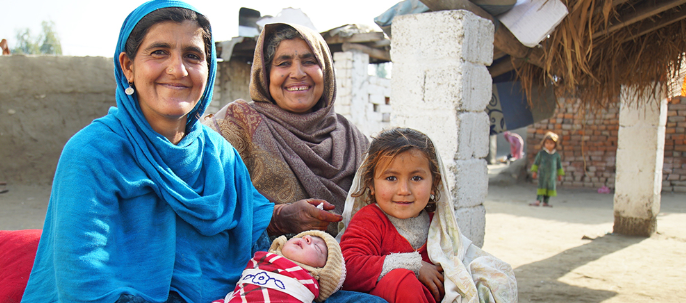
Journal of Global Health. 2020 Dec; 10(2): 021303. doi: 10.7189/jogh.10.021303. Image caption/credit: Palwashay (left) and her 3-day-old newborn baby, with TBA Sultan Bibi and one of Palwashay's other children. © Sahar Zafar / International Catholic Migration Commission (ICMC)