










































Developing a Three-Dimensional Narrative to Counter Polio Vaccine Refusal in Charsadda
Government of Khyber Pakhtunkhwa (Khan); World Health Organization, or WHO (Ashfaq); Khyber Medical University, or KMU (Ayub); ICU Healthcare (Jamil); United Nations Children's Fund, or UNICEF (Shahabuddin, Khalid, Badshah, Ullah)
"Evidence suggests that a counter-narrative for vaccine refusals, considering local experiences and concerns, should be adopted..."
The Global Polio Eradication Initiative (GPEI) faces numerous challenges in polio-endemic Pakistan, including illiteracy, misinformation, medical misconceptions, and a weak healthcare system. These challenges are more pronounced in the Pashtun belt, where district Charsadda, an active hub of nationalist politics and religious ideologies, has seen violence against polio vaccinators. Approximately 2,000 oral polio vaccine (OPV) refusals are reported with every National Immunization Day (NID) in the area. The current study was conducted to understand the ethnic, religious, and cultural roots of vaccine refusals in Charsadda and to explore remedial options.
The context is that, due to protracted ideological and armed conflict in the region, the Pashtun ethnic group has suffered. This scenario led to an ethnic mistrust and created a public-versus-state ("us" versus "them") mindset. Given this hostile backdrop, zealous efforts by the state for polio vaccination have made the population wary of state's intentions.
Using a case-study methodology, the researchers conducted 43 in-depth interviews with 15 male and 8 female residents district Charsadda who had refused polio vaccines for their children and 20 Polio Eradication Initiative (PEI) staff, 15 of whom were frontline polio workers, including 5 union council (UC) polio officers, 5 UC communication officers, and 5 religious support persons (RSPs). The research team consisted of members from the local Pashtun ethnic group and included both male and female interviewers.
Study findings include:
- Reasons behind vaccine refusals: Among the conspiracy theories are that polio vaccination is a Jewish plot or that OPV causes infertility. In general, there is a trust deficit at the community level. One female respondent said: "Why should we trust our government which never brings us requirements of our living like sugar and flour, and which is unable to employ us, yet has endless resolve and resources for the polio vaccination campaign...?" (As the researchers note, vaccination does not seem a relevant problem to people when they have unmet basic medical and nutritional needs.) In other instances, the trust deficit arises from questioning the credibility of vaccinators. One community member said, "there are rumours that the team members are just filling the bottles from water, for the sake of their daily remunerations."
- Pashtun ethnicity and vaccine refusals: Some believe polio vaccine is a tool for wiping out Pashtuns entirely; others resent what they feel are threats to their autonomy, with one saying: "The government knows that the Pashtuns would not allow such objectionable and ineffective drops for their children. Now they are using police, but how can they force us, these are our children, and we will decide what is best for them."
- Religious considerations and vaccine refusal: One of the female participants said, "Islam does not forbid us from polio vaccination, but the imam does...for the same reason that America is manufacturing it, and it may be a conspiracy." Regarding the clergy's influence, one participant said: "It is better to persuade one religious scholar rather than the persuasion of hundreds in a locality. Religious scholars will convince people..."
- Cultural considerations and vaccine refusals: For example, keeping in view the patriarchal structure of the society, there is a natural preference for male children, and this cultural preference plays into vaccine refusals. One respondent said: "These drops affect [decrease] the ratio of male offsprings compared to female. The drops alter the genetic matter [sperm and ova]. Then, the element of modernism and increase of obscenity [vulgarity] are among the major effects of these vaccinations. Therefore, we keep our children away from polio vaccinations." Another peril of the Pashtun culture is that women in rural areas are "impossible to reach", causing an information barrier. When asked about the role of Hujra, conventional community gatherings, one female respondent said: "Hujra is the place of finding solutions to common problems...If the polio teams come to Hujras to converse with the male family heads, it will surely bring benefit."
- Stakeholders' views on steps to convert vaccine refusals to acceptance: The overriding message is that the community has unmet information needs. Regarding the content, a community member said, "once the campaign starts, we come to know [from banners] that polio vaccination has started. So, the current campaign material tells about the campaign-dates only." Echoing this, a frontline worker said: "we first launch an initiative, and the awareness part of it follows later. This awareness becomes a damage control strategy, ie, going for awareness when there is an inertia and stalemate." Another frontline worker said, "our government is lagging in the awareness part. Why doesn't the government make it compulsory on all television channels to have PEI and EPI [Expanded Programme on Immunisation-] related awareness messages?" Another step identified was to uphold the credibility of the vaccination programme in light of the wave of disinformation on social media being spread by militant groups like Tehrek-i-Taliban Pakistan, which are discrediting global institutions like the World Health Organization (WHO).
The researchers observe that, instead of trying to establish a credible image and creating active demand for vaccines, the government has started to arrest parents for refusing vaccination. The interviews reveal that the use of force is counterproductive and further maligns this ethnic group. In addition, the informal Hujra and Jirgah institutions, which have played a vital role in Pashtun society by dispelling conspiracy theories and sharing information, are being replaced with social media, where malicious messages are spreading at an exponential rate.
In light of the findings, the researchers recommend that the PEI take steps to foster open discussion to dispel myths, such as those around infertility and gender ratio related to OPV. Simultaneously, the PEI and EPI, along with their partners, should fully utilise social media to disseminate accurate information to the public. The researchers also suggest that anti-terrorism and cyber-crime laws should be enforced to take on the militant groups that use social media to promote refusals based on false religious notions.
In conclusion, this study has revealed how the ethnic, cultural, and religious dispositions of Pashtun community members shape polio vaccine refusals in Charsadda District, in different ways. In concert with existing conspiracy theories and medical misconceptions, these three factors make refusals harder to counter. Awareness campaigns with content addressing these three dimensions - especially using engagement on social media, which "is proving to be the Achilles heel of PEI" - could help improve the situation.
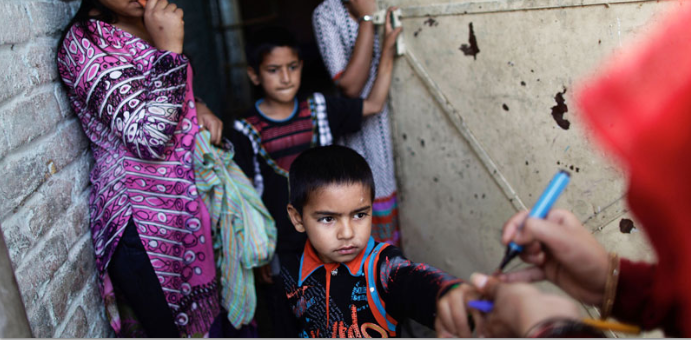
Journal of Global Health (JOGH) 2020; 10: 021301. Image credit: Dawn
- Log in to post comments