










































Effective Vaccine Uptake: Lessons Learned from the Global Polio Eradication Initiative
World Health Organization (WHO)
In this Second Annual Beth Waters Memorial Lecture, organised by the Global Health Council, Dr. Bruce Aylward spoke about immunisation policy, the role of government in widespread vaccination programmes, and practical and ethical issues associated with such efforts. He specifically focused on the role of communication in the global effort to eradicate polio. This PowerPoint presentation, 53 slides in length, highlights the key points from Dr. Aylward's lecture.
The presentation begins with the claim that polio eradication helps us go to scale with interventions needed to help meet the targets articulated in the Millennium Development Goals (MDGs). For instance, polio personnel deliver millions of insecticide-treated nets (ITNs), assist in fighting pandemic flu, and deliver other vaccines such as measles vaccine. Specifically, as explained here, the Global Polio Eradication Initiative (GPEI) is a partnership carrying out National Immunisation Days (NIDs), routine immunisation, surveillance, and mop-ups. Twenty million workers in 200 countries have immunised 2 billion children over a 20-year period. However, insufficient political and societal buy-in (in Nigeria), active conflict (in Afghanistan), insufficient political buy-in and insecurity (in Pakistan) and insufficient vaccine effectiveness (in India) have led to recurrent importations into formerly polio-free areas.
Through the process of trying to cope with this resurgence, Dr. Aylward notes, we have learned several lessons, such as:
- Bring in professional management to establish a basic management process and to ensure measurement of progress to maximise efficiency and accountability.
- Invest heavily in on-the-ground technical assistance (e.g., personnel have been rapidly scaled up for an "acceleration" phase, with distribution of WHO polio technical assistance reflecting epidemiology and risks).
- Establish robust capacity for all aspects of communications - including intensive social mobilisation, interpersonal communication, and underserved engagement. Aylward makes several observations, such as: polio required us to think differently about the complex, unique structures and networks that make up "communities"; changing behaviours and social norms require penetration, engagement, trust, and perseverance; the message is often not as important as the messenger; process is as important as outcome; scale and quality are critical to achieve change; and decisions (e.g., about who we need to reach) should be data-driven. Examples are provided, such as social mapping in Pakistan that has involved FM radio, Taliban (religious and political movement) meetings, Jumma (Friday morning prayer) announcements, and an inauguration meeting. As these examples highlight, engaging affected communities has been part of the tailored strategies developed to meet specific challenges.
- Advocate effectively, especially at sub-national levels - Nigeria's Governors have launched an "Abuja Communique" on polio, Bill Gates has met with the Sultan of Sokoto and Nigerian traditional leaders, the Governor of Kano was seen publicly vaccinating his daughter in January 2009, etc.
- Maintain an active research programme, "especially if you think you know all the answers" - new tools, such as new vaccines in 2005, are still being introduced, 20 years after GPEI was launched.
- Establish robust, innovative, and diverse funding streams - financing from 1988 to 2010 will amount to US$7.13 billion, but there has been a drop in G8 country contributions since the 2005 "Gleneagles Summit" Commitment.
- Protect your gains - chronic gaps in routine immunisation services have massive costs. The polio campaign approach for 2009-10 involves enhancing protection of high-risk areas.
- Plan for contingencies - a post-eradication activity timeline is offered.
Looking ahead, Dr. Aylward stresses the need to finalise the new multi-year strategic plan released in May 2009. For instance, in addition to sustaining implementation of core strategies, the GPEI needs to carry out additional activities to limit international spread, to develop and evaluate new tools (e.g., bivalent OPV), and to continue with a coordinated outbreak response that is ongoing in the Horn of Africa and West Africa. "Days of Tranquility" are being added to the range of approaches in Afghanistan to help reach every child.
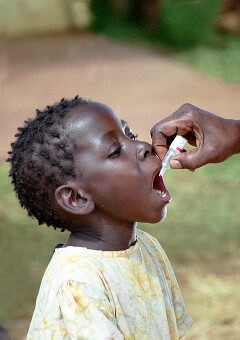
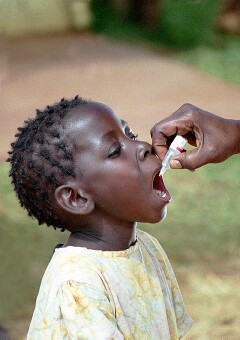
Email from Judith Kaufmann to The Communication Initiative on July 24 2009; image credit: WHO.
- Log in to post comments