











































Efforts to Monitor Global Progress on Individual and Community Demand for Immunization: Development of Definitions and Indicators for the Global Vaccine Action Plan Strategic Objective 2
United Nations Children's Fund, or UNICEF (Hickler); Dalhousie University (MacDonald); World Health Organization, or WHO (Senouci); Johns Hopkins Bloomberg School of Public Health (Schuh); Loma Linda University School of Public Health (Schuh)
"Demand for vaccines and vaccination is a complex concept that is not external to supply systems but rather encompasses the interaction between human behaviors and system structure and dynamics."
The Second Strategic Objective (SO2) of the Global Vaccine Action Plan (GVAP), "individuals and communities understand the value of vaccines and demand immunization as both their right and responsibility", is unique among the objectives in that it focuses on public demand for vaccines and immunisation services rather than on the supply side of immunisation programmes. This commentary summarises the work (literature review and consultations with both experts and potential users) and findings of the UNICEF/WHO SO2 informal Working Group on Vaccine Demand (iWGVD), which developed a definition of demand and indicators related to SO2.
A Strategic Advisory Group of Experts on Immunization (SAGE) Working Group on Vaccine Hesitancy was formed in 2012 to explore the phenomenon of vaccine hesitancy, but, as outlined in its 2014 report, the term "demand" as expressed in SO2 encompasses more than hesitancy. Therefore, in 2014, the SAGE Decade of Vaccines Working Group, which is in charge of reviewing annually the progress made towards the achievement of the GVAP goals, tasked the WHO Secretariat to develop: (i) a better understanding of the term 'demand' in the context of SO2 and (ii) potential indicators for monitoring and evaluating progress globally. In response, in 2015, the iWGVD was formed under the leadership of UNICEF and in collaboration with WHO; members are listed in Appendix A of the paper.
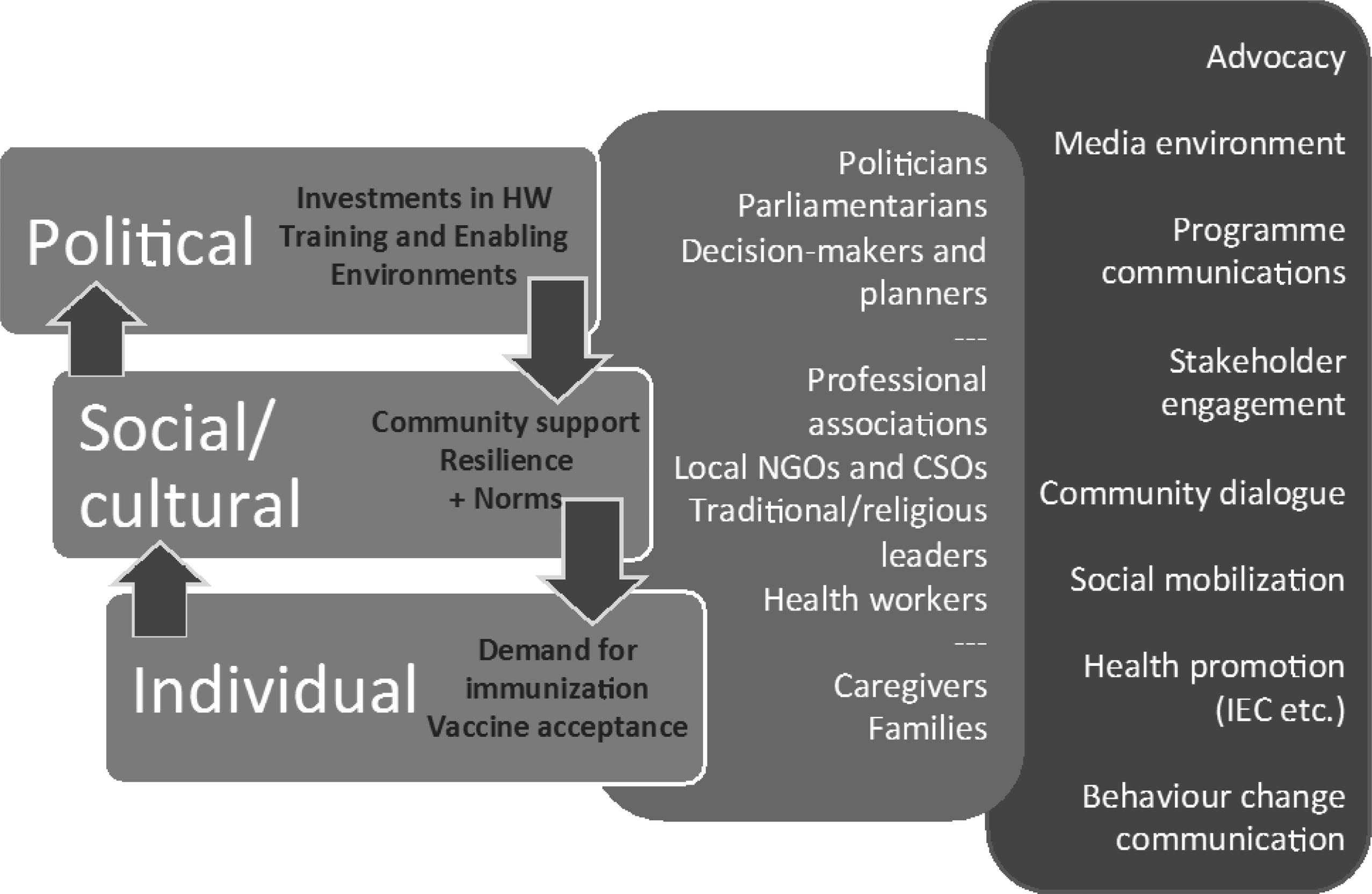
To gain a more thorough understanding of the meaning of demand in the context of SO2, the iWGVD first conducted a literature review. Within the immunisation literature, demand has a range of meanings that fall under one or more of three major categories: classic economic interpretations of supply and demand, immunisation system structure and operations, and the attitude and behaviour of individuals and groups of actors who comprise these systems (see Figure 2 on page 3517). One of their key findings was that demand for vaccines and vaccination is not external to supply systems but, rather, encompasses the interaction between human behaviours and system structure and dynamics. The iWGVD determined that immunisation demand is best conceived as a complex state built on pillars and enablers (e.g., information environment, local norms, political support, service quality) that are vulnerable to shocks, with active demand at a point beyond mere acceptance at the top. The risks of hesitancy or refusal increase when foundational elements and enablers are not in place at the bottom (see Figure 3 on page 3518).
The iWGVD concluded that an active definition of demand is useful for thinking beyond common terminology of passive demand like acceptance. The iWGVD defined vaccination demand in terms of behaviours rather than attitudes, using verbs like seeking (individual behaviour), supporting (expressing a social norm), and advocating (organising action to claim rights and influence decision makers). The definition is supplemented with accompanying statements that emphasise the responsibility of programmes to promote and sustain vaccination demand as well as recognition of variability in manifestations and determinants of demand according to context.
In short, the definition is as follows: "Demand is the actions of individuals and communities to seek, support, and/or advocate for vaccines and immunization services. Demand is dynamic and varies by context, vaccine, immunization services provided, time, and place. Demand is fostered by governments, immunization program managers, public and private sector providers, local leadership, and civil society organizations hearing and acting on the voices of individuals and communities."
Building on findings from the literature review and recognising the need for any associated indicators to be practical and readily measured, the iWGVD concluded that a single, direct, and global measure of vaccine and immunisation services demand to monitor SO2 progress was not feasible. Thus, the iWGVD proposed a composite of four indicators, which - along with the proposed definition of demand - were subjected to several rounds of feedback and revision with over 100 stakeholders in different settings. The final composite indicator proposed after feedback and pilot testing to track SO2 were:
- SO2 Indicator #1 - National Immunization Programme activities to promote and sustain vaccination demand (e.g., "In [index year], what did the country's immunization program (at the national or lower levels) do to promote or sustain public (individuals' and communities') demand for vaccines and vaccination services (directly or indirectly; alone or in coordination with/through partner agencies and/or CSOs [civil society organisations])?"
- SO2 Indicator #2 - Coverage: diphtheria-tetanus-pertussis (DTP3) and measles containing vaccine 1 (MCV1)
- SO2 Indicator #3 - Dropout: DTP1 compared to DTP3
- SO2 Indicator #4 - Timeliness: MCV1
The SAGE Decade of Vaccines Working Group recently endorsed the proposed definition of demand and associated indicators developed by the iWVD. Starting in 2017, data will be collected from all countries, and an initial assessment of progress related to SO2 will be published in 2018, "representing the first time demand-related factors will be assessed globally and systematically via the Joint Reporting Form."
Vaccine Volume 35, Issue 28, 16 June 2017, Pages 3515-3519.
- Log in to post comments