










































Eradicating Polio in Nigeria
McKinsey & Company
"The success of Nigeria's federal and state governments, Global Polio Eradication Initiative partners, and the Bill & Melinda Gates Foundation is all the more impressive given the climate of disinformation, intimidation, and violence..."
This article reviews the steps that Nigeria and its partners took to eradicate polio, especially the introduction of emergency operations centres (EOCs), which are centralised command-and-control units responsible for disaster preparation and management. It also explores what the lessons learned from Nigeria's approach to polio might teach other countries about emergency health responses. The below summary focuses on the importance of communication strategies and collaborative approaches in the story that author Scott Desmarais tells.
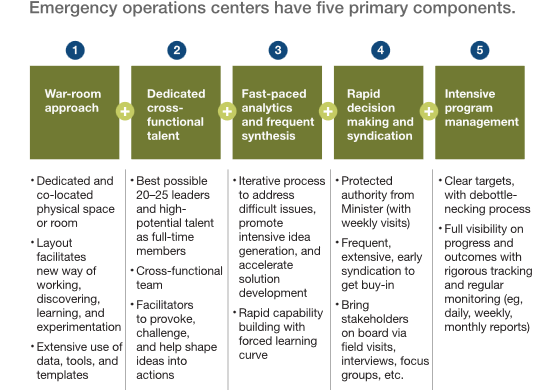
As Desmarais explains, in October 2012, the Ministry of Health created the first national polio EOC in Abuja to focus on the highest-priority interventions, to improve coordination, and to manage the polio eradication programme's overall performance closely. The EOC model requires national and international organisations to locate their leaders in the same place and to meet regularly to develop and execute eradication strategies, improve vaccination campaigns, and respond immediately to outbreaks. In addition, the ministry oversaw the design and set up the first state EOC in Kano, which became the model for the EOCs opened in 6 other high-risk states in northern Nigeria. Each EOC in the states most at risk for polio required a team of 10 to 15 people, including highly trained interagency public-health officials, epidemiologists, communication experts, data analysts, and support staff.
Specifically, Nigeria's national EOC is structured around a "war room" where the walls are covered with regularly updated wild poliovirus maps, data and analysis on polio cases, and polio immunity coverage in the country's 11 high-risk states. Digital screens not only depict up-to-date polio-performance indicators but are also used for videoconferences with state EOCs and external experts. The complete EOC meets twice a week in the war room to assess the performance of vaccination campaigns, outbreak response, efforts to extend access to hard-to-reach populations, and activities in insecure areas. The EOC also holds meetings of its strategy, operations, outbreak, and communications committees in this room. "Nigeria's government and its international partners posted experienced polio experts and emergency health professionals to work closely together." For example, the United Nations Children's Fund (UNICEF) addressed the challenges of communication, social mobilisation, and noncompliance to support traditional, religious, and opinion leaders, and to educate Nigerians to overcome misinformed arguments against vaccination. The national EOC data team included members from UNICEF and all of the EOC partners. Desmarais notes that the EOC leadership and the strategy and operations committees work closely with the data team to analyse vaccination campaign performance during and immediately after all campaigns, to develop interventions to reduce the number of missed children (e.g., by using polio survivors, community clowns, and drummers to mobilise house-to-house vaccinations), and to increase the level of polio immunity in high-risk states, lobal government areas (LGAs), and wards. He provides data to show how lessons learned from directly observed polio vaccination (DOPV), an intervention introduced in priority LGAs in September 2014, were used to improve the programme to reach more children and further increase polio immunity coverage.
Along these lines, Desmarais explains that the EOC helps the team to make and review decisions rapidly, using more than 50 monitoring and accountability officers with direct connection to the most vulnerable LGAs and wards. For example, EOCs develop, execute, and actively follow responses to new polio cases and take specific education and communication measures in targeted high-risk communities - e.g., in one where an anti-oral polio vaccine video had been circulating. The EOC records and disseminates discussions and decisions throughout the entire EOC community. "The detailed collection and analysis of key performance indicators across all of the country's high-risk states, LGAs, and wards improved the quality and rigor of monthly polio vaccination campaigns." However, collecting and verifying data from field staff using mobile phones in remote northern areas is a challenge, where mobile networks do not extend far beyond major population centers and are frequently out of service.
The next section of the article focuses on how the EOCs focus efforts on top-priority challenges. For example, health camps were set up across Kano to provide not only vaccination against polio but also other health services and medicines. In an analysis of the impact of these health camps, the national and Kano State EOCs found a need to emphasise communication with traditional emirs and chiefs, religious leaders, and supporting organisations (such as the local Rotary polio survivors group) to reduce the level of noncompliance. In June and August 2014, inactivated polio vaccine (IPV) campaigns based in health camps covered areas of Borno and Yobe, places that were difficult to access through traditional house-to-house campaigns because of the insurgency affecting parts of northern Nigeria. The insurgency displaced millions of families and disrupted the healthcare networks, which were already weak, required for effective vaccination programmes, in addition to the direct threats against and murder of vaccinators. The national EOC, working with colleagues in the field, intervened to address these security challenges and to plan next steps for covering other challenging areas in Borno and Yobe.
Finally, Desmarais offers some ideas for applying the lessons learned from Nigeria's EOCs' efforts to combat polio. Noting the importance of collaboration on the part of the Ministry of Health, state and local health agencies in the north, and all international partners, as well as an emergency posture with strong leadership and improved data collection from the field (with satellite imagery to identify communities being missed), Desmarais suggests that developing countries can consider applying these lessons to respond more effectively to other health challenges. For example, Nigeria's Ebola EOC ran on the polio EOC principles, particularly bringing together international organisations under the strong leadership of the national government to improve coordination and accountability, focusing on evolving high-priority initiatives, and using data-driven analysis. The EOC also worked hard to educate Nigerians about the disease, collaborating with local mobile phone operators and banks to send millions of text messages, along with frequent updates and other information on radio and television. Nigeria met the World Health Organization (WHO) requirement of no new Ebola cases over a 42-day period in 3 months and was declared free of Ebola transmission on October 20 2014. The WHO praised the Nigerian government's leadership and outstanding coordination, specifically mentioning the Ebola EOC. "In fact, a number of countries at risk for Ebola have deployed EOCs, and their earlier use in the affected countries would likely have improved the response."
McKinsey & Company website, February 8 2016.
- Log in to post comments