










































The Evolution of Vaccination Week in the Americas
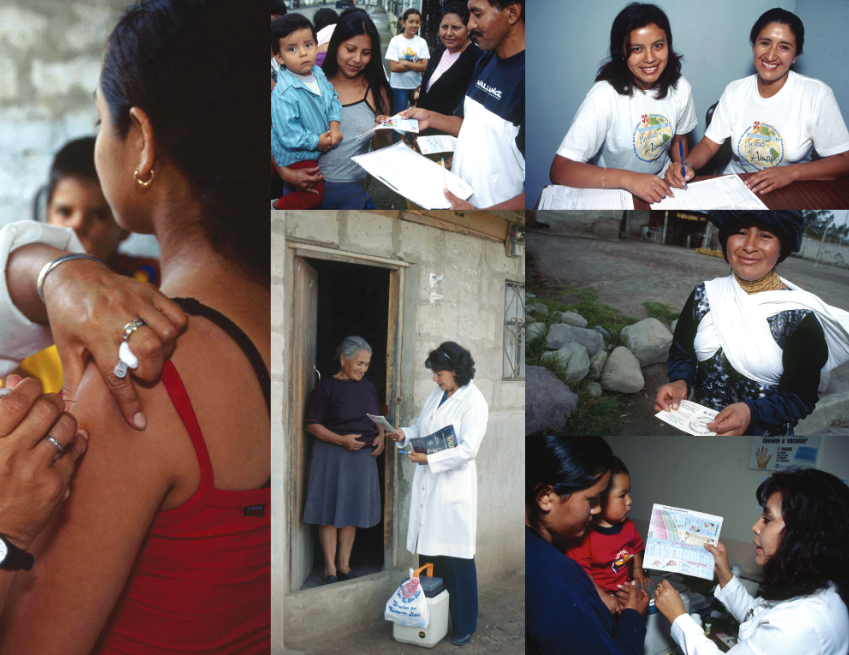
"As a social mobilization campaign, relevant themes and the use of diverse media have allowed PAHO, its partners, and Member States to give visibility to the importance of immunization and communicate with key audiences, building public confidence in vaccination, and countering the emerging messages of anti-vaccination groups."
This report explores the background and evolution of Vaccination Week in the Americas (VWA), one of the flagship initiatives of the Pan American Health Organization (PAHO), which started as a coordinated response to a 2002 measles outbreak in Colombia and Venezuela and then evolved into the model for other regions and World Immunization Week (WIW). (See Related Summaries, below.) It offers examples of how countries have leveraged VWA to implement a diverse array of vaccination activities, strengthening overall health services and bolstering "Pan-Americanism" and health diplomacy.
As detailed here, since its launch in 2003, VWA has focused on the work of national immunisation programmes, with special efforts to reach populations living in vulnerable situations: those with limited access to regular health services, especially populations in border and rural areas, urban fringes, indigenous communities, and other high-risk groups. In addition to advancing health equity, VWA strategic objectives are: reaching individuals across the life course; highlighting the work of national immunisation programmes in the media; keeping immunisation on the forefront of political agendas; using the initiative as a platform to integrate other preventative health interventions; and promoting cooperation and collaboration among countries, public health agencies, and partners.
Each year, countries select their respective VWA activities based on their current national health priorities, but, in general, national VWA activities can be broadly categorised as efforts to: (i) sustain vaccination achievements; (ii) complete the unfinished agenda for prevention and control of vaccine-preventable diseases; (iii) tackle new challenges in vaccine introduction and impact assessment; and (iv) strengthen health services for effective vaccine administration - e.g., through education for health workers on vaccine-related topics, outreach to health professional students, and sensitisation of teachers and parents to the importance of children being fully immunised.
With regard to communication and social mobilisation, final country reports to PAHO/World Health Organization (WHO) show that "VWA has provided a key opportunity for countries to engage with the general public on a range of immunization-related topics and to help individuals and communities understand that vaccination is a basic right at all stages of life." Each year, PAHO proposes an overarching Regional campaign theme, which often relates to current events or interests, such as the World Cup or the Olympic Games, or to pop culture. Past slogans have included "Boost your power! Get vaccinated!", "Vaccination: Your best shot", and "Go for the gold! Get vaccinated!" Regional campaign materials reflect the theme and can be adapted by each country. Celebrities have lent their voices as champions of health, promoting vaccination and helping PAHO and public health authorities reach broader audiences. Social media has played an important role in VWA activities since 2011, giving PAHO and countries access to the general public while advocating for immunisation, dispelling myths, and strengthening collaboration with partners. Countries also develop their own national VWA communication activities and mass media campaigns using television, radio, and print media. In addition, many countries focus on sensitisation sessions and community fairs to educate parents and the general public on vaccination issues.
"Over its tenure in the Region, VWA events have facilitated cross-border cooperation and provided the opportunity to keep immunization on the fore-front of political agendas. Each year, numerous celebrations are held throughout the Region to launch VWA, with a special emphasis on bi- and tri-national events. These activities often include the participation of high level authorities, such as presidents, first ladies, celebrities, governors, mayors, and local leaders, as well as the Director of PAHO and representatives from other United Nations agencies, non-governmental organizations, and civil society. Media coverage of VWA celebrations gives visibility to the benefits of vaccination and the work of national immunization programs, and puts the focus on the needs of the host communities....In border areas, organizing a VWA launch requires collaboration between the government ministries and local authorities on both sides - international collaboration purely in the name of public health and Pan-Americanism."
The report examines the ways in which successful VWA experiences have led to a global movement, illustrated for instance by other WHO Regions developing their own sister initiatives (e.g., European Immunization Week). Since 2012, WIW has served as an overarching framework linking together all the regional vaccination weeks. The opportunities offered by this initiative were demonstrated in April 2016, when the successful global switch from the trivalent oral polio vaccine (tOPV) to the bivalent vaccine (bOPV) was synchronised with WIW.
To date, VWA has vaccinated an estimated 686 million individuals through the activities conducted under its framework. "Looking to the future, WIW, VWA, and the other regional vaccination weeks will continue to offer a critical platform to harness political will, increase public demand for vaccination, and close the current gap in access to immunization and other health services."
Revista Panamericana de Salud Pública 2017;41:e150. doi: 10.26633/RPSP.2017.150 - sourced from: PAHO/WHO Institutional Repository for Information Sharing, January 5 2018. Image credit: PAHO
- Log in to post comments