










































An Experience of Mass Administration of Fractional Dose Inactivated Polio Vaccine through Intradermal Needle-Free Injectors in Karachi, Sindh, Pakistan
Emergency Operations Centre for Polio Eradication and Immunization (Bullo, Mehraj, Raza, Rasool, Ansari, Shaikh, Phul, Memon, R.I. Baloch, Chandio); Shaheed Zulfikar Ali Bhutto Institute of Science and Technology, or SZABIST (Mehraj); United Nations Children's Fund, or UNICEF (Raza, Chandio); National Stop Transmission of Polio (N-STOP) Program (Rasool, Phul, Memon); Bill and Melinda Gates Foundation (Shaikh); Expanded Programon Immunization, or EPI (Z.A. Baloch)
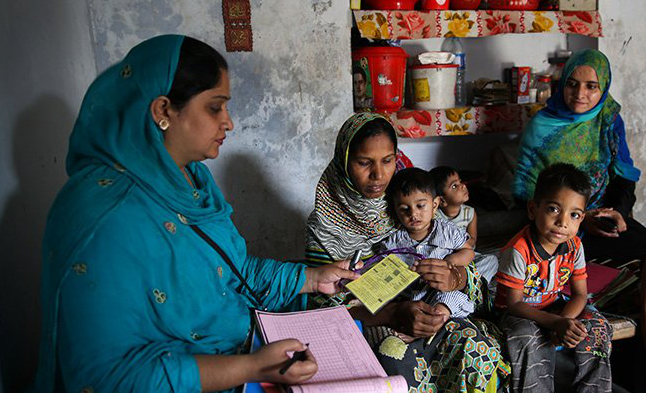
"Social mobilization is one of the key strategies to enhance community awareness regarding the IPV campaign..."
In polio-endemic Pakistan, inactivated polio vaccine (IPV) is being used to increase population immunity in advance of withdrawal of oral polio vaccine (OPV), to eradicate remaining wild polio virus, and to respond to any outbreaks of vaccine-derived poliovirus. This study analysed the impact of the needle-free device "PharmaJet Tropis ID" on vaccination status in fractional dose of IPV (fIPV) and full IPV areas of Karachi, Pakistan. It also evaluated the effect of social mobilisation activities on the awareness level of the community regarding the IPV campaign; the latter component is the focus of the present summary.
The IPV campaign was conducted in 10 towns of 5 districts of Karachi from February 18-26 2019; in 4 of these towns, fIPV was given using "PharmaJet Tropis ID", and in the other 6 towns, full-dose IPV was given to children 4-59 months of age. The composition of each team was one skilled person, one team assistant, one social mobiliser, and one focal person (medical doctor) for adverse events following immunisation (AEFI) at the union council (UC) level. To check campaign quality, independent monitors conducted at least one rapid convenience assessment (RCA) house-to-house cluster survey daily, collecting data such as the source of campaign information for the parent.
Observations from 33,815 households with IPV-eligible children were included in the final analysis. Wheras there was an increase of 5% in average coverage between August 2018 (80.3%) and February 2019 (85.3%) in fIPV areas, the coverage in 6 full IPV towns declined from 81.1% in August 2018 to 79.5% in February 2019. This decline may be due to low importance given to vaccination by parents, less vaccination due to the sickness of children, or fear of injection.
Source of campaign information in fractional and full-dose IPV areas shows (all p values < 0.0001) that more frequent mobile miking 416 (3.1%) was observed in fIPV areas as compared to 92 (0.4%) in full IPV areas. Mosque announcements were also more rigorous 1247 (9.4%) in fIPV areas as compared to 542 (2.6%) in full IPV areas. In contrast, more community health workers (CHWs) - 11,210 (54.6%) - visited areas of full IPV campaign as compared to 4,829 (36.4%) visits in fIPV areas. An additional 4,122 (31.1%) social mobilisers visited fIPV areas as compared to 4,675 (22.8%) in full IPV areas. Other sources of campaign information were statistically insignificant in this analysis.
The researchers conclude that using a needle-free injector for the administration of fIPV in a campaign setting is well accepted by the community. By reporting the source of campaign information in the community and reasons related to children being missed, they hope to contribute to planning for future IPV campaigns. In closing, they suggest: "vigorous social mobilization through mobile miking, Mosque announcements, social mobilizer's visits, and CHW visits help achieve high IPV vaccination coverage."
BMC Public Health 21, 44 (2021). https://doi.org/10.1186/s12889-020-10041-8. Image credit: Pakistan Polio Eradication Programme
- Log in to post comments