










































The Hearts, Minds, and Sentiments: The Volunteers Program in the Immunization Program in Bangladesh and the Chagas Diseases Control Project of Honduras
JICA Project for Capacity Building of Nursing Services
This paper explores the work of the Japan Overseas Cooperation Volunteers (JOCV), arguing that they brought about sustained developments in social capital (SC) in host communities and contributed to motivating people to change their individual behaviour. Naoko Ueda of the Japan International Cooperation Agency (JICA) used a mixed-methods approach to examine how the volunteers worked to instill norms and trust and to effect changes of sentiment among people in 2 developing countries. Specifically, the paper is concerned with the activities undertaken by the JOCV within the Polio Control/EPI (Expanded Program on Immunization) programmes in Bangladesh from 1999 to 2015, especially in relation to the prevention of poliomyelitis, and the Chagas Disease Vector Control programme for the prevention of parasitic infectious disease carried out in Honduras from 2003 to 2011. The paper stresses that more attention should be focused on the heart, mind, and sentimental aspects of individual aid workers.
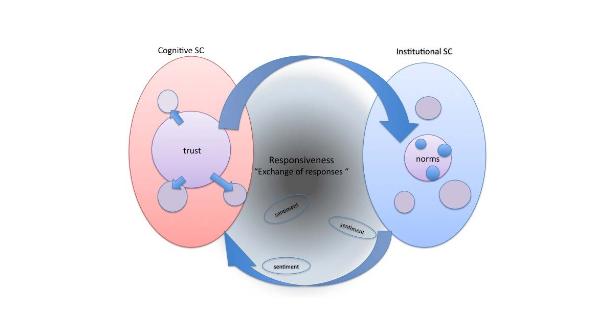
Ueda explains that the residents and the administration/government respond to each other in a sustainable manner, thus forming the basis of the SC. (As the diagram above illustrates, responsiveness is thus understood as a flow of mutual responses, not a one-way flow or a top-down flow from the administrative level to the individual residents.) She classifies SC into 2 complementary categories: institutional (structural) SC and cognitive SC. Trust is conceptualised as the core component of cognitive SC and is concerned with the minds of individuals, while norms and networks comprise the institutional components of SC, as they directly regulate the visible and concrete behaviour of individuals. Some examples of norms discussed in this paper concern the attitudes of the volunteers and the way they are expressed through behaviour such as accuracy, politeness, or acceptance of immunisation in the community.
"Sentiment" can mean emotion in the sense of primitive feelings or physical sensation; however, in the context of this paper, the term expresses a rational sense that is used in social contexts. Sentiment is communicated through the "feeling rules" fostered in the society under a certain set of circumstances. Feeling rules include such items as manners, etiquette, religious norms, ideology, and views on values. Ueda hypothesises that, if the volunteers have encouraged the development of SC, responsiveness would also be secured and sustained, as the intervention of any volunteer is controlled by feeling rules or other social mechanisms. This process may lead to a change of sentiment among local people, thus bringing to the fore their intrinsic motivation for the continuation of responses.
In the first case study, Bangladesh, the paper draws on 16 semi-structured interviews that were conducted by the author in October 2014 and May 2017. Six of the participants were from the JOCV, and 10 were Bangladeshi EPI administrators in Chittagong Division who had experiences working with the volunteers. The interviews utilised open-ended unstructured questions organised thematically around the participant's view of his or her experiences working with their Bangladeshi counterparts (Bangladeshi participants were asked about their Japanese counterparts and vice versa), how they felt about their counterparts, what they learned from them, and the obstacles they faced when fulfilling their duties.
Ueda discusses the volunteers' work since the first generation of EPI volunteers was dispatched in Bangladesh, in 1999. For example, to enhance the surveillance network, the volunteers held community meetings in each village and invited various community actors, including traditional healers, leaders, religious people, nurses, midwives, non-governmental organisation (NGO) staff, teachers, and students, to attend. Council members of the Union, the smallest administrative units in Bangladesh, were also involved in these educational events. In kindergartens, the volunteers explained to parents how they can find children suffering from acute flaccid paralysis (AFP) associated with poliomyelitis. According to Ueda, most of the participants in these assemblies listened eagerly to the volunteers, especially as they explained things plainly with the aid of pictures and illustrations. Moreover, the enjoyment that the participants got from the rare situation of young foreigners speaking in their language, Bengali, also helped to attract village people to the meetings; this is the "foreigner effect". In a related activity, the volunteers sought to raise awareness of EPI by appealing to multiple layers of the village community, from leaders to the mothers at EPI sites. On these occasions, too, the volunteers communicated in Bengali and drew on various methods such as using pictures to explain the importance of EPI so that listeners would not become bored; this also ensured that illiterate mothers were able to understand the message they were conveying.
Between 1995 and 2011, polio vaccination coverage in Bangladesh increased from 69% to 96%, which contributed to the polio-free status gained by the state in 2014. While Ueda stresses that it is the effort of the government of Bangladesh and its other technical, physical, and financial supporters that should receive the largest share of credit for this achievement, "the role of the JOCV who collaborated at vaccination sites and who spoke the language of the local people should also be highly commended." To ascertain what the volunteers were able to change for their Bangladeshi collaborators and the residents, Ueda reviews these themes:
- Networking: The volunteers were not superiors or technical experts like doctors sent from the World Health Organization (WHO); rather, they shared the same problems of implementation as the field workers at the various sites. They optimised their unique position to connect the bottom with the top, even within the ministerial hierarchy that existed among the field workers, their supervisors, and the people in the capital.
- Presentation of norms to the field workers: In preparing for National Immunisation Days (NIDs), for example, volunteers assisted in preparing EPI sites, mobilising and training field workers and local volunteer workers from the community and sharing information and advertising for several months beforehand. By demonstrating the norms of accuracy, diligence, integrity, and politeness, the volunteers helped the Bangladeshi colleagues, field workers, and their supervisors understand the importance and effect of attitude, which, according to Ueda, brought about improvements in the quality and quantity of immunisation services.
- Motivation of field workers: Ueda explains that being together with the foreign volunteers might have placed pressure on field workers and supervisors, but it also became a good opportunity to motivate and stimulate their willingness to work. The volunteers, who lived next door, ate the same food, and spoke the same language, were different than the experts from other donor agencies; they were observers and guests from outside, but also close colleagues with whom the locals worked, even in hard times.
- Improvement of vaccination acceptance and the motivation of residents by building trust: One of the main challenges to the implementation of the Bangladeshi EPI might be considered to be a lack of information and a low level of belief in the efficacy of the programme based on superstition or anxiety. To cope with these problems, the volunteers and field workers helped disseminate accurate information by explaining, persuading, and advocating, as well as by visiting each household. According to Ueda, the volunteers displayed an attitude of stewardship when they went with field workers to villages and households, and this led to the dissolution of fear and distrust among residents, thus widening the acceptance of vaccinations.
In the second case study on Honduras, the paper draws on 72 semi-structured interviews and quantitative surveys conducted by the author with Community Health Volunteers (CHV). This section of the paper considers the aforementioned concept of "responsiveness", and its developed form, "exchange of responses", as elements of SC brought about by mutual interaction between government administrations and the community.
In short: "The attitude of the Volunteers, who did not hesitate in accompanying local health officers along mountainside trails to the remote areas where the vector is common, has been praised by people involved with disease control, including the WHO, and others organizations in Southern America. Again, the willingness to continuously accompany local people was unique to the Japanese Volunteers, and no other experts behaved in this way. This attitude greatly fostered teamwork and a sense of belonging among the team of Volunteers and their Honduran colleagues; this in turn led to an optimization of the outcomes of the program."
Specifically: "In Honduras, as in Bangladesh and many other countries, the Volunteers spoke in the same language as their colleagues and the CHVs. They supported local health officers when they explained vector control to the CHVs. Volunteers also assisted by helping to create audio-visual materials, and they assisted in CHV meetings. They also talked directly to school children using picture play, coloring books, and many other means to help them understand the importance of vector control in their houses. The curious and active children became contributors in the search for vector insects in their homes."
The paper goes on to explore the responsiveness that brought about a sustainable surveillance system with community participation at its core. For example, the volunteers prompted the administration of the process to show their thanks and respect to the CHVs for preventing the spread of Chagas disease by cleaning up of the environment and bringing any vector found to the attention of the local public health office. This cycle of CHV's searching and delivering insects to the administration, and the response from the administration, became a new norm that built trust between the 2 actors; in turn, this enabled the creation of responsiveness for a sustainable surveillance system with community participation. Ueda explains that the sentiment felt by the CHVs was a key factor here, as it underpinned the establishment of the exchange of responses. Quotes collected from the CHVs illustrate these positive sentiments of happiness, sense of achievement, and pride.
Looking at both cases, Ueda concludes that, "By motivating community members and raising awareness, the activities of the Volunteers produced outcomes in the communities. Both sets of Volunteers succeeded in creating and altering the SC of the communities by advancing into remote areas, talking directly to local people, and optimizing the advantage inherent in the 'foreigner effect.' Thus, the influence on norms and trust that the Volunteers had led to a new norm of wider acceptance of vaccinations in Bangladesh. The same change in sentiment brought the 'exchange of responsiveness' that led to sustainable vector control in Honduras....In both cases, the Volunteers moved and acted directly in relation to the hearts, minds, and sentiments of the people....Moving peoples' hearts changed their SC and also brought about changes in the effects and sustainability of aid activities."
JICA-RI [Japan International Cooperation Agency Research Institute] Working Paper No. 162.
- Log in to post comments