










































How Internet Access Drives Global Vaccine Skepticism
University of Minnesota-Twin Cities (Trujillo); Carleton College (Trujillo); Oklahoma State University (Motta)
"Access to mass telecommunications, particularly the internet, is higher among wealthier countries...The internet can greatly increase people's exposure to information, including to misinformation and disinformation..."
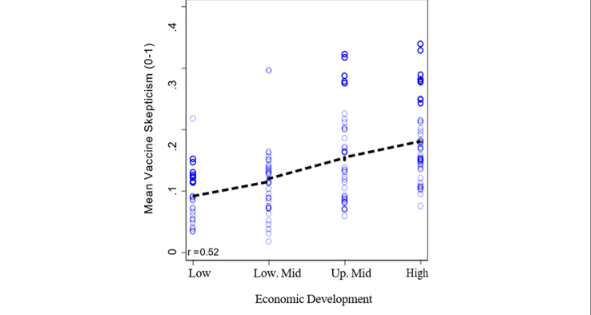
Data suggest that wealthier countries tend to be more vaccine skeptical than economically poorer countries. One possible explanation - the Online Accessibility hypothesis - posits that internet access facilitates the spread of the antivaccine misinformation that can fuel skepticism, particularly for those lower in scientific and medical expert trust. Another explanation - the Out of Sight hypothesis - is that some citizens in economically richer countries fail to consider the risks of vaccine-preventable diseases (VPDs) because they are rarely experienced directly. Using nationally representative data from 144 countries, we test these two potential explanations.
To test these hypotheses, the researchers use multilevel modeling (MLM) to model individual survey respondents' attitudes toward vaccines as a function of both respondent-level characteristics (e.g., attitudes toward scientific and government institutions) and contextual, country-level factors (e.g., development, internet access, and the prevalence of communicable disease in that country). They then examine the interaction between these two sets of predictors. Data for the study come from a 2018 Wellcome Global Monitor (WGM) survey, in which Gallup, on behalf of WGM, surveyed 149,014 individuals across 144 countries (reflecting about 99% of the planet's population).
As expected, the data show a strong positive relationship between economic development and vaccine skepticism, at the country level. (See figure above.)
Of the two potential explanations tested, the analysis found support for the Online Accessibility hypothesis; these findings are robust to alternate measures of wealth and modeling strategies. Country-level internet connectivity is associated with individual-level vaccine skepticism, controlling for other factors. That is, several individual-level factors (e.g., trust in doctors, in country government, and in non-government medical institutions) are associated with decreased vaccine skepticism. Nevertheless, these factors fail to explain away the relationship between internet access and vaccine-skeptic beliefs. Internet connectivity (but not disease prevalence) explains away any effect of country-level wealth on vaccine attitudes.
Conversely, the number of communicable disease cases per capita is positively correlated with vaccine skepticism, which is the opposite of the Out of Sight expectation. The researchers provide an additional test of the Out of Sight hypothesis by examining vaccine hesitancy and misinformation endorsement among residents of the United States (US) during the COVID-19 pandemic - a time where infectious disease risk is highly salient. If the Out of Sight hypothesis is true, vaccine hesitancy should decrease during this time period. However, using Lucid data, US residents in 2020 express similar or greater levels of vaccine hesitancy and misinformation endorsement compared to those in 2018.
Consistent with previous work, the researchers also note that the effect of country internet connectivity on vaccine attitudes tends to be stronger for those most likely to consume online misinformation about vaccines (i.e., those with low trust in government and medical experts). In the highest-internet-access countries, those with low levels of trust in doctors score nearly 12 percentage points higher on the vaccine skepticism scale than those who express high levels of trust.
Further, recognising the limitations of drawing micro-level inferences from country-level data, the researchers show that individual-level internet and alternative medicine blog use are associated with increased vaccine skepticism in a representative case (the US, a high-internet-access country). Specifically, they find that wellness blog consumption is positively and significantly associated with increased misinformation acceptance about the measles, mumps, and rubella (MMR) vaccine in four survey waves. Similarly, a more general online news indicator was positively and significantly associated with increased belief that the MMR vaccine can cause children to develop autism. "These results provide strong evidence in favor of the theoretical mechanisms (i.e., exposure to antivaccine misinformation online) that we expect drive vaccine skepticism cross-nationally."
Thus, this study finds that internet access is strongly associated with negative attitudes toward vaccines, and it explains away the effect of economic development on vaccine skepticism. Moreover, those people expected to consume antivaccine misinformation online are more likely to hold vaccine-skeptic views. However, this only appears to be the case in countries that have comparatively greater internet access.
In conclusion: "if a significant portion of the population remains vaccine skeptical then the spread of COVID-19 may not be sufficiently curbed. Future studies should hone in on the prevalence of vaccine misinformation in the face of such a clear and present danger. Vaccine misinformation also matters because such misinformation poses a threat to support for vaccine policies, regardless of uptake."...[E]ven a small number of vaccine skeptical citizens could potentially cause disease outbreaks; it is therefore imperative that researchers devise strategies for stemming the flow of misinformation and correcting misinformed attitudes..."
International Journal of Public Opinion Research, edab012, https://doi.org/10.1093/ijpor/edab012.
- Log in to post comments