











































Immunization in Developing Countries: An Interview with Dr. Jos Vandelaer, Chief of Immunization for UNICEF
Medical.Net
From the "Thought Leaders" series of the News-Medical.Net website, this interview with Dr. Jos Vandelaer, Chief of Immunization for the United Nations Children's Fund (UNICEF), is a question-answer discussion of the fact that one child in five does not get properly immunised and that coverage rates are worse among the economically poor, presenting an equity issue: an immunisation gap. Success in vaccine coverage includes polio immunisation, the global maternal neonatal tetanus programme, and new vaccine development programmes.
In answer to the interview question: "How important is making vaccination a political priority?", Dr. Vandelaer states that countries need political commitment to invest in immunisation. Vandelaer outlines UNICEF's role in new vaccine introductions in developing countries, describing its support of country governments in such things as training of health workers and supporting communication "so that people understand better why new vaccines are being brought into immunization schedules; why these vaccines are important and against what diseases they protect." He cites the challenge of communicating, for example, that "pneumococcal and rotavirus vaccines protect only against some forms of pneumonia and diarrhoea, but not against all." Thus, the messaging needs to focus on introducing the vaccine "hand in hand with other interventions, such as promotion of breast feedin , hand washing, reducing indoor pollution, general hygiene methods, and so on" so that communities understand the extent of vaccine prevention and engage in behaviours that also promote diarrhoea prevention: "UNICEF is helping governments to set up the systems around communicating with parents and caretakers so that they understand why it's important to immunize their kids, what they can expect from these vaccines, but also that there is more to it than just vaccinating your child."
UNICEF also works on cold chain (vaccine preservation) and buys vaccine for approximately 1/3 of the world's children and partners with the Global Alliance for Vaccines and Immunization (GAVI Alliance) to negotiate prices down to levels as low as possible, so they become more affordable for countries, while still ensuring a healthy vaccine market.
Inequity in vaccine coverage can be linked to a number of factors - remote locations, migration, economically poor status, but, "[o]n an individual level, there is a clear correlation between a child’s immunization status and the level of the mother's education. The better the mother is educated, the higher the chance that the child is immunized. And of course, it comes back yet again to the fact that we're talking about children from disadvantaged groups, disadvantaged families." UNICEF looks at available data and maps out locations of poor immunisation coverage, then looks at reasons in its planning, whether it be improving the cold chain, or, for example, working with health workers to retrain them in how they plan their immunisation sessions. "If it's a matter of the parents not really wanting immunization or understanding the need for immunization, we see what we can do so that there are information sessions with the parents or village leaders so that they understand that immunization is important, that immunization saves lives."
Through health centres, village immunisation sessions, and campaigns, not only can vaccinations be given but other interventions may be combined with "a lot of social mobilization around the administration of a given vaccine...", for example, distribution of bed-nets, or vitamin A, or messages about hygiene, breast feeding, nutrition, etc.
Reducing inequity and demand creation are two goals of the World Health Assembly called the “Global Vaccine Action Plan” of 2012. The interview ends with two links:
More information on UNICEF immunisation can be found here.
More information on the Global Vaccine Action Plan can be found here.
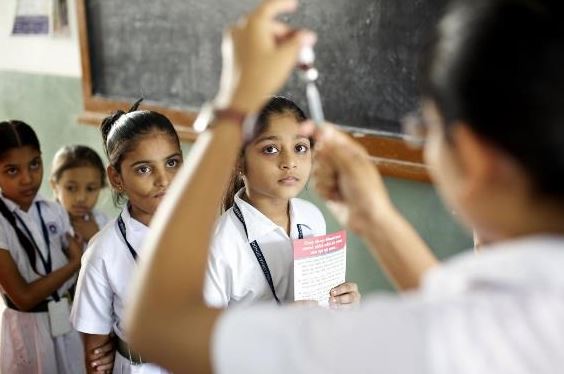
News-Medical.Net website, accessed April 13 2014. Image credit: ©UNICEF/NYHQ2012-1642/Pietrasik
- Log in to post comments