











































'Injections-While-You-Dance': Press Advertisement and Poster Promotion of the Polio Vaccine to British Publics, 1956-1962
London School of Hygiene and Tropical Medicine, or LSHTM (Elizabeth, Mold); University of Warwick (Millward)
"Focusing on the emotional dimensions of the polio vaccination campaign facilitates our exploration of the nature of the relationship between public health policymakers and the public."
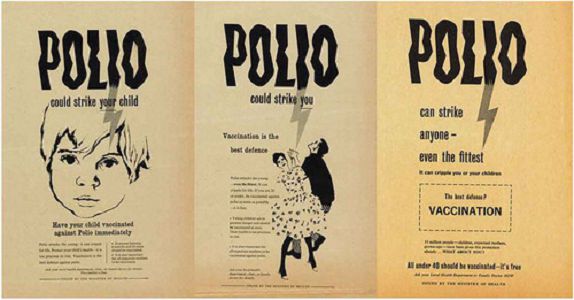
"Polio could strike your child. Polio could strike you. Polio can strike anyone - even the fittest" - so declared three newspaper advertisements from the Ministry of Health's 1959 campaign to increase rates of polio vaccination in the United Kingdom (UK). This article explores the British government's campaign to promote polio vaccination registration through its newspaper advertisements and posters, investigating their cultural, political, and emotional context. Looking at the specific phases of the campaign, it demonstrates how and why the campaign's content changed over time.
The British inactivated poliomyelitis vaccine (IPV) programme began in 1956 and ended in 1962 with the introduction of a new oral vaccine (the oral polio vaccine, or OPV). While fear of polio was pervasive in the 1950s, there were also reasons to fear IPV - a vaccine using inactivated strains of poliovirus and injected into the patient. Soon after IPV became widely available in the United States (US), Cutter Laboratories released a batch of vaccine containing poliovirus that had not been properly inactivated. The incident, which was widely reported by the British press, infected hundreds and led to the deaths of 10 people, shaking the confidence of governments and the public. "Despite the Cutter Incident, there was great appetite for the vaccine in the UK."
Initially, IPV was offered only to children. However, the Ministry of Health gradually expanded the eligibility criteria to include young adults and then everyone under the age of 40; the authors describe this as an "incremental widening of targeted 'publics'". This meant that the campaign had to evolve to reach different groups, requiring those producing promotion materials to imagine these "publics" (and their emotions) in different ways. This can be seen in the way early poster and newspaper adverts explained IPV's benefits to the mothers of infants, whereas later propaganda emphasised the financial risks to the family if a father were struck by the disease.
In essence, the campaign had 4 phases, the communications during each of which the article describes:
- "They may have cause to reproach themselves": the 1958/59 winter polio publicity campaign
- "It can leave your child crippled for life": parents, risk, and blame
- "Injections-while-you-dance!" Vaccination as a marker of agency and healthy citizenship among teenagers, young adults and adult men
- "15 million people.. have been given this protection already. WHAT ABOUT YOU?" Persuading the 26-40s to vaccinate
The authors situate the campaign posters and advertisements, which were provided to areas where vaccine uptake was low, methodologically and historically. By making use of a combination of techniques drawn from literary analysis in the vein of Russian philosopher Mikhail Bakhtin and the history of emotions, they explore some of the emotions behind the textual record of the IPV campaign. For instance, negative emotions such as fear and guilt were played upon within the posters, but positive emotions were also mobilised, such as humour and appeals to young people's burgeoning sense of their own adulthood. ("Injections 'while you dance'", declared a Manchester Guardian article on 8 April 1959, reporting the various efforts of health authorities around the country to reach people under age 26. Approaches were to be made to youth and dance halls with a view to give injections.)
As the authors show, the work of emotions in this campaign went beyond a simple persuasive tactic intended to increase vaccination uptake. The Ministry of Health was also engaged in creating new groups as they transformed rational and irrational "emotional communities" into a set of overlapping publics. In a dichotomy that is often present in health education, in these communications, the public were imagined as both obstacle and solution to polio - as both rational and emotional - able to act in a way that could prevent polio by registering for the vaccination, or to spread the disease if they failed to vaccinate. The publics were simultaneously: individuals or groups vulnerable to disease; threats to the stability of the state as potential vectors for the spread of disease; and the mechanism by which, if persuaded to vaccinate, disease might be prevented. So, unvaccinated children were presented as both vectors of disease and victims of parental failure to act as rational citizens. Vaccinating one's child becoming both an act of good parenting and citizenship. Vaccination was thus a right and a duty: something a parent demanded to protect their child, but also something that they did to ensure collective well-being through the establishment of herd immunity. Addressing these three publics - potential victim, vector, and vaccinator - the government presented the problem of polio as surmountable through the actions of obedient citizens.
In conclusion, as the posters evolved to target the assumed emotional and educational needs of each newly eligible public through text and image, "the public[s] were not an inert entity acted on only from above, rather they were a fractured, reactive and unpredictable force that often forced policymakers to respond to their demands for reassurance, information and vaccines."
Cultural and Social History, DOI: 10.1080/14780038.2019.1586061
- Log in to post comments