










































Integrating Nutrition Services into Mobile Health Teams: Bringing Comprehensive Services to an Underserved Population in Afghanistan
United Nations Children's Fund, or UNICEF (Qarizada, Gallagher, Goergen); Agency for Assistance and Development of Afghanistan, or AADA (Baqakhil)
"MHTs have been an important vehicle in the immediate term to improve coverage of health and nutrition services in hard-to-reach areas of Afghanistan. They have also served to increase awareness among remote populations of the importance of health and nutrition services, sensitising them to seek services in future."
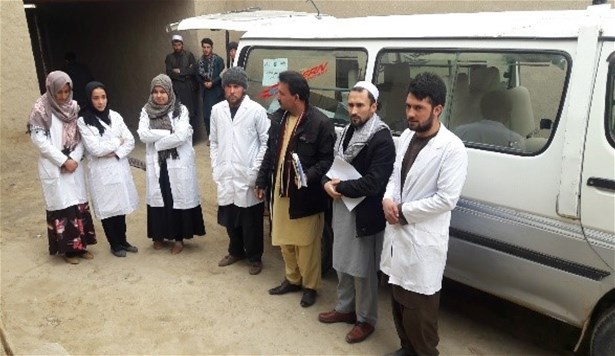
Mothers and children living in Afghanistan's remote and conflict-affected areas often do not access the Ministry of Public Health (MoPH) basic package of health services (BPHS), which is reflected in very low coverage of antenatal care, postnatal care, immunisation, and nutrition services in these areas. In 2018, the United Nations Children's Fund (UNICEF) and a local partner, Agency for Assistance and Development of Afghanistan (AADA), rolled out mobile health teams (MHTs) to implement the BPHS in remote/hard-to-reach communities in Faryab province. This article explores how the pilot project worked.
MHTs provide a vehicle to bring care closer to the homes of underserved populations living far from fixed health facilities and to sensitise communities to health and nutrition services. For this pilot project, 4 MHTs visited designated service delivery points (SDPs) in Faryab province on a monthly basis between February and December 2018, covering a population of 66,590. The MHTs provided monthly antenatal care, postnatal care, immunisation, nutrition education, and management of uncomplicated severe acute malnutrition (SAM).
Community groups (health shuras) were established in each SDP area, made up of 6 members representing the local population. MHTs regularly engaged with these community groups, who provided assistance to staff, including accommodation and security, and feedback on the performance of MHTs to improve service delivery. The groups also helped to sensitise their communities to the services the MHTs provide and supported MHT health-awareness activities concerning, for example, timely health-seeking behaviours. A mini nutrition team consisting of a small vehicle, a nutrition counsellor, and supplies visited each SDP every 2 weeks to ensure continuation of SAM case management between MHT monthly visits. All mobile teams operating in Afghanistan are registered in the Health Management Information System (HMIS) of the MoPH and provide regular reports to the HMIS for health services and to the online nutrition database for nutrition services.
Estimated baseline coverage of health services at the start of the project was around 70%. HMIS shows that coverage of the BPHS in the 4 districts covered by MHTs increased by 10-15% in a 1-year period (2018). Over the pilot period, 66,590 people were reached with health and nutrition services, 57% of whom were children under 5 years old. Community sensitisation through the established community groups enabled screening of 19,187 children, of whom 1,586 SAM children were successfully treated (94% cured, 4% defaulted, and 1% died). Other services provided by the MHTs also proved successful. For example, 2,070 children aged 0-11 months (82% of the project target) and 1,035 children aged 12-23 months were immunised with pentavalent-3, 1,931 children received the first measles vaccine, and 1,194 children received the second measles vaccine.
The main enablers of this success were: the integration of health and nutrition service delivery into a single platform; community engagement to identify acceptable locations for service delivery; good coordination with government authorities at provincial level; and the support that communities provided to MHTs in the delivery of health-promotion activities and accommodation of MHT staff. While effective in the short term, there are still challenges to mobile service provision in this context, including high costs, impediments to physical access to certain pockets of the population, and supply chain issues.
"Despite these limitations, this pilot programme demonstrates that MHTs can be a useful way of providing critical services in the immediate term while the capacity of the existing system is built up to achieve a more sustainable model of accessible healthcare."
Field Exchange 61, November 2019. p62. www.ennonline.net/fex/61/mobilehealthteams
- Log in to post comments