











































Introducing Rotavirus Vaccine in the Universal Immunization Programme in India: From Evidence to Policy to Implementation
United Nations Development Programme, or UNDP (Malik, Kumar); Ministry of Health and Family Welfare, Government of India (Haldar, Bhadana); Bill & Melinda Gates Foundation (Ray, Ghosh); Johns Hopkins Bloomberg School of Public Health (Shet, Santosham); United Nations Children's Fund, or UNICEF (Kapuria); John Snow Inc., or JSI (Steinglass)
"The introduction was complemented with strong communications systems and media involvement to allow for good acceptability of the vaccine on the ground."
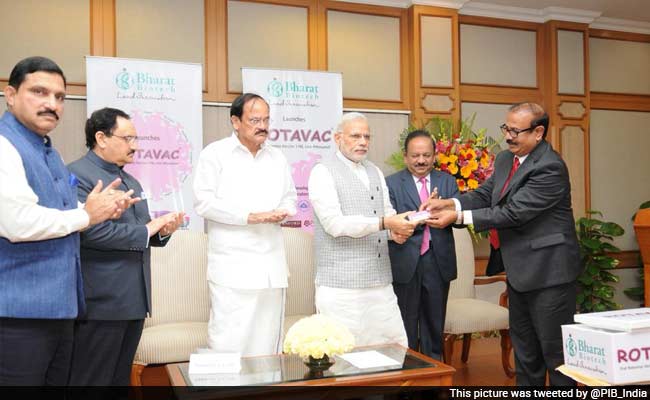
With India being declared "polio free" in 2014 and validated for maternal and neonatal tetanus elimination in 2015, confidence in new vaccines in that country has reportedly risen. In March 2016, India introduced rotavirus vaccine (RVV) into its Universal Immunization Programme (UIP) in an effort to combat RV diarrhoea, a common vaccine-preventable disease with high mortality in children. This article documents how research generated evidence to inform policy, which was then translated into action: From March 2016 to November 2017, approximately 13,260,000 rotavirus vaccine doses were administered in the country.
As reported here, the UIP is implemented on the ground by nearly 200,000 auxillary nurse midwives (ANMs) who vaccinate children and pregnant women and are in turn supported by nearly a million accredited social health activists (ASHAs) who counsel and mobilise beneficiaries. There is a regular reporting system from the health sub-centre to primary health centre (PHC), district, state, and national level. This reporting has been computerised in the country as a part of a health management information system (HMIS), and the data are available from health facility level and above every month. The Ministry of Health and Family Welfare, Government of India (MoHFW, GoI) has also implemented a reproductive child health portal to track every pregnant woman, mother, and child up to 5 years of age to ensure delivery of health services.
This was the system into which RVV was introduced. As part of the process, in December 2005, the MoHFW, GoI and the Indian Council of Medical Research (ICMR) established the National Rotavirus Surveillance Network (NRSN). The NRSN produced and shared region- and state-wide RV burden data to convince policymakers at the state and national levels about the high disease burden caused by RV and the need to incorporate the vaccine into the UIP. In June 2014, an independent technical body, the National Technical Advisory Group on Immunization (NTAGI), recommended a phased introduction of RVV based on Standing Technical Sub Committee (STSC) meeting deliberations. RVV introduction in India was guided not only by informed decision-making - e.g., a thorough review of the existing evidence by the GoI NTAGI - but also by a strong global commitment to tackle morbidity and mortality due to diarrhoea.
The selection of the states for each of the first two phases of RVV introduction, covering 35% of the annual birth cohort, was done based on the burden of RV diarrhoea according to NRSN data, as well as the ability and readiness of the state health system to take up a new vaccine based on past experience. With GoI funding, activities such as training of health workers, development and printing of communication material, and strengthening for surveillance for adverse events following immunisation (AEFI) took place. Immunisation partners such as the World Health Organization (WHO), JSI, UNICEF, Global Health Strategies (GHS), and PATH provided catalytic technical support, with expertise in developing training materials, serving as master trainers of trainers (ToT), and supporting monitoring and evaluation of the rollout. The third phase of RVV introduction in Uttar Pradesh began in July 2018, with the vaccine procured through support from Gavi, the Vaccine Alliance; the MoHFW, GoI had planned to expand RVV to the entire country by the end of 2019.
For each phase of RVV introduction, training was imparted using a cascade model, starting from a national-level ToT, followed by state, district, and sub-district level trainings. The national ToT workshop, which was attended by national representatives of WHO, UNICEF, JSI, GHS, and PATH, served as a platform not only to orient the master trainers but also to standardise training material: A standard set of slides and uniform messages were prepared to be used across all training workshops to ensure that the messages delivered were consistent at state, district, sub-district, and beneficiary levels. Examples of trainees' roles were district information, education, and communication (IEC) officers (at the state-trainings) and mobilisers (at the district- and block-level trainings), among others. Thus, RVV introduction was used as a platform to reiterate key messages and approaches related to UIP with an aim to strengthen the overall routine immunisation system.
To support this capacity-building, media workshops were conducted before the launch to ensure media engagement and facilitate positive messaging for RVV, facilitated by standardised IEC materials. With support from partner organisations, new vaccine introduction workshops were organised for civil society organisations (CSOs) in Odisha and Andhra Pradesh states to seek their support for a successful rollout. An RVV discussion platform was organised at the annual national conference of Indian Academy of Pediatrics (PEDICON 2016) to involve paediatricians in RVV discussion and rollout, and a one-day orientation workshop on RVV introduction was organised for paediatricians working in the private and public sector in Odisha State.
One of the challenges the RVV introduction had to overcome was the fact that it overlapped with other major initiatives like Polio National Immunization Days and Sub-National Immunization Days, Mission Indradhanush (mission launched by GoI in 2014 to strengthen and re-energise the programme and achieve full immunisation coverage for all children and pregnant women at a rapid pace), the (global) trivalent to bivalent oral polio vaccine (OPV) switch, and the introduction of inactivated polio vaccine (IPV). However, the presence of national and state government leadership, clear distribution of roles to partners, and establishment of dedicated RVV management cells at state levels by JSI to provide catalytic support "facilitated a successful seamless introduction with timely mitigation of challenges."
The authors conclude that the "well-defined plan and meticulous implementation with support from various stakeholders ensured that the introduction was smooth and did not add additional burden on the programme....The experience of RVV introduction in India may be used to inform countries who might be looking for low-cost yet effective options."
Vaccine, Volume 37, Issue 39, 16 September 2019, Pages 5817-24. https://doi.org/10.1016/j.vaccine.2019.07.104. Image credit: NDTV
- Log in to post comments