










































Maternal and Child Survival Program Polio Communication Program Summary [Research]
The Communication Initiative
Research
Peer-Reviewed Papers
In 2016, MCSP established an initiative calling on researchers, policymakers, and program managers to submit papers that address critical issues related to the communication lessons and legacy of the GPEI and the relationship between polio and routine immunization (RI) programs. The purposes were to increase the number of peer-reviewed papers on RI and polio communication, and to ensure that academics from a range of countries—those defined by the GPEI as polio infected, where MCSP was working, and/or that USAID had declared high priority—were supported in getting their research peer-reviewed, published, and widely disseminated through the polio website, its newsletters and partner networks, and the new open-access journal, Global Health Communication. In the end, this initiative generated 11 papers. All of the papers were summarized and posted to The Polio Network website and disseminated to partner networks in a special edition of The Drum Beat, which has a subscriber base of over 47,000. The papers are listed below:
- Evidence-Based Engagement of the Somali Pastoralists of the Horn of Africa in Polio Immunization: Overview of Tracking, Cross-Border, Operations, and Communication Strategies
- Community Engagement, Routine Immunization, and the Polio Legacy in Northern Nigeria
- Polio Immunization Social Norms in Kano State, Nigeria: Implications for Designing Polio Immunization Information and Communication Programs for Routine Immunization Services
- Looking Back and Planning Ahead: Examining Global Best Practices in Communication for Inactivated Polio Vaccination Introduction in Rwanda
- Redefining Immunization: Not Just a Shot in the Arm
- Polio Eradication and Health Systems in Karachi: Vaccine Refusals in Context
- Association of Volunteer Communication Mobilizers' Polio-Related Knowledge and Job-Related Characteristics with Health Message Delivery Performance in Kano District of Nigeria
- Variations in the Uptake of Routine Immunization in Nigeria: Examining Determinants of Inequitable Access
- The Polio Communication Network Contribution to the Polio Outbreak Response in Ethiopia's Somali Region, 2013-2015
Posted directly to The Polio Network website:
- Dynamics and Motivation of Online Pro- and Anti-vaccination Lobbyists in Nigeria: A Qualitative Exploration
- Use of SMS-Based Platforms for Health Communication and Monitoring in the Context of Polio Outbreak Response
There were also two papers written based on the Nigerian original research described below. The first was published in Vaccine, and the second is being revised for submission but should be submitted to a journal before July 2019:
- Understanding vaccine hesitancy in polio eradication in northern Nigeria
- How reliable is the asset score in measuring socioeconomic status? Comparing asset ownership reported by male and female heads of households
Original Research
MCSP conducted two major original research projects.
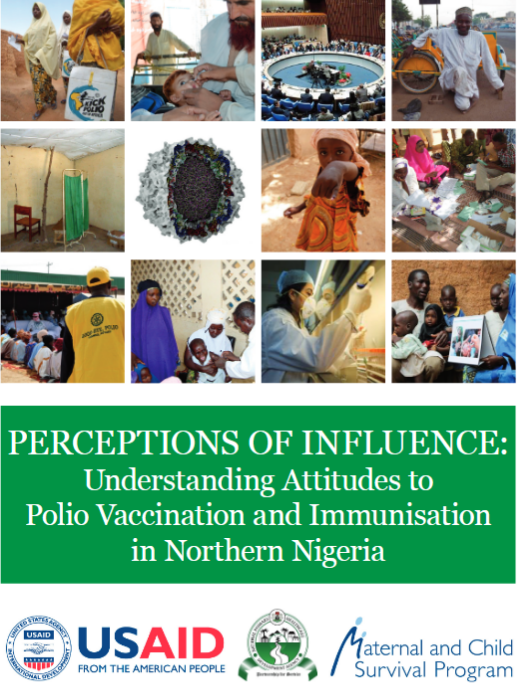
The first adapted a methodology from qualitative comparative analysis that involved using a mix of qualitative and quantitative approaches. It randomly sampled 30 households per settlement in 60 settlements within wards and local government areas in Sokoto, Kano, and Bauchi states of northern Nigeria. Researchers surveyed a total of 3,306 respondents (male and female) in 1,653 households using a questionnaire eliciting information on quantitative and qualitative dimensions of family life: general developmental conditions, household perceptions of (and trust in) external actors, health and health care experiences, and knowledge of/attitudes to RI and polio eradication. The findings were published in a report, Perceptions of Influence: Understanding Attitudes to Polio Vaccination and Immunization in Northern Nigeria, and a paper was published in Vaccine which is mentioned in the Peer-Reviewed Papers section above.
This research was presented to the USAID Mission in Nigeria, the Nigerian government through the National Primary Health Care Development Agency (NPHCDA), WHO, and UNICEF where key findings were discussed in relation to existing research and methodology. The research provided new data on the complex processes of household decision-making related to health. It challenged long-standing polio program assumptions on the importance given to religious leaders’ opinions on health and offered new insight into community reactions to polio campaigns in areas where government services were limited. As the executive director of the NPHCDA said at the time:
"The findings and recommendations in the report would be of extreme value in restructuring aspects of the Polio Eradication Initiative strategy at the micro level, particularly in the areas of behavioral change communication and shoring up demand for vaccination in communities with low uptake. In addition, the application of the pertinent recommendations in this report would contribute to further improving coverage, population immunity, and sustaining the more global gains in immunization across Nigeria."
The second identified several important links between Ukraine’s 2015 polio outbreak and how caregivers utilized social networks and social media for health decision-making. The study examined how different communities in Ukraine use social media to communicate and search for health information by applying a unique qualitative approach based on manual search and monitoring of popular and thematic social media spaces on Facebook and Vkontakte networks. Analysis of active discussions and information shared within pages revealed the level of communities' engagement with and intentions to initiate and respond to vaccination-related conversations.
The study, Social Media Initiative in Ukraine: Analysis of Online Conversations on Polio, Vaccination, and Routine Immunization, was presented in Kyiv to government and polio partners, and its findings were incorporated into social media strategies for polio and RI.
Direct Publications
MCSP also wrote a number of publications for direct publication to The Polio Network website. Some of these have been joint publications written with other organizations, and some have been written in-house. All attempt to capture polio lessons. They are:
- Influencing Change: Documentation of CORE Group's Engagement in India's Polio Eradication Programme
This publication captured lessons from CORE Group's experience with India's Social Mobilization Network from a practitioner's perspective. Divided into chapters on major program areas deemed essential to its success, such as partnering with government, empowering women, and building trust, this book captured the essence of strong communication programming while also looking into what did not work and the trial-and-error nature of building a successful program. - Polio Primer
This primer was written to help brief communication review consultants, some of whom were experienced communication experts but had a limited background in polio. It provided a basic understanding of the virus, vaccines, surveillance, monitoring, and mobilization. - Social Shakes: Rethinking the Core Principles for Principled and Effective Development Action
This paper examined the role communication plays in major social change movements around issues such as rights, governance, health, and environment. It contains a section on polio that looked at how polio has adjusted from talking to people to engaging with them and the realities in which they live. - Word of Mouth: Learning from Polio Communication and Community Engagement Initiatives
This document was written jointly with other agencies receiving USAID funding for polio projects. It captured lessons from this experience identified through a series of discussions, workshops, and teleconferences. The lessons are grouped into several categories: social mobilization, norms and culture, community-based surveillance, data-driven strategy, and operational oversight. This document has been distributed widely through partner networks involved in its writing and the thinking behind it.
Editor's note: Above is part of an end-of-project report on the Maternal and Child Survival Program (MCSP)'s work as part of a global 5-year cooperative agreement funded by the United States Agency for International Development (USAID) to support the global effort to eradicate poliomyelitis by providing expertise, research, and knowledge dissemination in communication. The full table of contents is here.
The next section in this paper is Knowledge Dissemination.
The previous section in this paper is Expert Technical Advice.
- Log in to post comments