










































Maternal Perceptions of Childhood Vaccination: Explanations of Reasons for and against Vaccination
Alberta Health Services (McNeil, Mueller, McDonald, Saini); University of Calgary (McNeil, MacDonald, Tough); Alberta Children's Hospital Research Institute (McNeil, McDonald, Kellner); University of Alberta Edmonton (MacDonald); University of Calgary Faculty of Veterinary Medicine (Saini); University of Calgary Cumming School of Medicine (McDonald, Kellner)
In the hope of supporting the design of vaccination campaigns and informing other interventions to increase vaccination uptake in Canada, researchers undertook a study to examine how do mothers with infants up to 24 months explain their decisions to vaccinate, not vaccinate, or not fully vaccinate their children. They observe that vaccination decision making includes a spectrum from complete refusal to confident acceptance. Parental vaccination decision making involves cognitive, psychosocial, and political factors influenced by scientific, cultural, and media environments. There continues to be a knowledge gap in how to best increase vaccination rates.
Survey data were obtained from All Our Babies (AOB), an ongoing longitudinal pregnancy cohort study in Calgary, Alberta. Women were recruited in the second trimester of pregnancy, when they provided written informed consent and completed mailed questionnaires during pregnancy and at 4, 12, 24, and 36 months postpartum. The researchers analysed 1,560 mothers' narrative responses to 2 questions: (i) "If your child has NOT received any or all of the vaccinations listed above, for what reason(s) did you NOT immunize your child?" (ii) "If your child has received any or all of the vaccinations listed above, for what reason(s) did you immunize your child?” Qualitative inductive content analysis was used to develop codes, categories, and themes from the text responses.
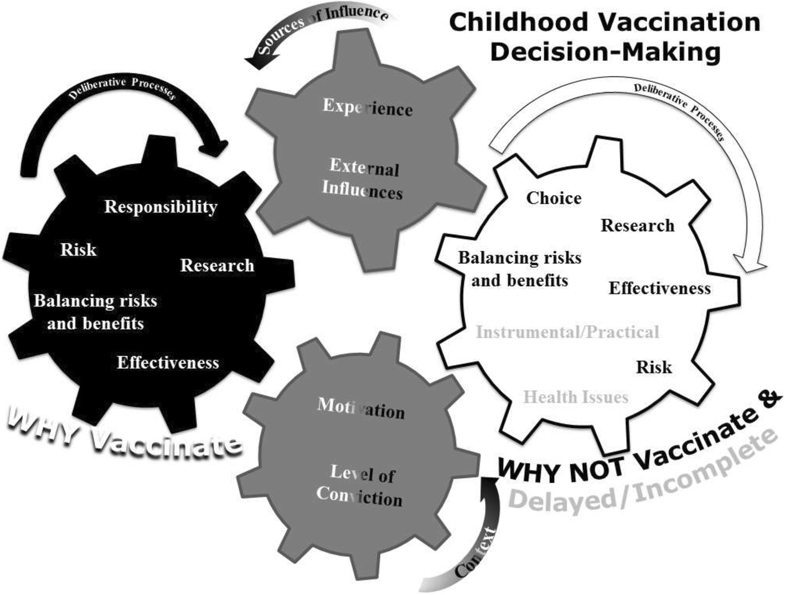
Level of conviction was reflected in certainty or uncertainty in response(s), and motivation conveyed how much decisions were internally or externally driven. Themes were similar for those vaccinating and not vaccinating/delaying; however, interpretations were different. Two broad themes were identified:
- Sources of influence on decision making included personal, family, and external experiences. For example, those who chose not to vaccinate/delay were influenced by a doctor, nurse, naturopath, or paediatric infectious disease specialist with whom they discussed vaccinations. For those who chose to vaccinate their children, additional external influencing categories included social norms and opportunity. Vaccinating was considered routine, regular, common sense, or standard by "following the norm of society". Those who had timely completion of vaccination for their children were also positively influenced by their personal experiences or experiences of their family, which is consistent with existing child care decision making frameworks and vaccine decision making frameworks in which social networks are seen as sources of influence in decision making and thought to be an avenue for interventions. Basing decisions on personal experience is also consistent with psychological decision making frameworks contending that perceptions and judgements, particularly in situations of uncertainty, are more likely influenced by information that is familiar, salient, and recent. Information from healthcare providers created the impetus, and in some, the feeling of pressure to complete vaccinations.
- Deliberative processes included risk, research, effectiveness, and balancing risks/benefits. Responsibility was a category for those vaccinating, while choice, instrumental/practical, and health issues were categories for those not vaccinating/delaying. Parents from each perspective (describing why they vaccinated and why they did not) reported doing research on their own; the researchers indicate that the use of the internet for "research" to support decision making is concerning, as non-medical websites can include inaccuracies, rumours, and myths that contribute to fear and hesitancy.
The study found that when parents received information from healthcare professionals that supported their own negative views or pressure they experienced to vaccinate, this contributed to them deciding to not/delaying vaccinating their children. This highlights the phenomenon of parents choosing healthcare providers who have consistent views with their own and reinforces the need to address healthcare provider doubts and knowledge gaps because of the influence they wield.
Based on the findings, the researchers propose 2 strategies to combat vaccine hesitancy:
- Examine the utility of motivational interviewing to address the feelings of pressure experienced by parents and the voiced commitment to parental choice that the study identified. Parents might feel more understood and the conversation less likely to contribute to negative and lasting impressions.
- Explore use of storybooks to target parental attitudes towards childhood vaccination. The premise is that the story is written for children but subtly gets parents to think about their attitudes towards the subject. An example could be the use of a plot in which a character is unable to get vaccinations due to medical reasons, and the story could show how others can vaccinate to protect that child.
Additional suggestions include using approaches to enhance paradigms of collective responsibility, which may influence those hesitant parents with social responsibility beliefs. Addressing instrumental issues through vaccine delivery systems or approaches such as short messaging service (SMS, or text) reminders may address barriers for those experiencing obstacles to access. Whatever the approach, the researchers say, it is crucial for health professionals to recognise the careful contemplation of those who choose to delay/not vaccinate their children in conversations with parents about vaccinations.
BMC Public Health 2019 19:49. https://doi.org/10.1186/s12889-018-6338-0