











































Messengers of Change: Involving Children in Polio Awareness
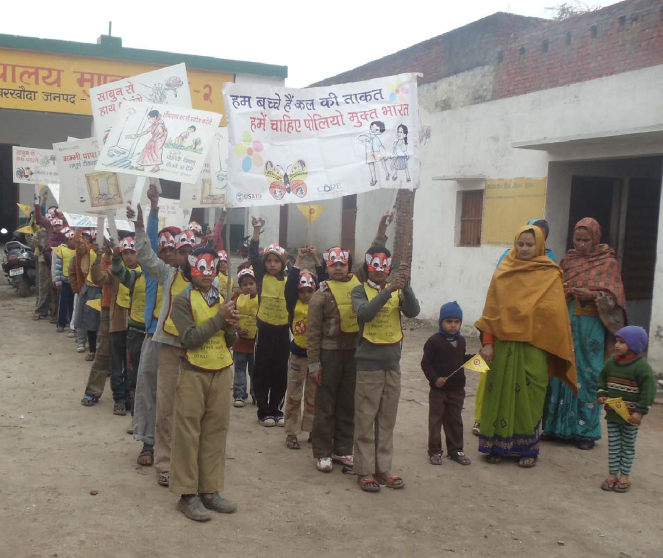
Early in the Pulse Polio Programme, the CORE Group Polio Project (CGPP) was convinced that by encouraging the participation of children, they would be able to extend their reach in the communities. Children could operate as messengers of change and encourage their parents to vaccinate their younger siblings. In addition, involving children as mobilisers would be a colourful and effective way not only to increase coverage, but also to educate the next generation and instil a spirit of community service that can be tapped into for other child health problems. This chapter from the document Influencing Change (see Related Summaries, below) details the key elements of CGPP's child-to-parent approach to disease education and prevention.
The strategy was designed to partner with local schools and Madrassas in order to engage teachers and students in the polio effort. Before each polio campaign, CMCs conducted a "polio class", where primary and middle school children learned about polio transmission and its link with sanitation. Over the years, these classes/sessions were modified to incorporate more fun activities, using entertainment formats like colouring books, games, etc., to discuss polio, immunisation, hand washing, and sanitation issues. These classes came to be known as "Masti ki Kaksha", or fun classes. These classes were conducted once a month, whether the polio campaign was being held or not. The community mobiliser would then identify some children as fun messengers or Masti ke Doot, who were made responsible for ensuring that the school premises were kept clean and for ensuring that children washed their hands. The children were urged to share the health and hygiene information with their families and neighbours and to encourage them to maintain health and hygiene.
At the end of this class, the mobilisers and teachers would identify children aged 5-12 years who showed leadership skills and were interested in becoming a member of the Bulawwa Tolies (Bands of Children or Calling Teams, who "called" parents and their children to booths for immunisation). The day before booth day, children would march through the community, beating drums and shouting slogans, to create a celebratory atmosphere and to generate interest in the vaccination campaign. On the polio booth day, the Bulawwa Tolies called out to the mothers, waved their flags, sang songs, and shouted slogans about immunisation and would go from house tohouse, according to the plan shared by the mobilisers, to bring caregivers and children to the immunisation booths in their community. Children were seen to be effective ambassadors for change, as they were enthusiastic and were perceived by the community as non-threatening.
During booth day, the children also participated in art competitions, and their art was used to decorate the booths. At the end, all the children who participated in the Bulawwa Tolies were given a small gift and refreshments for their enthusiastic participation. The schools also encouraged these children by recognising their contribution at special functions and school assemblies.
Gradually, the polio rally was transformed into a "Kukuru-ku" or Rooster Rally, which was conducted to promote not only immunisation, but also hand washing and the use of household toilets for defaecation. There was no singing of songs or slogan shouting; instead, the children would go to a central/busy location, loudly make the sound of a rooster, kukuru-ku (cock-a-doodle-do), and hold up placards with messages on maintaining hygiene, hand washing, and promoting the use of their toilets/latrines to stop open defaecation.
More than 1,000 schools were involved in these activities. Between 2007 and 2012, over 5,000 children participated in 29,683 rallies in 44 rounds of polio vaccinations. According to CGPP, involving children to support the programme helped in creating awareness of polio vaccination and routine immunisation (RI) and instilled a spirit of volunteerism among school-going children. The children were enthusiastic, as their role gave them a sense of pride and importance. The Bulawwa Tolies seemed to have provided a trusted and convenient way for parents to get their children immunised. Parents trusted these children because they were from their own community, and often they knew the child and her/his family. In fact, parents who were reluctant to trust health workers appeared to be far more willing to listen to children.
Because of the Bulawwa Tolies, taking children to the booth for polio immunisation became a normative behaviour. This is corroborated by quantitative findings from 2016, which show that in areas covered by CGPP's social mobilisers, 83% of children under 5 years of age received oral polio vaccine (OPV) at booths, compared to only 44% in areas not covered by CMCs. Figure 11 shows how the programme had an impact on booth coverage from 2008-2016. Furthermore, more than 100,000 families were reached with health messages by 1,500 bands of children. And in schools, the Masti ke Doot ensured that all children would wash their hands before their midday meal. Because of this, the school authorities started keeping soap for children and ensuring that water was available for washing hands. Following the Masti ki Kaksha, most participating schools encouraged children to clean and comb their hair, clean their nails, and wear clean uniforms to school.
Qualitative evidence shows that the knowledge children gained from the programme was passed onto the family and had an impact on health-related behaviour; for example, a father of a child participant of the Kukuru-ku rally said, "My children tell me that we must wash our hands with soap after defecation. I happily obey their instructions."
Reflecting on the intervention with children, Rina Dey, CGPP Behaviour Change Communication (BCC) Advisor, felt that when working with children, it is essential to keep the activities simple and fun. This may require that coordinators and workers become creative and flexible to engage and maintain the attention of children. Dey also discusses the challenges they faced in their work with schools, explaining, for example: "As we did not involve teachers and school authorities in developing the microplans, or offer training for teachers to conduct the classroom activities, we were unable to give them responsibility to conduct the sessions....In future programmes, such a partnership should be done from the start - wherein the school and teachers should be given equal responsibility to feel like partners and own the change."
Editor's note: This is Chapter 6 in the document Influencing Change: Documentation of CORE Group's Engagement in India's Polio Eradication Programme, which is a collaborative effort of the CGPP and The Communication Initiative. Please see Related Summaries, below, to access it in its entirety.
Image credit: CGPP
- Log in to post comments