










































Now Is the Time for Peak Performance: Twelfth Report of the Independent Monitoring Board of the Global Polio Eradication Initiative
"The Global Polio Eradication Initiative (GPEI) has implemented changes to its structure and functioning following the management and governance review that reported in 2014. Decision-making, partnership working, overall leadership, financial transparency, and the cohesiveness of the programme have steadily improved since then but the level of coordination across partners necessary to assure high within-country performance remains problematic."
This report from the Independent Monitoring Board (IMB) provides an independent assessment of the progress being made by the Global Polio Eradication Initiative (GPEI) in the detection and interruption of polio transmission globally. It follows the IMB's meeting in London, United Kingdom (UK) from October 5-6 2015. Since the last IMB report, Nigeria has been removed from the list of polio-endemic countries. Only two now remain: Pakistan and Afghanistan. The Polio Oversight Board (POB), at its meeting at the end of September 2015, after reviewing four end-of-transmission scenarios, concluded that the most likely outcome of the eradication programme is that polio transmission will be interrupted in 2016, and eradication officially certified by 2019.
Selected communication-related insights excerpted from the report:
Afghanistan:
- "In the southern part of the country, the root cause of the failure is weak social mobilization and vaccination team performance. Overall, 62% of missed children are absent, and in an additional 17% of situations, parents refuse. These metrics, derived from social data, are a clear indicator of poor programme performance....In the eastern part of the country, the reasons for missed children are different. Here, refusals are in the minority, with 64% of missed children not reached because they were inaccessible due to insecurity."
- "Working relationships between the country offices of WHO [the World Health Organization] and UNICEF [the United Nations Children's Fund], between the two agencies and their headquarters, and with the Afghanistan government are not well aligned and are frankly ineffective."
Pakistan:
- "The management and governance processes within the programme in Pakistan have improved since the last IMB report. A functioning Emergency Operations Centre is now in place. Shortcomings in data are being addressed. Health Camps are operational in different parts of the country; they provide a range of public health services, engage more communities, and, thus, inter alia increase polio vaccine uptake, and improve relations with communities. There is more training of front-line workers. A fresh communications strategy is being rolled out."
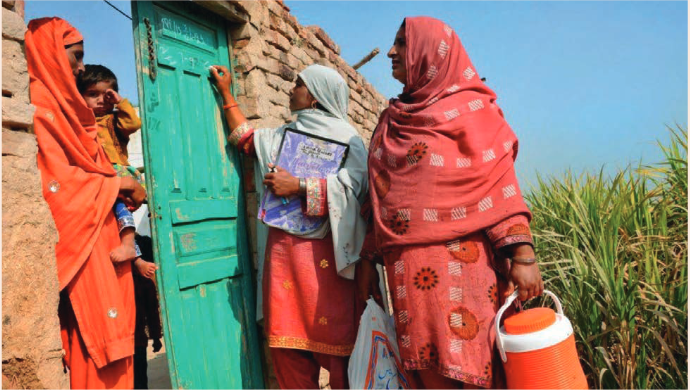
- "One innovation that is proving effective is the Continuous Community Protected Volunteers. This involves using locally recruited staff - often female - working with a low profile but on a continuous basis within their own communities and promoting health practices beyond polio vaccination. This should be rapidly scaled up."
- "The IMB is concerned that populations are being missed because they are not known about. Micro-planning is well-established good practice and essential to track down each child in an area. However, this must be combined with micro-censuses to document and enumerate previously unrecognized or newly located populations. Stopping polio transmission in Peshawar and surrounding large areas is vital."
- "The new positive and trust-based communications campaign represents progress, particularly the presentation of frontline workers as champions of their community..."
Nigeria and the Rest of Africa: "Shifting the focus of the Nigeria programme to resilience requires the same strong level of political and professional commitment as before. It requires the same high level of technical and managerial performance as before. It requires an obsessive interest in having enough of the right data and acting on the insights that this create....[T]he concept of resilience is novel to the programme and needs to be well communicated if the essential change to the mindset of leaders, policy-makers, managers and the public is to be achieved."
Ukraine: "There has been no public communication or social mobilization campaign of any note and as a result false and damaging rumours about vaccine safety have been able to take root. With this background, it might have been expected that a robust response to the polio situation would have been mounted. Instead, the response was to make no response (within the timescale that international standards require) and to depart from best practice in the choice of vaccine strategy."
Syria and Other Countries in the Middle East: "Despite the good work being carried out by the program in the region, the situation remains fragile. The insecurity situation is fluctuating. Elections in Iraq and Egypt could cause disruption to the programme. Political leadership and commitment to polio is not strong in some countries. The major risks are of a new importation of polio or the emergence of a vaccine derived strain of the virus."
The report examines the issue of persistently missed children, stressing that "a philosophy of understanding why every child has been missed and implementing a sustainable solution must permeate the GPEI and its country delivery system from top to bottom and from bottom to top." For example, the IMB urges the GPEI to pay attention to data such as shown by the fact that, in two regions of Pakistan where polio is still transmitting, researchers found that: caregivers' trust in vaccinators was at 26% and 34% against a Pakistan average of 61%; in the Borno state of Nigeria, it was 48% against a Nigeria average of 70%; in Afghanistan, the national average was 41%.
Other issues covered are vaccine-derived strains of polio, security challenges, and "the challenge of maintaining focus with increasing programme complexity". On the latter topic, the IMB notes: "The same staff that are accountable for interrupting transmission are also expected to manage: the logistics of a forthcoming planned major switch in the type of oral polio vaccine used by the programme, a worldwide roll-out of inactivated polio vaccine (including to polio affected countries) and the evaluation and preservation of polio infrastructure and good practice that can provide future benefit to other public health programmes, particularly routine immunization. While this is vitally important, it must not become a distraction from the number one goal of the programme: clearing polio out of every corner of the world."
Among the conclusions: "If every level of the programme, from global, to national, to regional, to local, to team, to individual vaccinator were relentless and unswerving and at their most creative in finding missed children, understanding why they were being missed and putting in place a solution matched to local circumstances, polio would be gone from the world."
GPEI website, accessed November 16 2015.
- Log in to post comments