










































Occurrence of Home-Based Record Stock-Outs: A Quiet Problem for National Immunization Programmes Continues
Brown Consulting Group International, LLC (Brown); World Health Organization, or WHO (Gacic-Dobo)
"HBR stock-outs...may impact continuity-of-care, increase inefficiencies at the point-of-care and reduce the ability of caregivers to be effective health advocates."
Vaccination cards and child health books, also known as home-based records (HBRs), are designed to help document immunisation and other primary care services. They offer a simple and relatively inexpensive means of fostering coordination and continuity-of-care, facilitating communication between providers and caregivers, and improving caregiver understanding and expectations about health services. HBRs can also help stimulate demand for vaccination services by raising caregivers' awareness of the benefits of vaccines, the recommended vaccination schedule, and the date of the child's next vaccination visit. However, HBRs are often underutilised, in part due to insufficient supplies. The authors of this paper have previously highlighted the occurrence of national-level HBR stock-outs reported to the World Health Organization (WHO) and United Nations Children's Fund (UNICEF) for 2014 and 2015. (See Related Summaries, below.) This report provides an update on HBR stock-outs that occurred during 2016.
In 2016, 29 (15%) countries reported a national-level HBR stock-out, an increase from that reported in 2014 (n = 19); 16 of the 29 were located in the WHO Africa Region. While stock-outs occurred in countries of all income groups, middle-income countries reported stock-outs most frequently. In short, maintaining sufficient quantities of HBRs at the national level remains a challenge. ("Complex financing arrangements appear to be associated with the occurrence of HBR stock-outs.") Furthermore, monitoring of HBR supply chain systems remains inadequate. In 2016, roughly one-third of countries and 21% of Gavi 73 countries failed to report whether a stock-out did or did not occur at the national level. Across 2014–16, 75 countries failed to report data on HBR stock-outs for at least one year. Thus, the 48 countries reporting at least one HBR stock-outs during 2014–16 reflects a minimum number. ("Countries are encouraged to critically examine the roles and responsibilities around HBR supply chains and take action to ensure that one organization maintains monitoring responsibilities."
"Research has shown that a primary reason for missed opportunities for immunization is a caregiver being inadequately informed about the benefits of vaccines, recommended vaccination schedule and the child's next vaccination visit....When HBRs are not available for distribution, a critical opportunity to educate caregivers about the role of vaccination in protecting the health of their child is missed. Repeated or extended gaps in HBR availability further decrease the likelihood that instructional scaffolding - or the structured interaction between health worker and caregiver around the importance of immunization - is implemented and may impact the timely administration of the full infant immunization series."
"National immunization programmes, and the development partners supporting them, are encouraged to consider HBRs an essential component of the immunization delivery system. HBR availability should be monitored and adopted among other programme indicators to leverage existing investment opportunities...for exploring sustainable solutions that minimize mistakes in ordering, demand forecasting and supply chain to ensure a sustained, uninterrupted supply of HBR at the national and subnational levels moving forward."
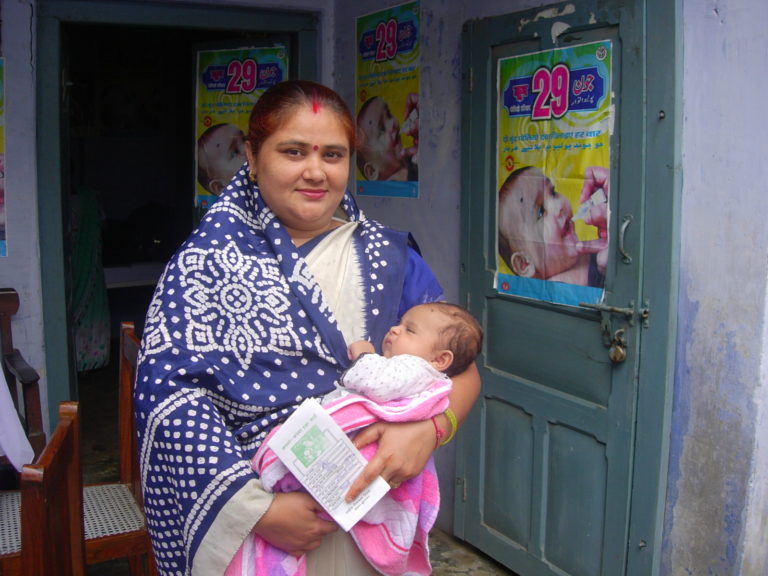
Vaccine, In press, corrected proof https://doi.org/10.1016/j.vaccine.2017.12.070 - sourced from a posting by David Brown to the TechNet-21 Forum, January 8 2018 - accessed on January 17 2018. Image credit: A mother holds her baby and the child's up-to-date vaccination card during a routine immunisation session at a health facility in Uttar Pradesh, India. Photo: Tasnim Partapuri