










































Poison or Prevention? Understanding the Linkages between Vaccine-Negative Individuals' Knowledge Deficiency, Motivations, and Active Communication Behaviors
Boston University
"[B]y showing the strong positive relationships between knowledge deficiency, attitudes, and intentions not to vaccinate, and communication behaviors, the results of this study...help situate vaccine negativity as a communication issue."
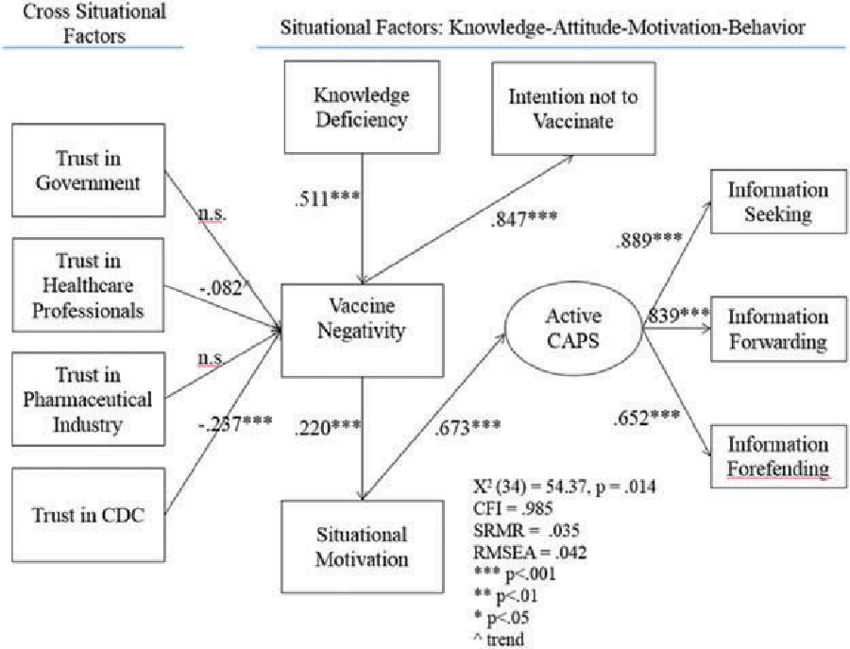
While the developing world is seeing an improvement in immunisation rates, developed countries, particularly in North America, are showing a decline in childhood immunisations. The drop in vaccination rates has been attributed to fears related to vaccines and their safety. This study is an effort to understand situational and cross-situational factors that influence individuals' negative attitudes toward vaccines, referred to as vaccine negativity. It tests how knowledge deficiency, or acceptance of scientifically inaccurate data about vaccines, and institutional trust influence negative attitudes toward vaccines. Using the situational theory of problem solving (STOPS) as the theoretical framework, the study also identifies and tests a knowledge-attitude-motivation-behaviour framework of vaccine negative individuals' cognitions and behaviours about the issue.
The STOPS explains why individuals communicate about a specific problem or issue. Like its parent theory, the situational theory of publics (STP), the STOPS theorises that individuals' perceptions about an issue will predict their communication behaviours about it. The STOPS captures 3 categories of communication behaviours individuals may display when faced with a problem: information acquisition, information selection, and information transmission (communicative actions in problem solving, CAPS). Each of the 3 categories of communication behaviours has active and passive dimensions, such that CAPS consists of 6 communication behaviours. In this study, the 3 active dimensions of the communicative actions in problem solving - information seeking, information forwarding (the volunteering of information without being prompted), and information forefending (actively rejecting certain types or sources of information) - were investigated to articulate a model of individuals' active communication behaviours.
Unlike the STP, the STOPS does not conceptualise problem perceptions to directly impact communication behaviours. Instead, the relationship between issue-specific perceptions and communication behaviours is mediated by situational motivation in problem solving. The latter is measured by "the extent to which a person stops to think about, is curious about, or wants more understanding of a problem" (Kim & Grunig, 2011, p. 132). In other words, perceptions about a problem may not necessarily predict communication behaviours directly; when individuals perceive a problem and their involvement in it, and don't feel constrained, they are motivated to do something about it, and go on to communicate about the problem. Within the framework of STOPS, this study draws on knowledge and attitudes to make sense of why individuals refuse to vaccinate their children and engage in negative communication behaviours about vaccines.
In this study, knowledge deficiency refers to the positive evaluation and acceptance of inaccurate data that has been stored for future use. In the context of vaccines, the link between the measles, mumps, and rubella (MMR) vaccine and autism is an example of inaccurate data, and acceptance of such data as knowledge would constitute knowledge deficiency. This study hypothesises that individuals who lack factual knowledge about vaccines and continue to believe the non-factual data are likely to hold negative attitudes against them. Recognising that trust in various stakeholders, including healthcare providers and the government, has been routinely discussed in conjunction with vaccine hesitation and vaccine rejection, the study also advances a series of hypotheses related to trust and vaccine negativity. Ultimately, it is expected that vaccine negativity is associated with intentions not to vaccinate.
A Qualtrics survey was conducted among 448 United States (US) participants between August and December 2015. Results revealed that negative attitudes about vaccines influenced individuals' active communication behaviours, but that this effect was mediated by situational motivation in problem solving. Furthermore, knowledge deficiency about vaccines contributed to vaccine negativity, which in turn impacted active communication behaviours (through motivation) and (vaccination) behavioural intention. In addition, although trust in the pharmaceutical industry, the government, and healthcare professionals were unrelated to vaccine attitudes, trust in the US Centers for Disease Control and Prevention (CDC) did significantly (negatively) predict vaccine attitudes. Lack of trust in the CDC and (and marginally, healthcare professionals) was associated with vaccine negativity, and through these attitudes, in vaccine rejection.
The paper's discussion section explores theoretical and practical implications of this research, including:
- Theoretically, strategies aimed at reducing individuals' knowledge deficiency (increasing acceptance of factual, scientifically validated data) may help reduce vaccine negativity and increase the likelihood of vaccination intentions.
- The results indicate the possible effectiveness of government-initiated efforts to reduce vaccine negativity about safety, and campaign strategies to address this issue may be a worthy direction of research.
- Institutions such as the CDC should enhance their efforts to engage with people with vaccine-negative attitudes - first by (re)building trust with them. How they might do so may be a fruitful area of research for communication scholars.
- The debate about parents' right to choose immunisations for their children underscores a different kind of negative attitude toward vaccines: vaccine negativity with regard to liberty. This research seeks to provide more nuance to discussions about vaccine-related attitudes by articulating a scale that captures different categories of vaccine negativity: safety-related and liberty-related. From a practical standpoint, this study points to the need for health communicators seeking to improve vaccination rates to pay attention not only to issues of vaccine safety, but also to parents' concerns of losing autonomy over making decisions about their children's health.
- This study found that individuals who held knowledge deficiency about an issue also held negative attitudes about the issue and were motivated to do something about it. These findings point to the importance of health communication scholarship and practice coming together to devise strategies to address the spread of these negative attitudes and misinformed beliefs and to engage with members of the public holding such erroneous beliefs. Future research may use this study as a starting point to identify what needs to be addressed (e.g., knowledge, differentiated attitudes, institutional trust) before theorising about how to address them (e.g., message content, form).
- Findings show that vaccine negativity, through motivation, is associated with communication behaviours, including information transmission. This means that vaccine-negative individuals have the potential and motivation to disseminate their knowledge deficiency to others. Future research should undertake social network analyses to identify patterns of information and behaviour spread, key influencers and opinion leaders, and weak ties in these pockets of social networks for more tailored strategies to address this issue.
"Moving forward, researchers should continue theorizing, improving and cross-validating this model across different cultural contexts, particularly in identifying what counts as knowledge deficiency across contexts."
Health Communication 33(9): 1-9, DOI: 10.1080/10410236.2017.1331307.