










































Polio Communications Quarterly Update - January 2012
"Never has there been so much pressure to deliver on communications and social mobilization [in an effort to eradicate polio] at country level..."
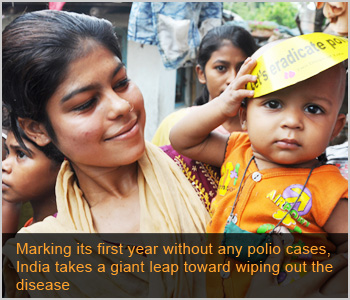
From the United Nations Children's Fund (UNICEF), this quarterly update prepared for the Independent Monitoring Board (IMB) of the Global Polio Eradication Initiative (GPEI) celebrates one year of polio-free India with the goal of putting the lessons learned from India's social mobilisation network, SMNet, into global practice. According to the report, the flagship of communication investments in the coming year will be the building of similar social mobilisation networks in India as well as these priority countries: Afghanistan, Nigeria, Pakistan, Angola, Chad, Democratic Republic of the Congo (DR Congo), and South Sudan.
The report begins with an overview, noting that, in spite of the landmark achievement in India and the overall decrease in the global case count in 2011, cases are still on the rise in both Pakistan and Nigeria. "The communication risk assessments for these two countries are particularly worrying, and it is clear that the end 2012 target of stopping global polio transmission is at significant risk. In response, the GPEI partnership has shifted into 'emergency mode', and is currently developing an Emergency Action Plan for 2012-2013. Efforts to scale up communications and social mobilization continue apace in all of the priority countries."
The overview section also points to the importance of research to fuel communication efforts to eradicate polio. According to the report: "The on-going lack of systematic and reliable data on missed children - to reveal who, and why they go unvaccinated - continues to hamper communication and operational planning on the ground....Revising monitoring systems and forms will help bring greater intelligence and focus to programme strategies." Furthermore, as detailed here, UNICEF is working with partners to look at alternative methods, including the use of new technologies, and means of gathering social data - e.g., to reveal insights into local cultural beliefs around immunisation. A number of countries, including Nigeria, DR Congo, and Angola, have undertaken qualitative social research in the past quarter to gain a deeper understanding of why children are missed.
A chart on page 5 of the report details GPEI communication indicators. It reinforces the strategic focus here on a programme's ability to collect and report on standard communications data, which UNICEF asserts is key to help guide and refine operational strategies and to ensure that minimum standards are met. In October 2011, the GPEI partners met to review progress against these indicators one year after their development. The group recommended an addition of several indicators that will hopefully broaden the analysis of social reasons leading to missed children, better assess where communication staff were placed in the field, and evaluate the effectiveness of social mobilisation funds at the community level.
A spread in the pages that follow highlights "the key social issues of concern this quarter, including continued institutionalised resistance in northern Katanga in DR Congo; inappropriate vaccinators in Balochistan, Pakistan; and ongoing non-compliance and security concerns in northern Nigeria. Another piece highlights the recent 'conversations about polio', which are shaping the political and social backdrop of the programme. This links to the various ways the programme has chosen to engage with the many ambassadors, spokespersons, and media outlets that have helped promote polio eradication in the last quarter. Finally a special feature on India showcases some of the impacts of their dedicated social mobilization network for polio."
Specifically, the section of the report focused on SMNet explores the many communication strategies developed over the past decade as this network "has emerged as the engine of community support for OPV" (the oral polio vaccine). As detailed here: "Going house to house each month, mobilizers visit over 2.5 million families in Uttar Pradesh alone. In Bihar, since 2010, they have helped build the capacity of over 200,000 frontline government workers to communicate more effectively about polio and routine immunization. Within communities, they motivate teachers, religious leaders and local influencers to support the cause. Each month, they organize rallies, festivals and campaign inaugurations. They track migrant children in railway stations, brick kilns, slums, and construction sites, building trust and breaking down social barriers inside their communities and in their own homes." One lesson to emerge from this experience: "Communication strategies designed to reach women are critical for success; but outreach that goes further by actually empowering women is likely to excel."
According to the report, similar networks are now rapidly being established in the highest risk areas of Pakistan (ComNet) and in 3 states of northern Nigeria. DR Congo, Chad, and Angola are also exploring ways to build similar networks of volunteers on existing government structures, or with faith-based networks, and Afghanistan is attempting to overhaul its existing government network of volunteer mobilisers.
The report continues with country updates from Afghanistan, India, Nigeria, Pakistan, Angola, Chad, DR Congo, and South Sudan. It concludes with communications data profiles.
Editor's note, January 30 2018: Apologies, but this resource is no longer available online.
GPEI website, February 13 2012. Image source: PolioInfo
- Log in to post comments