










































Polio, Meet Mobile: Targeting the Final 1% of Global Polio Cases with RapidPro
TextIt
"We've reached a point where current methods are no longer working. We need to think outside the box." - Asch Harwood, UNICEF
This blog describes an information and communication technology (ICT) project that centres on the potential of mobile phones as a point of connection with people in communities most at risk for polio infection.
As Kellan Alexander details, the United Nations Children's Fund (UNICEF) polio innovation team researched and tested various services that would allow them to build SMS (text messaging) and interactive voice response (IVR) applications to establish automated bidirectional communication at scale. The social mobilisation endeavour uses ICT as part of a communication for development (C4D) approach that seeks to motivate a wide range of players to raise awareness of and demand for an oral polio vaccine (OPV) through dialogue.
Specifically, RapidPro is a platform that a software shop called Nyaruka open sourced in partnership with UNICEF. TextIt, a hosted version of that software, allows the UNICEF team to build flowcharts ("Flows") that disseminate and collect actionable information geared toward improving vaccination awareness. (Those who are not associated with UNICEF may use the RapidPro platform by signing-up with TextIt.) Through this technology, the UNICEF team can build flowcharts that disseminate and collect actionable information geared toward improving vaccination awareness. RapidPro says that, by using a basic Android phone, "you can launch your application instantly in any country while avoiding expensive set-up costs or external technical support."
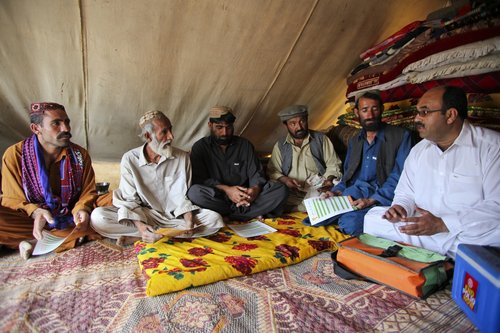
For example, registered social mobilisers in communities in countries like Afghanistan, Pakistan, and Nigeria might receive an automated phone call from UNICEF's team announcing a survey aimed at better preparing them for their jobs. The automated voice recording will, for instance, ask a question in Urdu (e.g., a quiz question about the symptoms of polio) and then ask the user to press the number that corresponds with their response. If the user answers correctly, the Flow will provide additional information before moving to the next question. If the user answers incorrectly, the Flow will respond with the correct answer and provide an explanation before moving forward.
Alexander explains that UNICEF's polio unit's RapidPro deployment integrates with Twilio's Global Reach to make international calls. "In an analysis of 7,000 calls made through Twilio connections to social mobilizers all over Pakistan, it was found that only 7% failed to connect. This indicates that mobile network coverage in Pakistan is extensive."
The project currently reaches more than 2,500 social mobilisers within Afghanistan and Pakistan. "In the coming weeks, UNICEF plans to increase that number to 7,000, focusing on females in high-risk areas. Asch and his colleagues expect IVR to be particularly powerful in low-literacy settlements. Next, Asch will be in Nigeria working closely with the Nigeria polio communications team to begin prototyping RapidPro applications with social mobilizers in that country."
Editor's note: To learn more about mHero, click here. Some results are provided - for example, in the areas of:
- Programming - example: "In a flow to assess interpersonal communication skills, mobilisers received a phone call where they listened to two scenarios they might encounter when speaking with caregivers. They were prompted to answer a question about each situation, received immediate feedback on their responses, and were provided with additional information on the topic. Mobilisers were also asked to give open ended feedback, where they expressed appreciation and even the intention to review training materials. Although 90% of 1021 respondents replied with the correct responses, UNICEF also learned through SMS that over 100 people were interested in additional training in the area of interpersonal communications. This flow is now part of a series of questions that will be used to reinforce interpersonal communications skills learned through training."
- Policy and advocacy - example: "To identify gaps in the programme and show support for COMNet, UNICEF deployed a voice flow asking four questions about training, supervision, community relevance, and payment. First, the results showed that only 61% of COMNet mobilisers in Islamabad had received training. Those who had not been trained were sent to training immediately. Second, results showed that timely payment was a problem across all provinces, but it was particularly low in northwest Pakistan. The consulting firm managing COMNet was notified of the inconsistencies and asked to resolve them."
RapidPro website, accessed July 17 2015; emails from Kellan Alexander to The Communication Initiative on July 20 2015 and March 1 2017; and mHero Polio description on the RapidPro website, accessed July 23 2015. Image credit: RapidPro © 2015 UNICEF
- Log in to post comments