










































Report on the Meeting of the Technical Advisory Group on Poliomyelitis Eradication in Pakistan [March 2012]
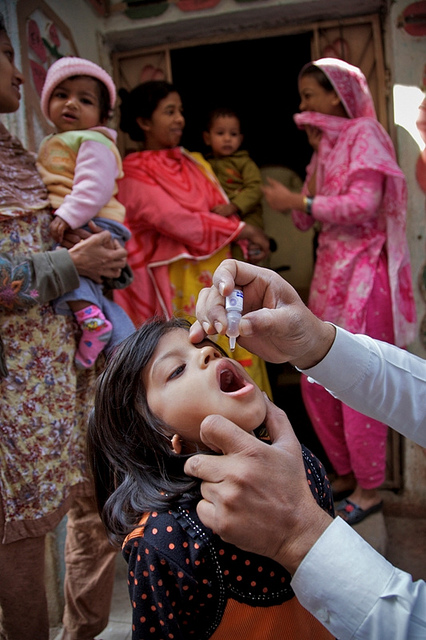
From the World Health Organization, Regional Office for the Eastern Mediterranean, this report details the proceedings of the meeting of the Pakistan Technical Advisory Group (TAG) on poliomyelitis eradication, Islamabad, Pakistan, March 21-22 2012. This meeting was held at a time when polio eradication has been declared to be "a programmatic emergency for global public health", with 3 countries (Pakistan, Nigeria, and Afghanistan) driving global transmission of polioviruses. This is the first meeting of the Pakistan-specific TAG, as previously it was combined for Afghanistan and Pakistan. Pakistan is the only one of the 3 aforementioned countries that has reported an increased incidence of poliomyelitis in the last 3 consecutive years. In addition, Pakistan has reported 50% of global cases to date in 2012. The main reason for that is an evident deterioration of immunisation status in key high-risk areas in this country.
Synopses of the presentations during the meeting are presented. Here are two communication-related synopses, both from the United Nations Children's Fund (UNICEF):
- "The presentation revisited last year's TAG recommendations and progress made against them, followed by communication objectives and milestones of the augmented NEAP [National Emergency Action Plan]. The presentation further illustrated efforts taken by UNICEF in conjunction with the decisions of the National Communication Technical Committee for increased ownership and accountability through advocacy; social mobilization and community engagement through COMNet and local partnerships; strategic shift for more data driven communication supported by data reporting/M&E [monitoring and evaluation] system (PRiME) and social research such as the recent KAP [knowledge, attitudes, and practices] survey the findings of which were also shared. The presentation also highlighted the rebranding of the mass media campaign to redefine polio in the eyes of the public through introduction of a new concept, engagement of celebrities to ask as polio spokespersons and public-private partnerships for polio eradication."
- "TAG presentation on media strategy was needed in the wake of negative media coverage of OPV [oral polio vaccine]. The presentation consisted of an overview of Pakistani media and a sketch of journalist professionals in Pakistan. After developing this context it analysed the negative media coverage and its impact. A survey of print media coverage before and after the negative TV coverage (Feb. 5th to March 12th) proved that the TV programs were isolated incidences and not a campaign. A plan of action was presented for media engagement and management, including capacity building of journalists on PEI/EPI [the Polio Eradication Initiative/Expanded Programme on Immunization], lobbying the case of polio with editorial decision makers, and most importantly creating demand for polio through enhanced social ownership. A multi-pronged, simultaneous strategy for mass media and its professionals was proposed to shift the focus from awareness to ownership."
Various conclusions are provided, with an eye to the fact that the challenge is to fully and consistently implement the NEAP. The report stresses that it is obligatory to immunise more children more consistently with special focus on the high-risk districts in the transmission zones. Communication elements are implied here: "There are some signs of early marginal progress including massively enhanced oversight at the national and provincial level, engagement of the district administration and spotting of clear indicators and milestones. Enhanced oversight has resulted in improved process indicators in some of the high risk districts, marginal improvement in the coverage rates..., identification of the program blocks and measures to overcome, placement of the communication network and gradual improvement of access in FATA [Federally Administered Tribal Areas] over the last 6 months."
Amongst the recommendations: "The national programme should deliberately plan to engage national and provincial parliamentarians, universities, professional bodies, community and religious organizations, and the private sector in a broad coalition of support for polio eradication." Another communication-related suggestion relates to social information from special investigations of the reasons for missing children, which the report urges should be used to inform actions in response.
Email from EMRO to The Communication Initiative on April 9 2012. Image credit: © UNICEF
- Log in to post comments