











































A Review of Water and Sanitation Provision in Refugee Camps in Association with Selected Health and Nutrition Indicators - The Need for Integrated Service Provision
United Nations High Commissioner for Refugees (UNHCR)
"Decades after WHO and UNHCR first introduced guidelines and standards on water and sanitation service provision..., the humanitarian community is still struggling to fully meet the minimum emergency standards for water and sanitation provision for displaced persons."
It has been recognised that, in complex emergencies, adequate shelter, water, food, and sanitation linked to effective case management, immunisation, health education, and disease surveillance are crucial. Ensuring this will often require that refugees and other stakeholders, especially women and groups with special needs, participate - such as in the design and maintenance of water and sanitation facilities. Using data from 2003-2006, this paper documents gaps in provision in the key interrelated sectors of water, sanitation, health, and nutrition in refugee camps. Where standards are not currently being met, or where there is insufficient information, the consequences are analysed and documented so as to support planning of effective solutions that protect refugees' well-being and dignity.
The methodology included:
- Analysing the data on water and sanitation services collected by UNCHR's principal global monitoring tool, known as the Standards and Indicators initiative, which was requested from the 130 refugee camps that were home to populations in excess of 2,500 refugees as of January 2005. The water and sanitation (primarily excreta disposal) data covers refugees in UNHCR-managed camp settings only.
- Collating the data supplied in the UNHCR health coordinators' annual reports covering the period July 2004 to June 2005 and spanning 20 countries, consisting of about 90 camps with a combined population of approximately 3 million refugees. These results were complemented by including nutrition surveys carried out in UNHCR-managed camps in, Algeria, Bangladesh, Chad, Kenya, Nepal, Sierra Leone, Tanzania, Sudan and Uganda during 2004 and 2005.
- Carrying out 2 household surveys in refugee camps, one in West Africa (Ghana) in December 2005 and one in East Africa (Kenya) in June 2006, to compare the standards and indicators information with the situation on the ground and to assess to what extent inequalities in distribution occur.
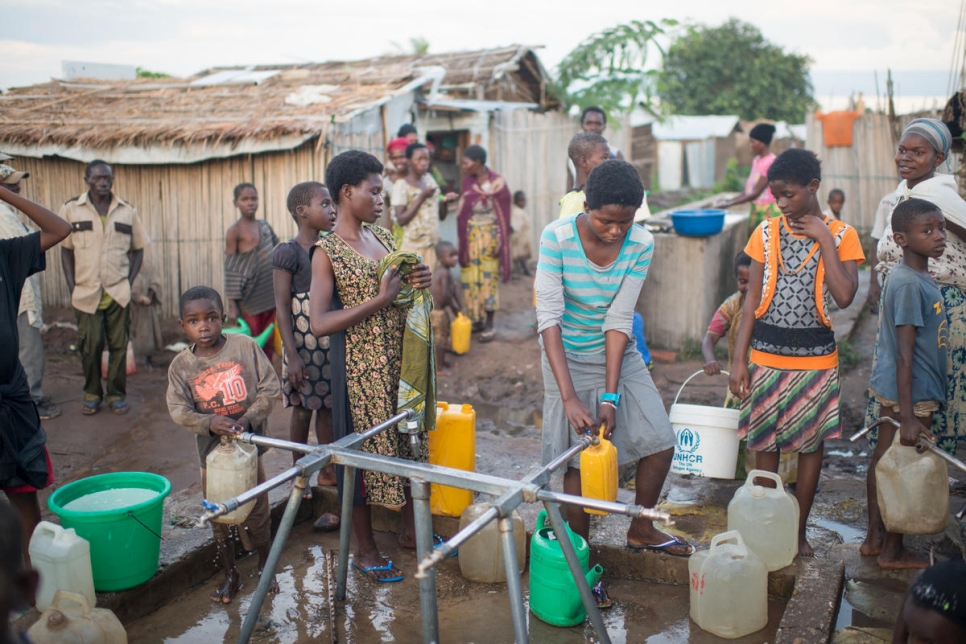
The analysis revealed that average levels of water and sanitation provision are acceptable at camp level but that many refugee operations are suffering from gaps that cross-cut these sectors - e.g., typically poor sanitation provision is corresponding with low per capita availability of water. For example, monthly or more frequent interruptions in water availability are reported in 54% and 79% of the west and east African camps, respectively - with the main coping strategies in both camps being reported as using less water (e.g., by foregoing bathing), buying or borrowing water, or going further in search of water, the latter increasing the risk of attack.
Household surveys also showed how gaps in poor water and sanitation were affecting refugee well-being and health. For instance, children collecting water has adverse effects on their education, and households reporting a case of diarrhoea within the previous 24 hours collect on average 26% less water than those not reporting any cases. In addition, typically higher levels of morbidity of one infectious agent are reflected across other infectious agents; this is reinforced by comparing the relationship between morbidity and nutrition status from selected camps.
In addition to difficult environmental conditions, insecurity and insufficient resources influence morbidity and mortality for both refugee and local communities. This is compounded by loss of health staff, damage to infrastructure, and poor coordination.
The findings underline the importance that hygiene, environmental conditions, and local settings have on health (both of refugees and local communities). It is recommended that interventions to improve indicators across the water, sanitation, health, and nutrition sectors include:
- Integrated approaches must be better planned and implemented to tackle shortcomings across all of the vital sectors and should also consider longer-term issues such as, sufficient water for agriculture, food security, access to livelihoods etc.
- These interventions must aim to improve service provision to over and above the prescribed minimum standards in the water, sanitation, health, and nutrition sectors; this will also require increased and sustained resources.
- Further and more detailed research at field level could provide an improved understanding on the impact of insufficient water and sanitation on refugees; the resulting findings should be shared with donors and resource managers. Strengthening of monitoring initiatives is also required.
- Continued improvement and expansion of the health information system could standardise and strengthen data collection and analysis across refugee operations. This will also enhance cooperation between all actors working in these difficult settings.
- In acute emergencies, there is a need to provide as much water as possible in the early critical phase, though practicalities dictate that this is not always possible.
- The plight of refugees in protracted situations must continue to be highlighted.
On the advocacy front: "Despite the insights which have been outlined as to how poor water and sanitation provision can compound morbidity and mortality, there is a need for greater awareness of the impact of resource gaps on the suffering related to poor water, sanitation, health and nutrition services, especially in protracted refugee situations. Detailed epidemiological studies can help demonstrate the cost-benefit payback of providing improved water and sanitation coverage and more effective hygiene promotion though these studies must consider how best to operationalise their findings. This can help convince donors and financial controllers as to why more resources are justified."
On that note, in January 2006, UNHCR and the World Food Programme (WFP) "held joint consultations and subsequently briefed donors and the international community on the nutrition situation, the gaps, and planned global strategies. Since then, UNHCR has communicated specific programming instructions to all field operations concerned with malnutrition and/or poor health situations, asking them to prioritize and strengthen the related sectoral elements of the integrated approach in their annual budget submissions. As a result, integrated plans of action are being drawn up in close consultation with partners on the ground. A range of project proposals has also been developed and submitted....Such initiatives need increased and sustained support if real improvements and consistent compliance with our humanitarian standards are to be achieved and long-term impacts made on overall refugee health, well being and dignity."
Journal of Water and Health 6 (1): 1-13. https://doi.org/10.2166/wh.2007.019. Image credit: UNHCR
- Log in to post comments