











































SDG ICT Playbook: From Innovation to Impact
"Used well, technology can help us realize the SDGs [Sustainable Development Goals] for our collective benefit. Nonprofit organizations are often at the forefront of addressing the SDGs. But for many nonprofits, understanding which technologies hold the most promise and how to implement technology most effectively is daunting and, sometimes, overwhelming." - Lauren Woodman, Chief Executive Officer, NetHope
The playbook was designed to help organisations that are committed to achieving the United Nations (UN)'s SDGs use information and communication technology (ICT) effectively. It addresses 10 technology areas and explores how each might be applied towards achieving the 17 SDGs. It is the product of collaborative thinking among several organisations across the technology, government, education, and humanitarian sectors, including NetHope, Catholic Relief Services (CRS), Intel, Microsoft, and CDW.
The playbook's introduction to the SDGs stresses the power of collaboration. The "shared commitment focuses on ensuring healthy lives, achieving dignity, prosperity and justice for all people and protecting our planet for all future generations. It relies on partnerships to catalyze global solidarity for sustainable development in all its dimensions (economic, social and environmental)." In this context, ICTs can:
- Enhance the capability to: measure progress toward the SDGs, evaluate the methods used to achieve them, learn what is working and not working, and improve the timeliness and quality of decision-making;
- Provide opportunities to streamline and enhance the efficiency and effectiveness of activities across the development landscape; and
- Increase access to a new range of digitally enabled products and services that strengthen local economies, local innovation, and local communities.
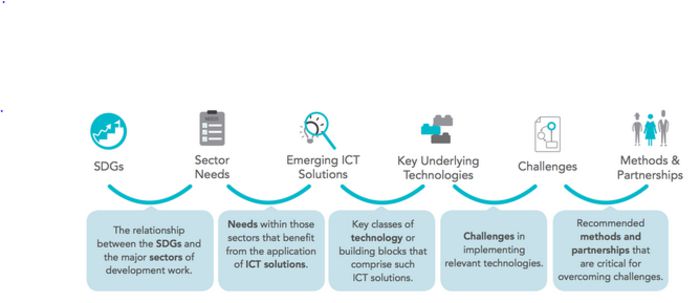
The playbook explores related development sectors with the topics of: SDGs by Development Sector, Sector Information Needs, Sector ICT Solutions, and Measuring Impact. The subsequent section, titled "Planning for the Future", examines ICT Strategy, ICT Portfolio, and Major Challenges. The 10 technology building blocks outlined are: power, mobile devices, connectivity, "the Internet of Things (IoT)" (the network of physical objects embedded with electronics, software, sensors, and network connectivity, which enables these objects to collect and exchange data), cloud computing, analytics, social media, digital services, smart systems, and 3D printing. Technology uses by sector focus on: livelihoods; agriculture; health; education; water, sanitation, and hygiene (WASH) and power; infrastructure; disaster relief; governance; and environmental protection.
Throughout the resource, key points in bullet list format outline benefits, trends, and challenges related to each of the 10 technologies; recommendations are offered for what nonprofits, governments, and the private sector can do to enhance the impact of these technologies toward the SDGs. For example, with regard to SDG #9 - "Build resilient infrastructure, promote inclusive and sustainable industrialisation, and foster innovation" - the playbook recommends, among other things, that local governments should "[i]ncrease affordable Internet access through regulatory reforms that foster market competition, establish an independent regulator, reduce tariffs, encourage shared use of passive network infrastructure, incentivize network operators to expand coverage and make open, transparent frequency spectrum allocations that favor innovations designed to close the Internet gap." Technology providers are encouraged to evaluate factors such as whether current services can be adapted to be viable in low-density settings through use of connectivity innovations. And all organisations should, according to the playbook, adopt strategies to extend the benefits of existing networks in advance of universal internet access by investing in things like occasionally-connected applications and portable storage/Wi-Fi devices that can be used by individuals traveling in and out of unconnected environments.
Prior to a list of contributors to the playbook and several pages of resources (with URLs) is a call to action that stresses strategies such as: "ICT plans should consider opportunities to bypass or leap-frog older technologies altogether in favor of new, more beneficial ones. ICT plans must also balance investments in basic ICT solutions that provide immediate benefits to developing countries (such as existing power, connectivity, cloud computing, analytics, social media and digital services) with those that are necessary to grapple with access to scarce resources within changing economic, social and physical environments around the world. Each individual public, private and civil society organization has the responsibility to ensure that their strategic goals align with the SDGs and that their plans to invest in ICT enhance their ability to contribute to the SDGs. They also have the responsibility to identify and build the cross-sector partnerships that strengthen that contribution and to actively seek alignment at national, regional and global levels."
66
"The Sustainable Development Goals ICT Playbook", by Lauren Woodman, September 28 2015 - sent to Soul Beat Africa by ICTworks; and email from Emma Schwartz to The Communication Initiative on April 12 2016.
- Log in to post comments