











































Tailoring in the Digital Era: Stimulating Dialogues on Health Topics in Collaboration with Social Media Influencers
Center for Media & Health (Lutkenhaus, Bouman); Erasmus Research Centre for Media, Communication and Culture (Lutkenhaus, Jansz, Bouman)
"Against the background of...open communication networks, where there is less control over how content ultimately arrives at end-users' screens, how can we tailor health communication interventions to be more personally relevant? How can we leverage the dynamics of conversations and social influence in online networks to create and deliver tailored health interventions more effectively?"
Strategies drawn from the field of influencer marketing provide opportunities to reach and engage with online communities in a personally relevant manner, tailored to their specific cultures and health-related perceptions. This article reflects on what health communicators might learn from influencer strategies and proposes digital methods to target and tailor health communication in the digital era. More concretely, it presents methods to: identify online communities engaging on a specific health issue; map community-specific perceptions, beliefs, and norms; and identify social media influencers as potential collaboration partners whose creative and cultural competences can model health behaviours, break taboos, and initiate conversations. The article illustrates the potential of these methods with a study of how vaccination is discussed among Dutch Twitter users.
In many online communities, content-creating audience members have become particularly influential and act as opinion leaders, introducing new information and ideas to their social circles and setting the agenda for conversations. Health communicators are taking notice. The STD AIDS Foundation in the Netherlands, for instance, has built a legacy of collaborations with social influencers such as beauty vloggers, rappers, and gamers in order to engage with online audiences. An example is its collaboration with rappers in the intervention Beat the Macho, which reached out to young audiences with an interest in urban culture with a view to challenging community specific perceptions on masculinity through raps and dance, encouraging them to think and talk about what it means to be a "real man".
Studies have shown that tailoring is an effective method for increasing the relevance of health communication programmes. In addition to tailoring a message's contents, it is also important to ensure that it reaches its prospective audience. The article reflects on changes in the media landscape and explores how open data collection methods can be leveraged to:
- Identify online communities: To reach audiences, it is important to study media networks. Audiences make use of a mix of traditional and online media. Such "media repertoires" transcend passive media use and comprise media-related communicative practices that individuals use to relate to online communities focusing on niche interests. The sum of communicative practices around a social domain is called a "media ensemble" and can be seen as the collective voice of a community, or the voices of different communities that engage with the same topic from different perspectives. Open data collection methods can be leveraged to retrieve these media ensembles from the web, social media, or content platforms to create media networks in which it is possible to distinguish between different online communities that can serve as audience segments for targeted health communication strategies.
- Understand community perceptions: Analysing conversations on specific health topics among different online communities can contribute to understanding the communities' knowledge, attitudes and social norms, which are important determinants for behavioural change that can be taken into account when creating tailored health interventions. Focusing on specific media ensembles, investigators can use text mining techniques and qualitative content analysis approaches to disentangle the voices of the stakeholders engaging with the issue and to create tailored health interventions.
- Identify influencers: Social influencers can be ordinary citizens as well as established celebrities who share parts of their personal life, promote political views, or advertise services or products through their Twitter, Facebook, Instagram, or YouTube accounts. In interacting with their peers, they invite their followers to leave their thoughts in the comments section, vote in a poll, or react by creating memes. As such, they can set the agenda for conversations in online communities. Conversations are capable of pushing the boundaries of social norms, implicitly and explicitly raising awareness about an issue within a community, and making audiences more receptive to information about a specific health issue. Two kinds of influencers are described here as suitable collaboration partners in targeting and tailoring health interventions: (a) social influencers who are influential in one specific community (opinion leaders); and (b) social influencers who are influential among more than one community, thereby facilitating the flow of information from one community to another (gatekeepers) and who act as bridge builders.
A case study out of the Netherlands follows in order to illustrate how this process works in practice. Following a global trend, vaccination rates in the Netherlands have been declining. In response, the Dutch National Institute for Public Health and the Environment (RIVM) invited a group of social and communication scientists, the Vaccine Hesitancy Commission (VHC), to study the situation. The VHC wanted to increase its understanding of the (mis)information that is circulated online and thus commissioned researchers at the Center for Media & Health to explore how vaccination is being discussed on Twitter.
The researchers used a set of custom scripts in Rstudio based on the rtweet package to retrieve all the tweets between August 28 and October 9 2017 that included the Dutch words "vaccineren", "vaccinatie", "vaccinaties", "inenten", "inenting", or "inentingen". This produced a data set with 10,710 tweets written by a total of 2,600 unique authors, including associated quotes, retweets, and replies. The authors' followers and accounts they were following were also retrieved. These data were combined, and a network file was created that included 125,746 accounts and 3,822,000 connections. Iterating through a cycle of network analysis, text mining, and qualitative analysis, the researchers identified online communities, distinguished them by common characteristics in their profile texts and tweets, and analysed how they talked about vaccination. (Researchers interested in employing these methods can use the researchers' scripts, publicly available via GitHub, to gather, process, and analyse Twitter data.) Specifically, they:
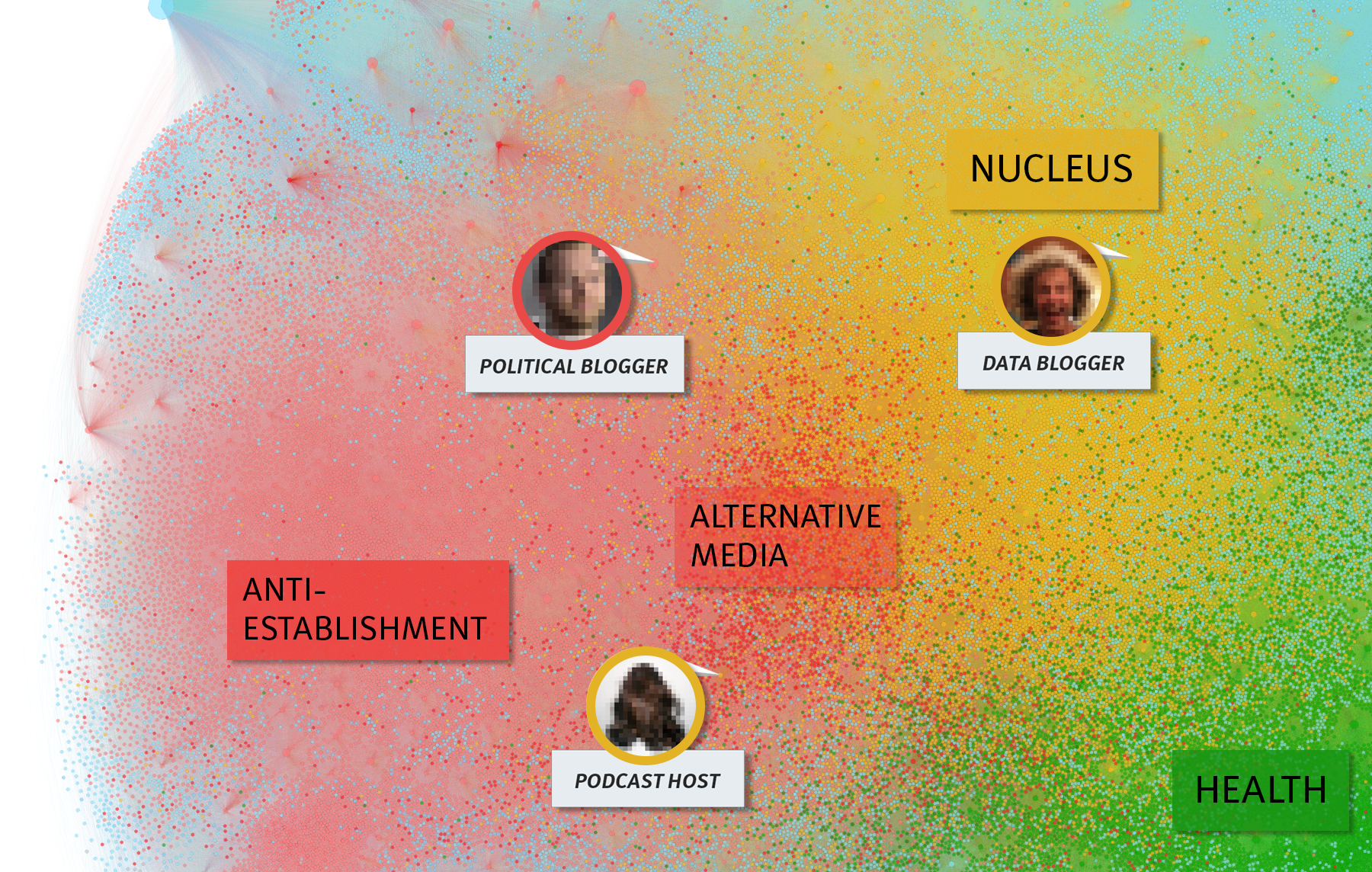
- Identified communities: Figure 1 in the article shows a plot of the network created in Gephi, in which the communities are distinguished by colour. The researchers used the Louvain algorithm for community detection. The nodes (Twitter accounts) are sized according to the number of times they are followed by co-members of the network. Analysis of the profile description texts confirmed the expectation that the communities are inhabited by like-minded audiences. For example, the nucleus community represents the space where a critical general audience engages in conversations about vaccination, and where Twitter users who are aligned with the surrounding communities try to influence the debate.
- Mapped perceptions: The researchers identified patterns in the tweets using text mining techniques from the tidytext package. Using a constant comparative procedure, they then followed these patterns in a subsequent step of the qualitative content analysis. They also traced back chains of retweets, quotes, and replies to determine how the communities engage with each other. Figure 2 shows the different themes, frames, and narratives and how they flow through the network. Mapping the discourse on vaccination in and between communities produced results that can be used to define and tailor health communications to the perceptions of the different online communities. It also provided input when deciding which frames to support and which misconceptions to address. For example, the analysis revealed that members of the health communities antagonise and joke about anti-vaccination activists who, in turn, see their prejudice about the arrogance of the traditional elite confirmed. For some audiences, the fact that a doctor, researcher, or someone from what is perceived as "the establishment" is sharing this information may be enough reason to dismiss the message.
- Identified social influencers: Sorting the individual Twitter accounts in each community by their respective PageRank and betweenness centrality scores yielded a list of the most influential opinion leaders and gatekeepers. The researchers were specifically interested in influencers who are native to the communities they are seeking to reach. Ideally, the RIVM would collaborate with social influencers who can create their own media content, or already do so (semi-)professionally. Social influencers should be willing to collaborate on a pro-vaccination campaign, although a curious, critical attitude would add to the authenticity of the prospective media content. Figure 3 highlights 3 potential social influencers in the network: a data blogger who could share fact-based information, a podcast host who could spark conversation, and a political blogger who could share different perspectives.
This case study illustrates that targeted health interventions require strategies in which health communicators and social influencers work closely together. In such collaborations, there is a need for a common frame of reference that guides the collaboration process, balancing tasks and responsibilities. In the case study on vaccine hesitancy above, this might translate into: letting the hosts of existing podcasts lead discussions about vaccination; making vaccine-related data sources available to data bloggers, artists, and other enthusiasts; and (co-)producing live discussion events about vaccination.
To strengthen this common frame of reference, the researchers suggest following a media mapping procedure that effectively integrates the efforts of the different stakeholders. During the orientation phase, health communicators can use digital methods to identify online communities, understand their health-related perceptions, and define audience segments. During the crystallisation phase, health communicators can use digital methods to further increase their understanding of health-related perceptions and find potential collaboration partners across online communities. During the dissemination phase, digital methods can be used to detect changes in online conversations about the issue across the different communities researchers hope to reach.
The case study has demonstrated how digital methods can be used to target and tailor health interventions in the digital era. It illustrates an alternative approach to tailoring by making the creative and cultural competences of social influencers central, hopefully resulting in health communication that is more personally relevant and impactful.
Digital Health, Volume 5: 1–11. DOI: 10.1177/2055207618821521
- Log in to post comments