











































Vaccines: Religio-Cultural Arguments from an Islamic Perspective
ESRC Centre for Corpus Approaches to Social Science (CASS), Lancaster University
"The information provided in this article is aimed to help deliver appropriate health care advice to Muslims in a culturally sensitive manner."
To support vaccination, Muslim jurists have over the past few decades put forward arguments in favour of vaccines. On the other hand, there have emerged arguments against intramuscular (IM) and oral vaccines from non-jurists. This article provides an analysis of the research into the main arguments made from an Islamic perspective concerning vaccines. These arguments are extrapolated from the discourse on vaccination by examining key fatwas and events since the late 1980s. The specific purpose of the article is to help guide British muftis, Muslim faith leaders, and healthcare professionals in the United Kingdom (UK) regarding the Islamic ruling on the Pfizer-BioNTech COVID-19 vaccine.
Section 2 of the paper highlights the efforts of the member states of the Organisation of Islamic Cooperation (OIC) to eradicate deadly diseases using vaccines. The author's research indicates that the 57 member states of the OIC have been and continue to be strongly in favour of the use of vaccines. For example, in February 2014, an Islamic Advisory Group for Polio Eradication (IAG) was launched to promote the use of IM and oral vaccines. Sheikh Yusuf Al-Qaradawi, Chairman of the International Union of Muslim Scholars, stated that the polio vaccine has been effective in over 50 Muslim countries and that its lawfulness in Islamic law is "clear as sunlight". In fact, in 2016, the Fatwa Committee of Perlis in Malaysia, which is one of the member states of the Parliamentary Union of the OIC (PUOICM), stated that vaccination is an Islamic obligation.
Section 3 explores key arguments made in favour of vaccines. These arguments include not allowing harm to oneself or others ("La dararwa la dirar"), as well as ensuring that harm to others is prevented. According to Islamic law, a collective public effort is valued more than individual choices during pandemics. Nevertheless, before a form of treatment is promoted, Muslim jurists examine the details of the treatment to determine whether it is Shari'a compliant. The UK Medicines and Healthcare products Regulatory Agency (MHRA) confirms that the Pfizer-BioNTech COVID-19 vaccine does not contain any components of animal origin; likewise, no product used in the vaccine is derived from foetal cell lines. However, taking a broader lens on issues around vaccination and Islam, this section of the paper highlights the differences among Muslim jurists concerning the permissibility of the inclusion of porcine gelatine in vaccines and the use of human cell strains in vaccine development.
Section 4 examines the arguments and criticisms levelled against vaccines. Arguments selected in this section are ones that appear to have influenced anti-vaccination campaigns among Muslims. Such arguments made against vaccines are based on an interpretation of the Qur'an that the human immune system is not designed to be vaccinated through IM or oral vaccines and that, rather, humans are designed to be treated by natural means such as breastmilk and other natural foods.
Among the additional arguments explored in this section is the notion that vaccines could be adulterated to sterilise Muslim women, especially in war-ravaged countries. The origin of this set of beliefs perhaps originates from political tensions in Afghanistan, Pakistan, and Nigeria. For instance, research cited here illustrates that the rise in vaccine hesitancy and refusal in Pakistan is correlated with the frequency of drone attacks between 2004 and 2011. In Nigeria, Ibrahim Shekarau, Governor of Kano State, refused the polio vaccine in the state, believing it to be a Western Christian plot to reduce the Muslim population in Nigeria. In the 1980s, the population policy was limited to four children per woman. The fact that the polio vaccination campaign incidentally followed this policy resulted in suspicions of depopulation.
Section 5 provides a summary of the main arguments for and against vaccines and also includes recommendations for British muftis and medical professionals in the UK to help address hesitancy around the Pfizer-BioNTech COVID-19 vaccine. As noted here, "[g]iven the spectrum of views on vaccination, there is no compulsion in Islam nor by the UK government as of January 2021, to be vaccinated....On the other hand,...a plethora of fatwas exists, which permit and encourage the use of vaccines. Protecting oneself and others by raising herd immunity may be viewed as a meritorious act based on the Qur'an, which states that 'anyone who saves a life, it is as though he has saved the whole of humanity'....As such, British Muslims are advised to make an informed decision regarding vaccination for themselves as well as for those for whose health care they are responsible."
Bearing this information in mind, concluding suggestions include:
- British muftis and Muslim faith leaders are advised to have discussions on vaccination with British Muslims by being informed of the existing literature of the fatwas on vaccines.
- Healthcare professionals, both Muslim and non-Muslim, need to be aware of the impact the Islamic faith has on Muslim patients with regard to the decision-making process to inoculate against COVID-19.
- Policymakers should take note of the nuances outlined in this article in relation to the gelatine and other contentious ingredients used in vaccines so as to help manufacture and provide suitable vaccines for Muslim communities in the UK. They should also undertake closer consultation with the body of Muslim scholarly and medical organisations that are increasingly involved in educating the British Muslim public.
- Data from trials that are representative of ethnic populations could be communicated transparently to help increase trust and informed decision-making.
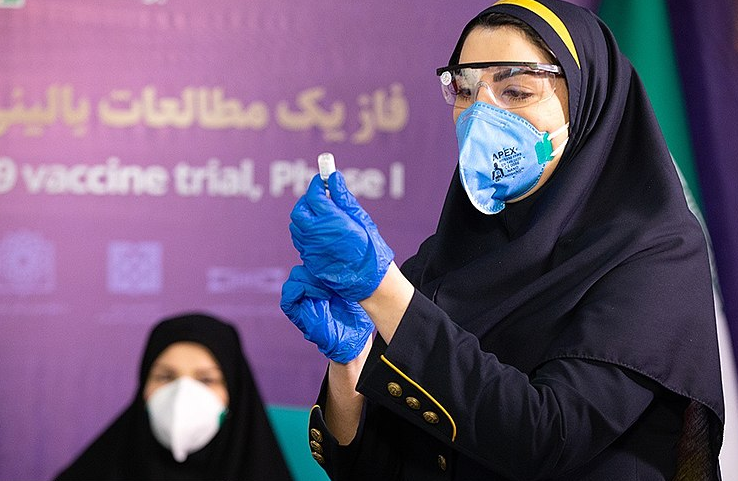
Journal of the British Islamic Medical Association, Vol 6 - No. 2 | December 2020. Image credit: Mohammad Mahdi Dorani/Fars News Agency (Creative Commons Attribution 4.0 International license)
- Log in to post comments