










































Voluntary Vaccination through Self-organizing Behaviors on Locally-mixed Social Networks
Hangzhou Dianzi University (Shi, Qiu, Niu, Ren, Ding, Chen); Ministry of Education (Shi, Qiu, Niu, Ren, Ding); Wuhan University (Chen)
This paper focuses on individuals' self-organising behaviours under the circumstance of voluntary vaccination in different types of social networks. Specifically, it assumes that each individual, together with his/her neighbours, forms a local well-mixed environment, where individuals meet equally often as long as they have a common neighbour. The researchers carry out simulations on several types of locally mixed social networks to investigate the network effects on voluntary vaccination. Furthermore, they evaluate individuals' vaccinating decisions through interacting with their "neighbours of neighbours". The results and findings of this paper are meant to provide a new perspective for vaccination policymaking that does not rely on social learning among neighbouring individuals, nor individuals' past experiences about vaccination and infection from an infectious disease (a so-called pure vaccinating strategy).
The researchers adopt the Susceptible-Infected-Recovered (SIR) model (see Methods section for the description of the SIR model and its associated parameters) to simulate the transmission of a vaccine-preventable disease like smallpox or measles. They capture the strategic interactions of individuals in the following way. First, individuals randomly determine their initial probabilities of vaccination at the beginning of an evolutionary process. Because people play different roles and have contact with each other in groups, the SIM explains that individuals adopt a mixed vaccinating strategy rather than a pure strategy. Individuals predict the risks of infection in their locally mixed environments based on their neighbours' strategies, using an epidemiological model. Based on the perceived risks of infection, they further update their probabilities of vaccination to balance the costs of infection and vaccination. It is expected that such self-organising behaviours among interconnected individuals would lead to a steady state about their willingness to vaccinate under voluntary vaccination.
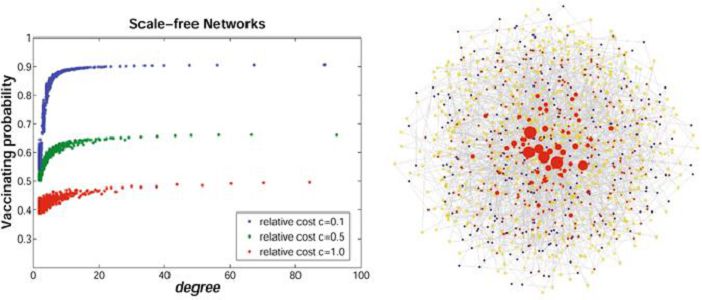
In this paper, simulations are carried out to study individuals' self-organising vaccinating behaviours on 3 types of locally mixed complex networks. They are: random regular networks, small-world networks, and scale-free networks. It can be observed that the average vaccinating probability p on all the 3 types of networks decreases when (i) the relative cost c increases, and (ii) the infection force ß decreases. The proportion of individuals with high vaccinating willingness decreases more abruptly in random regular networks than in small-world and scale-free networks. The main reason is that individuals in random regular networks have more homogeneous degree distributions than that in small-world and scale-free networks. In other words, individuals have similar local environment in random regular networks, which makes it more easily for individuals to perform similar vaccinating strategies through interacting with each other.
Moreover, except for certain individuals with low degree, there are no significant differences between nodes with high and middle degree in terms of the final vaccinating probability. This is because in scale-free networks, most individuals will belong to a large group centred by a small number of hub nodes through their "neighbours of neighbours". In this case, individuals with lower degree may overestimate the risk of infection, and then take vaccine with high probability.
Meanwhile, individuals with high degree are more likely to take vaccine if they consider only vaccinating strategies of their direct neighbours. However, if individuals have complete information about their "neighbours of neighbours", individuals with high degree will benefit from vaccinating behaviours of other individuals due to the effects of herd immunity.
The researchers explain that, as with any model, the proposed model has made several simplifying assumptions. For example, it is assumed that individuals make decisions based on strategies of their direct neighbours or "neighbours of neighbours". In reality, individuals could also get information from various types of social media. To address this limitation, they say, the impacts of public information on individuals' self-organising behaviours should be further studied. Moreover, it is also assumed that all individuals are rational to make vaccinating decisions. However, people often tend to exaggerate the negative effects of vaccination failure and complications. Therefore, it would be advantageous to study individuals self-organising behaviours with bounded rationality, as well as the effects of their memory and adaptability for past vaccinating events. Finally, all findings in this paper are obtained by simulating individuals' behaviours in synthetic networks. In the future, there remains a need to understand the interplay between disease prevalence and individual vaccinating behaviour based on real-world social contact networks. Such real-world networks can be estimated from human mobile data, census data, and other data acquisition techniques.
Scientific Reports | 7: 2665 | DOI:10.1038/s41598-017-02967-8
- Log in to post comments