











































Vaccination as a Social Contract
University of Erfurt (Korn, Betsch); University of Copenhagen (Böhm); RWTH Aachen University (Meier)
"Emphasizing the social contract could be a promising intervention to increase vaccine uptake, prevent free riding, and, eventually, support the elimination of infectious diseases."
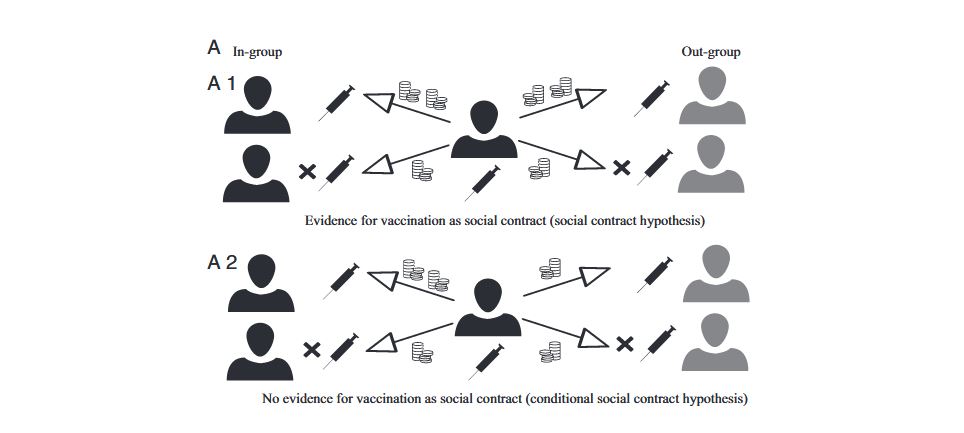
In order to eliminate infectious diseases through the herd immunity that vaccination can confer, individuals need to consider social welfare beyond mere self-interest - regardless of ethnic, religious, or national group borders. It has therefore been proposed that vaccination poses a social contract in which individuals are morally obliged to get vaccinated. This study investigates whether individuals' behaviour suggests that vaccination is indeed perceived as a social contract, where individuals reciprocate and reward others who comply with the contract and punish those who don't.
The study is grounded in morality-as-cooperation theory, which understands cooperation as morally good/respected and defection as morally bad/despised. The idea is that, given that others cooperate, cooperators should share their resources generously. However, when this reciprocity expectation is violated, cooperators should become less generous. If transferred to the vaccination context, individuals who are vaccinated (and therefore comply with the social contract) should show more generosity toward those who are vaccinated compared to those who are not vaccinated (and therefore violate the social contract). Importantly, individuals who are not vaccinated themselves should not (or to a smaller extent) differentiate between the other persons' vaccination behaviours.
Another question to explore is whether the social contract applies only to in-group members or whether it is moderated by group membership. This "conditional social contract hypothesis" challenges the idea of vaccination as a social contract, as it contrasts the idea of moral norms, which should apply to all people alike, with group- and context-specific reactions toward others' vaccination behaviour.
In the first 3 online experiments, the researchers collected data from 1,032 participants to test the social contract hypothesis. First, the participants indicated their unconditional generosity by distributing monetary tokens between themselves and another participant whose vaccination status was unknown. Afterward, they were informed that 2 groups existed during the experiment and that they were assigned to one of them. Experiment 3 further varied the framing of the decision situation by using a migration context for the intergroup setting: Instead of being a member of group A or B as in experiments 1 and 2, participants were informed that they were citizens of a country vs. immigrants from another country.
The participants then made a vaccination decision in an incentivised vaccination game (one-shot I-Vax game), which models vaccinations based on epidemiologically derived incentives capturing both the direct and indirect benefits as well as the costs of vaccination. After the vaccination game, the participants again indicated their generosity, but this time they received additional information about the other person's vaccination behaviour and group membership. An increase of money allocated to the other indicates higher generosity, while less money allocated indicates lower generosity.
A fourth online experiment (n = 1,212) tested whether the pattern of results occurred due to the incentive structure of the decision task or the contextual framing as a vaccination decision. It also tested whether vaccination is a social contract only when herd immunity plays a role and players' outcomes are mutually dependent. Finally, the researchers explored whether the belief that vaccination is a moral obligation moderates the expected changes in generosity.
In short, the 4 experiments demonstrated that vaccinated individuals indeed show less generosity toward nonvaccinated individuals who violate the social contract. Specifically, there was consistent evidence that vaccinated participants (more so than nonvaccinated participants) showed lower levels of generosity toward nonvaccinated others, representing the behavioural foundation of a social contract. Furthermore, vaccinated individuals showed lower levels of generosity toward nonvaccinated others regardless of their group membership. The effects were replicated for "perceived warmth" as a dependent variable, as warmth corresponds to a moral judgment of others' behaviour.
The fourth experiment explicitly examined whether perceiving vaccination as a moral obligation has an impact on the observed patterns. The results revealed that this belief is indeed a major driver among vaccinated individuals to show less generosity toward nonvaccinated others (vs. vaccinated others). Thus, the researchers conclude that vaccination is a social contract in which cooperation is the morally right choice. Individuals act upon the social contract, and more so the stronger they perceive it as a moral obligation.
In practical terms, the results suggest that emphasising that vaccination is a social contract could be a promising communication strategy. Stressing that everyone who is able to get vaccinated is expected to do so could have additional benefits in communicating the principle of herd immunity. The appeal could be based on moral grounds. However, the media often reports that nonvaccination is becoming more and more common. The results of this research suggest overcommunicating the prevalence of nonvaccinated individuals could jeopardise high vaccine uptake, as the social contract requires trust in others' compliance.
The researchers note that, while the results showed that people privilege those who obey the social contract irrespective of their group membership in real life, belonging to a specific group may often be confounded with a specific health status. For example, migrants may have limited access to health care and thus be unwillingly forced to violate the social contract. Thus, equitable access to health care and vaccinations is crucial to allow everyone to fulfill the social contract and also to avoid further discrimination based on health status.
In conclusion, the research "supports the notion that vaccination is a social contract wherein getting vaccinated is the morally right behavior. Future interventions should harness this finding to increase vaccine uptake. Moreover, the results also underline that equitable access to health systems and service delivery is of utmost importance to avoid further marginalization of already marginalized groups."
Proceedings of the National Academy of Sciences (PNAS) https://doi.org/10.1073/pnas.1919666117
- Log in to post comments