










































Polio-Free Chad: UNICEF Quarterly Newsletter on the Polio Eradication Initiative in Chad [July 2014]
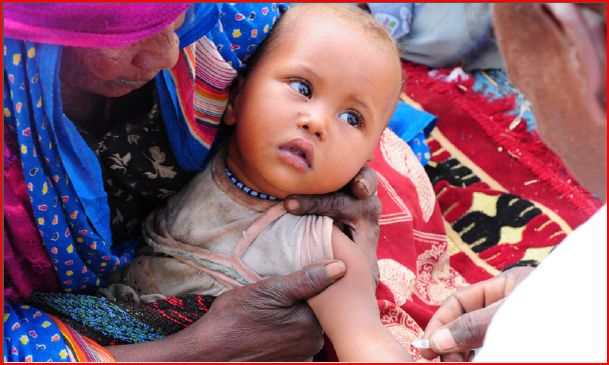
The United Nations Children's Fund (UNICEF) Chad Country Office released this edition of its quarterly newsletter to announce that, thanks to rigorous polio campaigning, the country has achieved a polio-free status for 2 consecutive years. This positive development is attributed to partnership and the "continued engagement of the Chadian government, backed by committed donor support and through close collaboration with UN operating agencies UNICEF and WHO [the World Health Organization]." While cognisant of the fact that the Global Polio Eradication Initiative (GPEI) finds itself confronted with setbacks such as the regional outbreaks in the East-African horn, the Middle East, and more recently in Cameroon, UNICEF Chad here describes the activities and strategies that led to the positive results in Chad to date, focusing on 3 major themes:
- Transborder vaccinations to keep polio at bay;
- Reaching every district (RED) endeavours to boost routine immunisation (RI) coverage; and
- "Zero Status: Is Polio Really Gone?"
"Despite having now reached 85% national coverage with at least 3 doses of Oral Polio Vaccine (OPV), we remain very vigilant in connection with the current regional outbreak which originated in Cameroon last October [2013]." So, for example, UNICEF Chad conducted African Vaccination Week with the intention to increase all stakeholders' awareness on the importance of RI for the survival of the child, as well as to increase immunisation indicators through improved advocacy, communication tools, and integrated health services and activities. Adopting the theme "Immunization is a shared responsibility" and the slogan "Vaccinated population, population in better health", the 2014 African Vaccination Week in Chad placed a particular emphasis on difficult-to-reach populations, such as island-dwelling populations of the Lake Chad region, and difficult-to-access populations in the Ouaddai region in eastern Chad. "In the districts of Bol and Bagasola in the Lake region, active search for vaccination dropouts helped recover 560 infants out of 616 identified. This 90% recovery rate is a promising result..., which surpassed the initial objective of 30% dropout recovery..."
This result was "largely obtained thanks to increased efforts by community health workers to reach out to parents and caregivers with vaccination services during the week's activities. These efforts included the input of specifically trained community relays whose knowledge of their own communities helps diffuse the importance of vaccination message to all community stakeholders, including parents and caregivers, traditional and religious leaders, women's associations and other associations." In total, 4 advocacy meetings with traditional leaders and 7 social mobilisation meetings with political and religious leaders were held; this involved the participation of 28 local organisation members and 12 community relays, who visited 664 households, reaching an approximate population of over 3,700 people. Eight public announcers were also deployed in the 2 lake region districts Bol and Bagasola, to relay the vaccination message and vaccination week dates to the community. In addition to immunisations, a range of other activities were held during African Vaccination Week, such as social mobilisation meetings, integrated health activities (distribution of long-lasting insecticide nets (LLINs) and water filters for malaria and guinea worm prevention), awareness events with communities for information sharing and dialogue, training sessions for community volunteers, and supervision activities.
The newsletter goes on to explore strategies undertaken as part of RED, which is based on 5 primary principles: more effective use of available resources (human, financial, technical), reaching all intended beneficiaries, including those who have been traditionally underserved or previously un-reached, use of supportive supervision to increase staff capacity on the field, use of quality data for monitoring-based action, and linking beneficiaries to health service providers through direct dialogue within communities. The way in which RED has been carried out in Chad, specifically, is described here. For example, as part of this process: "Specific software-based tools were designed after the validation of the RED performance indicators, and all relevant stakeholders were trained. Data was collected by UN local consultants and Government field staff, who dispatched the data to the central level, where it was compiled and analyzed, with results shared with all stakeholders at all levels on a monthly basis."
In terms of keeping Chad polio-free going forward, some communication-related experiences and lessons learned include:
- The importance of mobilising and training of "thousands of health workers, vaccinators, community relays, and public announcers - Several cooperation agreements were set up with national and local media outlets, including community radio stations in rural parts of the country, to improve demand for Oral Polio Vaccine. More recently, an agreement with one of Chad's primary telecommunications operators has been signed, to increase beneficiary awareness on campaign dates and benefits of vaccination via SMS [text message]."
- Improvement in the realm of data collection and analysis - "There is much more information about WPV [Wild Polio Virus] in the Chadian context today than there ever was. We know for example that 'Child Absence' is the leading cause of missed children at campaign time. We also know that the proportion of Chadian children aged less than five who have received 3 doses or more of OPV is around 85%. More importantly, we can trust this data more than ever, thanks to improved systems and tools of information cross-checking and verification."
- Communication and advocacy with community leaders (religious, traditional, women's groups) were "expanded at all levels, in an effort to create a platform for proximity communication and direct contact with parents and caretakers. Emphasis was placed on the engagement of village-based community relays who, supported by a large network of local communication consultants (about 40 of them deployed over the Chadian territory), built a network bridging health services and beneficiaries."
Email from Bruno Maes to The Communication Initiative on July 22 2013. Image credit: UNICEF Chad CO
- Log in to post comments