










































Data for Management: It's Not Just Another Report
VillageReach
"The vaccine program has taken on a culture of reporting rather than a culture of using the information for continuous improvement....[V]accine supply chain managers are being encouraged to contextualize data for more effective, immediate and routine decision-making and subsequent policy formulation and practice."
The policy paper series "Vaccine Supply Chains: Reaching The Final 20" (designed to reach the final 20% of children without access to vaccines) considers the different components of the supply chain, addresses the challenges faced at the last mile for distribution, and presents examples of innovative approaches to address those challenges. This report in the VillageReach series focuses on the many challenges in data collection and quality, discussing the global shift towards data visualisation and utilisation for improved decision-making.
The paper presents an in-depth case study of the informed push system for vaccines in Mozambique as related to data for management tools and processes. The context is that, for the vaccine programme, "the accuracy of the data collected at health centres and aggregated up the many levels is a quietly acknowledged problem, both at national levels and globally." Many root causes contribute to poor quality data, one of which is often cited as insufficient human resource capacity. However, according to the report, even if one were to address the challenges of data collection by health workers, having good data and analytics does not necessarily lead to use of the information for improved decision making. Thus, an emerging area of focus related to data for management for the global vaccine community is data visualisation and utilisation.
To that end, the case study explores the components of the Dedicated Logistics System (DLS), implemented to date in 4 provinces in Mozambique:
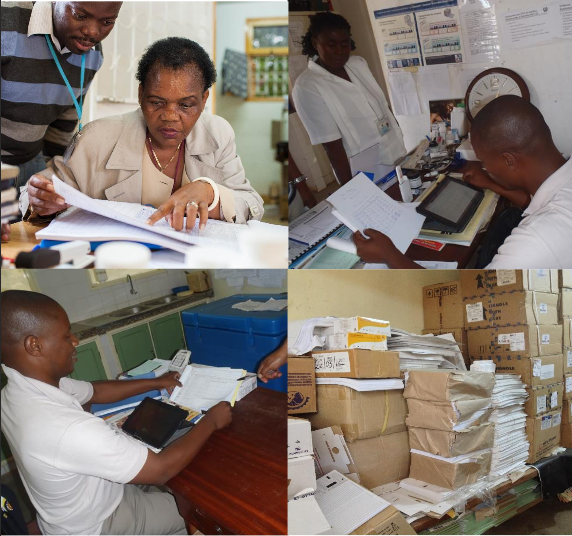
- the role of dedicated logisticians for improved data collection - They are responsible for data collection from the health centre, a process which confirms the quality of the data, triangulating from different sources to confirm validity. One benefit of this approach is that it reduces the burden of data collection on health workers, allowing for focus on patient care, their core skilled task. With this change in the system design and data collection process, the Provincial Directorate of Health (DPS in Portuguese) has insight into relatively real-time data from the health centre level, which can lead to improved decision-making.
- the introduction of an information system used by the dedicated logistician, Sistema Electronica de Logísticas de Vacinas (SELV), built on the OpenLMIS platform for improved data visualisation and analytics - Data are entered either on a tablet directly at a health centre or on a desktop computer upon return to the provincial capital. One beneficial aspect of SELV is the analytical function provided in the monthly reports. The data are presented in graphs for key performance indicators, which provide a quick overview of the performance of the distribution system, and all data points are available for deeper analysis by region, district, and health centre. "The graphs and interactive reports have captured the initial interest of decision makers, which has led to more in-depth analysis, participation, and processes for data utilization from SELV."
- systematised processes for better data utilisation - After each monthly distribution, participatory follow-up sessions are held where the dedicated logisticians review the dashboard with the provincial Expanded Program on Immunization (EPI) manager, medical chief, and the DPS logistics supervisor to identify bottlenecks and ways to improve subsequent distribution activities.
According to the report, these changes in data for management tools and processes are key components to an approach that has led to a more efficient supply chain and higher vaccine coverage rates. In addition, the paper features case studies of other successful global innovations including:
- India's Logistimo's Bulletin Board system, which focuses on the quality and timeliness of data, with an effective service design for data capture and visibility. "With these elements in place, marked behavioral changes related to improved stock management are evident. Vaccine stock availability has increased to 99% and replenishment responsiveness has improved by 64%.
- PATH's Better Immunization Data (BID) Initiative, one component of which is a peer support network designed to empower health workers to proactively seek out solutions through identified champions or high performers. Monthly dashboards are tailored to the context, showing the performance of health centres in a general vicinity. This enables any given facility to reach out to colleagues from health centres that are high performing in any given aspect of supply chain management. BID also incorporates social media groups for health workers, including District Immunization and Vaccine Officers (DIVOs) and Regional Immunization and Vaccine Officers. For example, health workers alerted the social media group about a temporary stock-out, which resulted in a health centre with excess stock quickly working to send stock to the health centre in need. In another instance, a health worker took a picture of a particular report she was having difficulty with and shared the picture with the social media group with a request for assistance on filling out the report, promptly receiving assistance. For health centres where connectivity and cell reception are not available, a 1-page newsletter supplements the monthly dashboard to enable the DIVO to have a regular forum to speak about district-wide challenges or opportunities. The newsletter also highlights champions within the district who can be reached for advice on a particular topic, help resolve challenges, or introduce solutions.
- eHealth Africa (eHA)'s Geospatial Tracking for Polio Eradication, which involves working in partnership with Novel-T to operate a custom Vaccinator Tracking System (VTS) and dashboard, enabling administrators to monitor the movements of vaccinators, view the percentage of area covered, and identify missed settlements. Each vaccinator is supplied with an Android-based mobile phone equipped with a custom tracking application. At the end of each day of the 4-day polio vaccination campaign, the vaccinators' "tracks" are uploaded to a server, missed areas are identified, and new locations are scheduled for campaign "mop-up" days. During each monthly immunisation-plus campaign, eHA provides mobile phones to 12,000 vaccinator teams, harnessing data from 80 local government areas (LGAs) across Northern Nigeria.
This paper has attempted to show that, while the need for data for management to strengthen the vaccine supply chain is clear, the need goes well beyond simply collecting data and filling out reports. Adapted to the low- and middle-income country (LMIC) context for the vaccine supply chain, there is a capability progression that starts with an aspirational stage involving basic data collection, with monthly reports being aggregated and sent up the hierarchical chain. A country at the experienced stage moves to improved analytics and increased ability to share information and insights. Finally, the transformed stage is reflects a culture of analytics and use the information for improved decision making. Global health thought leaders are exploring the details of this progression as they develop the Visibility and Analytics Network (VAN). Led by the Bill & Melinda Gates Foundation, this initiative has brought key global vaccines and supply chain leaders together to lay out key design principles in the areas of: people, process, technology, and policy. "It is encouraging to see the global shift to improved data analytics....The lives of the final 20 percent of children who are not receiving vaccines today are depending on it."