










































Misinformation Lingers in Memory: Failure of Three Pro-Vaccination Strategies
University of Edinburgh (Pluviano, Watt, Della Sala); Suor Orsola Benincasa University (Pluviano)
"Results show that existing strategies to correct vaccine misinformation are ineffective and often backfire, resulting in the unintended opposite effect, reinforcing ill-founded beliefs about vaccination and reducing intentions to vaccinate."
Noting that vaccine hesitancy can be exacerbated by people's continued reliance on discredited information - such as vaccines are not necessary, that they cause autism, or that they contain dangerous chemicals - these researchers undertook a study to investigate debiasing practices used to disseminate correct information concerning vaccines. The problem is that simply retracting a piece of information does not stop its influence, because outdated pieces of information linger in memory.
Among the strategies that have been used to communicate the scientific consensus about vaccination and promote correction of misinformation are the following, which the present study tests:
- The myth vs. fact message frame: reiterating myths and then discrediting them with facts. One problem here is that simply reviewing misinformation may even facilitate memory updating.
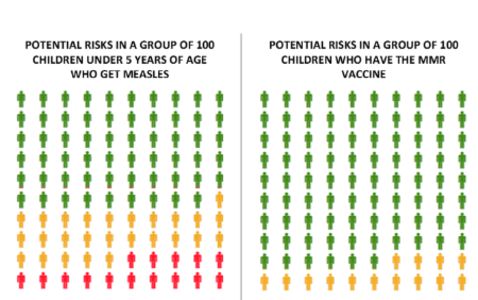
- The presentation of fact/icon boxes: representing information in visual form, using well-designed graphs that can attract and hold people's attention, help the observer to process information more effectively, and facilitate recollection. A "fact box" consists of a table for transparent risk communication, summarising the scientific evidence for a drug, treatment, or screening method in an easily understandable manner. Fact boxes usually show benefits and harms for people with and without treatment in plain frequencies. An "icon box" consists of a visual tool showing 2 groups of individuals: those who underwent a treatment and those who did not. Each individual is represented by an icon indicating benefits and harms.
- The use of fear appeals: using emotionally charged messages that show the possible serious consequences of a disease likely to happen in non-vaccinated individuals.
Two research questions were posed: (i) to what extent can these approaches influence people's vaccination beliefs and behaviour? (ii) do any of these approaches have a comparative advantage in terms of its ability to counter anti-vaccination attitudes, given the persistent effect of misinformation in influencing memory, reasoning, and decision making, as well as the possibility of backfire effects?
Participants were students from diverse departments of the University of Edinburgh, the Suor Orsola Benincasa University of Naples, and the Second University of Naples, resulting in an initial sample of 134 individuals. All participants completed a preliminary survey aimed at assessing baseline beliefs and attitudes towards vaccines and a post-manipulation survey that assessed whether and how participants' beliefs and attitudes toward vaccines changed compared to the baseline measure. Participants could be exposed to one of 4 experimental conditions:
- Myths vs. Facts Correction: Participants received a booklet confronting 10 "myths" with a number of "facts". Each page of the leaflet contrasted a popular erroneous belief about vaccination (e.g., low perception of vaccine efficacy, safety concerns about immune overload, etc.) with established evidence intended at decreasing the acceptance of that myth.
- Visual Correction: Participants viewed a series of tables comparing the potential problems caused by measles, mumps, and rubella (MMR) with the potential side effects caused by the MMR vaccine. In order to test the effectiveness of graphic material as a communication device, the MMR Decision Aid presented in the NCIRS' (National Centre for Immunization Research & Surveillance) website was adapted for this intervention.
- Fear Correction: Participants were presented with pictures of unvaccinated children with MMR, along with a description of the symptoms of each disease and a brief warning about the importance of vaccinating one's own child. The brief warning in the instructions, formulated in personalised language (i.e., "The following images show some of the consequences you may face choosing to not vaccinate your child"), were intended to increase perceptions of susceptibility.
- Control: Participants read 2 unrelated fact sheets containing tips to help prevent medical errors and get safer healthcare.
After the experimental intervention, participants completed the post-manipulation survey (Time 1); after a 7-day delay, they participated in the second wave of the study, during which the same questions of the post-manipulation survey were asked again (Time 2). This delay was meant to help evaluate the effectiveness of the aforementioned strategic messages over time, with a particular interest in explaining possible backfire effects. Three outcomes were evaluated: (i) individual beliefs in vaccines causing autism and (ii) side effects, and (iii) intention to vaccinate (vaccine hesitancy).
To summarise the results in brief, the researchers found that the myths vs. facts format, at odds with its aims, induced stronger beliefs in the vaccine/autism link and in vaccines side effects over time, lending credit to the literature showing that countering false information in ways that repeat it may further contribute to its dissemination. Also, the exposure to fear appeals through images of sick children led to more increased misperceptions about vaccines causing autism. Moreover, this corrective strategy induced the strongest beliefs in vaccines side effects, highlighting the negative consequences of using loss-framed messages and fear appeals to promote preventive health behaviours. The findings also suggest that no corrective strategy was useful in enhancing vaccination intention. Compared to the other techniques, the usage of fact/icon boxes resulted in less damage but did not bring any effective result.
The researchers conclude that this pattern of results confirms that there should be more testing of public health campaign messages. "This is especially true because corrective strategies may appear effective immediately yet backfire even after a short delay, when the message they tried to convey gradually fades from memory, allowing common misconceptions to be more easily remembered and identified as true." Multiple explanations have been proposed for the continued influence of misinformation, and the researchers review some of them. However, regardless of the process, they say that "a golden strategy capable of overcoming all the intricacies of setting people straight, regardless of their basic beliefs and/or temporal shifts, does not exist." That said, perhaps this work "can help public health authorities and practitioners to understand why it is necessary to adopt an appropriate strategy to influence people's beliefs and behaviours toward vaccination, which can result in better health outcomes..."
PLoS ONE 12(7): e0181640. https://doi.org/10.1371/journal.pone.0181640
- Log in to post comments