





























Introduction of Inactivated Poliovirus Vaccine in the Philippines: Effect on Health Care Provider and Infant Caregiver Attitudes and Practices
University of the Philippines Manila (Lopez, Raguindin, Aldaba, Morales, Sylim); Centers for Disease Control and Prevention, or CDC (Harris, Wannemuehler, Wallace, Ehlman, Hyde, Hampton); World Health Organization (WHO), Regional Office for the Western Pacific (Fox, Nyambat); Department of Health (Ducusin)
The introduction of inactivated poliovirus vaccine (IPV) to the Philippines' national immunisation schedule meant the addition of a third injectable vaccine at a child's 14-week immunisation visit. Although previous studies have shown that providing multiple vaccines at the same time affected neither the risk of severe adverse events nor vaccine efficacy, concerns were raised that providing 3 injections at a single visit, with 2 injections in 1 leg, might be unacceptable to health care providers (HCPs) and infant caregivers. This study documented perceptions and experiences on the introduction of a new injectable vaccine into an increasingly busy immunisation schedule.
As part of the global cessation of use of the trivalent formulation of oral polio vaccine (tOPV, containing attenuated strains of types 1, 2, and 3 polioviruses), the Philippine national immunisation programme switched from tOPV to the bivalent OPV formulation (bOPV, containing attenuated strains of types 1 and 3 polioviruses) in 2016. Prior to the worldwide cessation of tOPV use, the Global Polio Eradication Initiative (GPEI) recommended that countries IPV into the national immunisation schedule to help protect children against type 2 vaccine-derived polioviruses should they circulate after tOPV use discontinuation. Adhering to this GPEI recommendation, the Philippines introduced IPV in 2014 using a phased approach across its 17 regions, with introduction completed nationwide in 2016.
To understand the acceptability of multiple injections in the Philippines, a populous lower-middle income country, the researchers conducted pre- and post-IPV introduction surveys in 3 of the Philippines' 17 administrative regions. Regions 3 and 6 were included in the pre-introduction phase, and Regions 3, 6 and 10 were included in the post-introduction phase. Thirty public health centres (PHCs) were randomly sampled from each region. Eighty-nine HCPs and 286 infant caregivers were interviewed during the pre-introduction phase, and 137 HCPs and 455 caregivers were interviewed during the post-introduction phase. In addition, vaccination records from a minimum of 20 eligible children pre-introduction and 10 children post-introduction per PHC were reviewed.
Among 986 vaccination records reviewed post-introduction, 84% (n=826) of children received all 3 recommended injections at one visit. The proportion of HCPs reporting that they had administered 3 or more injectable vaccines and the proportion of caregivers that would be comfortable with their child receiving 3 or more injectable vaccines at one visit increased from pre- to post-introduction (p<0.0001 for both). Eighty-seven percent of HCPs who had administered 3 or more injectable vaccines post-introduction reported being comfortable or very comfortable with the number of vaccines they had administered. Acceptance increased after HCPs and caregivers had experience with this practice.
A factor in HCPs' reluctance to administer 3 vaccines is the overestimation of parental concerns. In the study, in PHCs where fewer than 90% of children received all 3 vaccines, none of the HCPs believed that all caregivers would accept multiple injections. However, among caregivers whose children did not receive all 3 injections, the majority stated they were not offered all 3. According to researchers, it is likely they would have accepted the 3 injections if offered, as overall acceptance was very high.
Among 165 caregivers who were comfortable with 2 or fewer vaccines post-introduction, the top reason cited was fear of adverse events (61%, n=100). Among 300 caregivers who were comfortable with 3 or more vaccines or any number recommended by the HCP, the most cited reasons were trust in the HCP or the immunisation programme (54%, n=161) and better protection against diseases (50%, n=151). A majority of caregivers in all regions and both phases believed that HCPs could be trusted with the number of vaccines that children should receive and that following the vaccination schedule is good for the children.
The study showed that attitudes do not always align with practices; for example, some caregivers stated they were comfortable with their child receiving only 1-2 injections at a visit yet allowed their child to receive 3. Similarly, some HCPs stated they would be willing to administer only 1-2 injections to a child at a visit, yet they administered 3 injections.
The information generated from this study was used to design training and educational packages for HCPs and the general public in the Philippines.
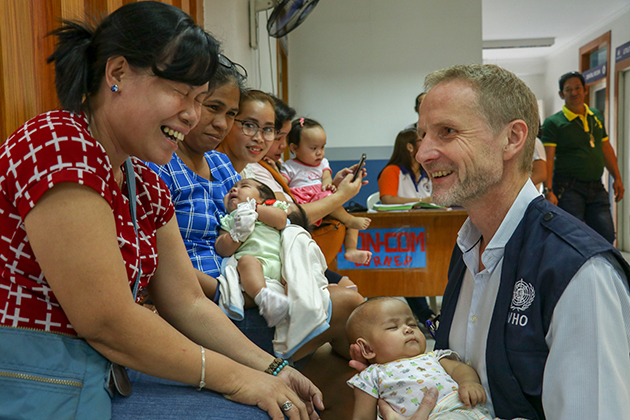
Vaccine Volume 36, Issue 48, 19 November 2018, Pages 7399-7407. https://doi.org/10.1016/j.vaccine.2018.09.028. Image credit: WHO/F. Tanggol