










































'A Matter of Commonsense': The Coventry Poliomyelitis Epidemic 1957 and the British Public
London School of Hygiene & Tropical Medicine
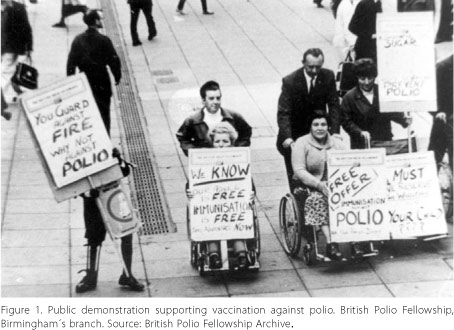
In 1956, the British Ministry of Health instituted a vaccination programme against poliomyelitis that was hampered by a myriad of supply and administrative issues. When Coventry, a city in England, experienced a polio epidemic in 1957, it came to symbolise these problems. The media made a series of accusations about government incompetence at the local and national levels, claiming that the outbreak was an avoidable tragedy. This article explores how and why "common sense" was used as a rhetorical weapon in the debates over policy at the local and national level and examines the deeply held beliefs about vaccination and disease underlying these arguments.
This article focuses on the rhetorical uses of the concept of common sense in Britain's political discourse. As author Gareth Millward explains, on some level, the people have to trust that experts can identify and solve problems in the common interest. Similarly, expertise has to prove its ability to do so and to communicate this effectively to the public. In the realm of public health, "evidence" became used in "policy" increasingly from 1945 onward. Yet in the debate over Coventry's 1957 epidemic, multiple publics could be invoked in multiple media and, as Millward goes on to show, multiple "common" senses. The question is, who was wielding common sense as a weapon, how did they do it, and who did they claim to represent?
The analysis uses internal files from the Ministry of Health and the Medical Research Council (MRC) to investigate the government's approach. Coventry History Centre also holds the records of the City Council minutes and the Medical Officer of Health's reports. From the media, a mix of local and national press is considered.
According to Millward, the reason Coventry became a rhetorical battle ground in 1957 was bound up in recent medical and technical developments in the treatment and prevention of poliomyelitis. He details these developments. In 1955, the University of Michigan announced in front of the world's media that an anti-polio vaccine developed by Jonas Salk had been shown to be safe and effective in a massive trial on American children. In short, the British medical authorities were convinced that it was possible to make a more potent and safer version of an inactivated polio vaccine. As part of a long course of events, detailed in the article, the British Medical Journal (BMJ) accused the government of using polio vaccine as a public relations exercise, and, initially at least, failing to inform the medical press about the specifics of the vaccine. It is into this context, then, that the 1957 epidemic in Coventry was born. Coventry had found itself victim to supply issues, with only 6,000 of its 11,000 registered children receiving the vaccine.
Common sense was a recurring trope in the coverage of the epidemic. The national press was already agitated by what appeared to be mismanagement by the Ministry of Health. Medical authorities appealed for calmer heads and recognition of the need for compromise at times of shortage. The local press and politicians, meanwhile, argued that technocratic and bureaucratic rigidity was overriding the wishes and rights of the city's population. Throughout, common sense was invoked in different ways by different authorities claiming to represent different constituencies (or "publics"). To demonstrate this in the context of the Coventry epidemic, Millward considers two distinct, but entwined, issues: the refusal of the Ministry of Health to redirect vaccine supplies to Coventry; and the refusal to accept vaccine from foreign suppliers when it was offered.
Millward observes, throughout the discussion, that "The British public and medical authorities had indeed blown 'hot and cold' on immunisation, and not just in 1957. It appeared that common sense could very quickly be brought into view by circumstances. England in particular had a long history of anti-vaccination sentiment from the nineteenth century, stemming in large part from opposition to compulsion measures in Victorian public health legislation....The Ministry of Health had high hopes that newer vaccinations against whooping cough and polio would see greater demand because parents still feared those diseases. But again, polio stands as an example of how parents were hesitant to give a new, untested vaccination to their children....It was only in the wake of an epidemic - seemingly fuelled by government mishandling - that it became 'common sense' to increase the availability of vaccine."
Millward continues: "Cultural memory of vaccination and public understanding of infectious disease helped to mould common sense. Thus, opinions and policies that drew on these memories could be framed as common sense and used to defend a political position. For the local press and politicians opposed to government policy, common sense offered protection against attitudes that were seen as technocratic, uncaring, 'rigid' and 'unduly harsh'....The wisdom of the public could go up against medical and expert knowledge to fight for concessions. At the same time, 'informed opinion' offered a spin on common sense....Still rooted in the reasoning and logic of the people, the Lancet could criticise government policy,...while the BMJ could argue that, once the public understood some of the key details, their opinions would be swayed.....This exposes a core tension in many of the arguments. Those wanting to wield common sense needed enough expert evidence to avoid the charge of ignorance, while simultaneously appealing to the innate knowledge and reasoning skills of the common man. They needed enough emotion to break down the heartless technocratic approach to disease prevention, but not so much that they appeared to be knee-jerk, panicked reactions."
In conclusion, Millward suggests that further study is needed on which forms of "expertise" have been able to sway common sense in different times and circumstances. But the idea of using a mass vaccination programme, centrally controlled and based on cutting-edge medical technology, was at the heart of the Coventry polio crisis. "From the sources consulted, nobody seriously challenged the idea of a technocratic solution to the scourge of poliomyelitis in Britain. Common sense was employed as a watchdog, to make sure technocracy remained fair and worked how it was supposed to. There was not a simple battle between the rational and the irrational. Rather, the two were intertwined and inseparable."
Contemporary British History. 2017 Jul 3; 31(3): 384–406. doi: 10.1080/13619462.2016.1247701. Image credit: British Polio Fellowship