











































Communication Ecologies: Analyzing Adoption of False Beliefs in an Information-Rich Environment
Northwestern University School of Communication (Walter); University of Southern California (Ball-Rokeach, Xu); Fordham University (Broad)
A media landscape in which individuals are exposed to a diversity of messages anytime, anywhere, and from a great variety of sources can complicate the measurement of media exposure. This article offers a method to map and analyse communication ecologies - defined as the networks of communication connections that individuals depend on in order to construct knowledge and achieve goals - as social networks. Scientific topics are rife with conspiratorial thinking and misinformation, perhaps accentuated by the fact that the United States (US) public has become increasingly polarised in their attitudes toward science-related issues. To demonstrate the potential of communication ecologies as an analytical tool in science communication, the article reports on the results of a feasibility study in the context of climate science and vaccine safety.
The authors explain why exposure to science information should be evaluated through an ecological lens, enabling us to examine the interplay between different information resources and their mutual influence on relevant outcomes. For instance, daily viewing of cable news is, perhaps, not sufficient to encourage skepticism toward vaccine safety; however, when this behaviour occurs in tandem with exposure to a local newspaper that gives voice to vaccine deniers, weekly visits to a church with a large number of vaccine skeptics, and vaccine-related misinformation disseminated on social media and presented as facts by prominent individuals from both sides of the political aisle, then people might gradually become skeptics themselves.
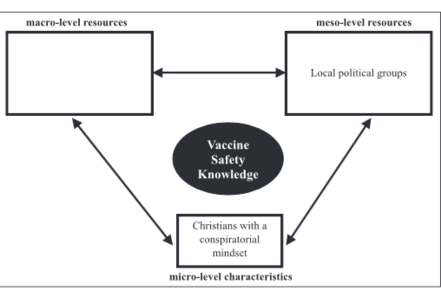
To this end, rather than focusing on a single source of media exposure or interpersonal interaction, the authors look through the lens of an individual's communication ecology. This multilevel network can include communication resources that cut across the micro- (based in sociodemographic characteristics and interpersonal connections), meso- (including local media and community-based organisations or institutions), and macro- (e.g., mainstream legacy media) levels.
The authors propose a network approach to measure and analyse the effects of different types of individual communication ecologies on misinformed scientific beliefs. In short, different communication resources intersect as they operate within the same ecological system, such that the ability to link these diverse sources together allows analysts to create a more complete information profile.
To answer their research questions, the authors conducted an online survey among 654 US adults. The questionnaire assessed respondents' beliefs in climate science and vaccine safety, measured meso- and macrolevel communication ecologies, and included various sociodemographic measures. Mesolevel resources included 6 different categories of local groups (i.e., recreational groups, cultural/ethnic groups, religious groups, neighbourhood groups, political groups, and educational groups) and 3 categories of media resources (i.e., local TV stations, local radio stations, and local newspapers). This resulted in a bimodal network that included 2 different types of nodes (people and mesolevel resources). Essentially, this is an affiliation network that linked people with mesolevel resources. The macrolevel ecology was gauged by providing respondents with a list of 7 macrolevel resources (i.e., websites/apps, social networking sites, national network TV stations, national cable TV stations, national radio stations, national print newspapers, and national magazines) and asking them to choose the ones that are relevant to them.
Results are shared. For example, with regard to misinformation in the context of vaccine safety, religious affiliations, including Catholic, Protestant, and other Christians, as well as having a conspiratorial mindset were significantly associated with misinformation. Individuals who identified as Protestants, Catholics, or other Christians were more likely to perceive vaccines as being unsafe compared with atheists/agnostics or unaffiliated respondents. Furthermore, having a conspiratorial mindset was associated with an increase in concerns over vaccine safety. Although there were no significant interactions among different levels of analysis, the mesolevel ecology was a significant predictor of beliefs in vaccine safety. In total, the regression model accounted for 9% of the variance in beliefs associated with vaccine safety.
According to the authors, the current study advances the literature, as it goes further to outline the mesolevel resources that predict people's beliefs in vaccine safety. Specifically, affiliation with local political groups was negatively associated with trust in vaccines, whereas local newspapers emerged as an information resource that carries positive influence for people's belief in science. Keeping in mind that the resurgence of antivaccination movements is associated with specific geographical enclaves, it stands to reason that local politics may play a much more important role in shaping vaccine-related beliefs than people's political leanings as democrats or conservatives. In line with the common notion that all politics is local, communication ecologies treat political ideology not as a monolithic construct but, rather, as a multilevel predictor that can be manifested in various choices.
In contrast to previous studies that measured the presumed effects of various information resources in isolation, the ecological approach advocated here does not assume independence between information resources. In line with the information-rich reality of the modern world, the proposed approach accounts for the fact that communication is always interdependent - either because legacy media provide content for social media or due to the fact that media diets tend to be relatively homogeneous. Thus, this article has argued for an ecological approach that investigates the constellation of multilevel and multimodal communication resources with which individuals connect in order to construct knowledge and achieve goals.
Science Communication, Volume 40, Issue 5, Pages 650-668. https://doi.org/10.1177%2F1075547018793427
- Log in to post comments