











































The Impact of Rare but Severe Vaccine Adverse Events on Behaviour-Disease Dynamics: A Network Model
Shiv Nadar University (Bhattacharyya); ICTS, Tata Institute for Fundamental Research (Vutha); University of Waterloo (Bauch)
"[T]hese findings highlight the dangers associated with vaccine rumour propagation through scale-free networks such as those exhibited by online social media, as well as the benefits of disseminating public health information through mass media."
Vaccine decision-making is influenced by a range of factors, including perceived risk of either vaccines or the infections they prevent. Information about adverse events associated with immunisation is often passed from one individual to another through their network of social contacts. Online social media and mass media can serve to disseminate perceptions of vaccine risks to the point that vaccine refusal can significantly impact vaccine coverage and herd immunity. This article develops a social network model of the coupled dynamics of infection spread, vaccinating behaviour, and individual risk perception due to adverse events, either from vaccination or infection. The objective was to study how information (whether true or false) that spreads through social networks can influence vaccinating behaviour.
The paper describes aspects of the model structure in the following subsections: spread of infection, spread of information on adverse events over the network that change the individual perceived risk, and individual vaccination decision-making. In brief, adverse events are perceived to occur to a vaccinated or infected individual, and information about the event spreads to neighbours through a contact network. The researchers model a self-limiting acute infection that can be prevented through vaccination and that spreads through the same contact network. The intensity of the information decays over time as it passes from neighbour to neighbour, in a ripple effect. To observe the effect of contact patterns, they also consider different social networks such as regular lattice, random network, small world network, power law network, and empirically-derived network.
The results suggest that epidemics in the presence of vaccine-adverse events - with or without the presence of infection-adverse events - last 150% longer (300 more days) than epidemics in the absence of vaccine-adverse events. The duration of the epidemic is actually lengthened - not shortened - when infection-adverse events are introduced. This long epidemic tail is due to pockets of unvaccinated individuals who continue to fuel the outbreak in its later stages. This phenomenon suggests that the circulation of stories about vaccine-adverse events not only makes it difficult to achieve elimination due to herd immunity effects, but it may also significantly prolong any given outbreak of a vaccine-preventable infectious disease.
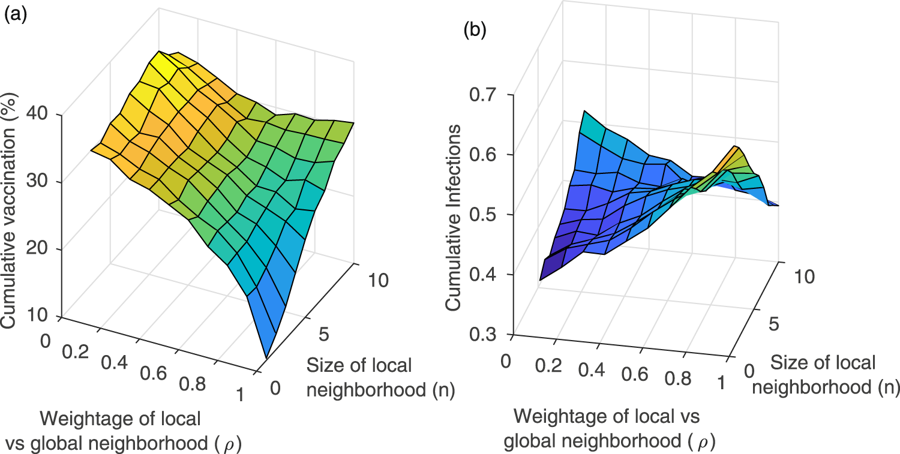
The size of epidemic peak and length of epidemic tail vary depending on whether individuals are using global or local information to determine their perceived infection probability. Compared to the scenario where dissemination of adverse events is local, the epidemic peak is significantly lower in the presence of global dissemination of adverse infection events, with or without the presence of adverse vaccine events. Hence, global dissemination of adverse infection events (such as through mass media) may be a useful public health strategy. (When individuals pay attention to a larger local neighbourhood of the network, they will see more infections, which in turn stimulates vaccine uptake by making the vaccinator payoff more attractive.)
The research found that only small increases in the probabilities of vaccine-adverse events and infection-adverse events from zero are required to have a large impact on the cumulative vaccination coverage, cumulative infections, and number of vaccine and infection-adverse events. Also, doubling the number of adverse events has the same average impact as doubling the severity of adverse events. Furthermore, the average effects of rare but severe events are similar to those of common but mild events in a highly controlled simulation experiment. This can be explained by the observation that rare but frightening adverse events can be disseminated more widely through social networks than mild and commonplace events. The results show that rare but severe events that spread far across a network cause a significant reduction in vaccination coverage, compared to common adverse events that occur very frequently but do not spread very far.
In short: "The propagation of rumours about rare but severe adverse vaccination or infection events through social networks can strongly impact vaccination uptake." There is an important role for public health dissemination of information about global infection prevalence in populations, such as through Canada's Fluwatch programme, CDC FluView, and mass media.
In conclusion: "Models allow us to tease apart the influence of different potential mechanisms, and to explore how coupled behavior-disease systems will respond to different interventions. Thus, public health can use such models to increase vaccine acceptance. For instance, strategies of spreading knowledge through social networks about vaccine preventable diseases, using dramatic narratives and pictures to communicate disease risk, and correcting misconceptions and myths about vaccines...could provide a counterweight to the effects of false vaccine risks spreading through scale-free social networks."
Scientific Reports (2019) 9:7164 | https://doi.org/10.1038/s41598-019-43596-7.
- Log in to post comments