










































Does Support to Private Health Practitioners Increase Childhood Vaccination Coverage? Findings from a Comparative Study in Afghanistan
Health Net TPO (Vink, Upadhaya, Amin, Liwal, Siddiqui, Naseem, Syawash); Amsterdam University Medical Centers, Location Academic Medical Center, or AMC (Vink, van der Loeff); Public Health Service of Amsterdam, or GGD (van der Loeff)
"Critical to the success of the PPP program was the involvement of PHPs themselves."
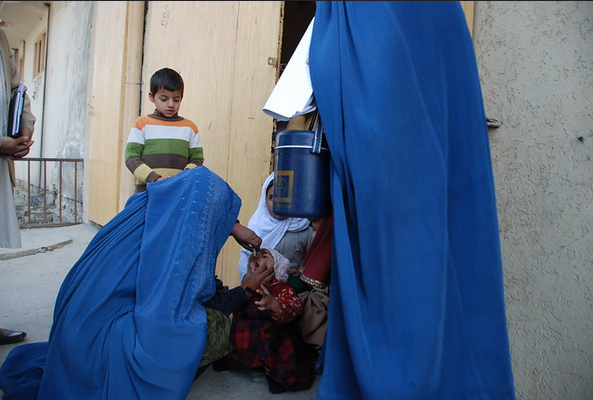
Decades of conflict in Afghanistan have hampered the expansion and uptake of the national immunisation programme. Coverage of childhood vaccinations is very low, especially in remote and insecure areas with a weak public health structure. Private health providers (PHPs) in these areas play an important role in healthcare provision. In 2009, HealthNet TPO, an international non-governmental organisation (NGO) based in the Netherlands, initiated a public-private partnership (PPP) programme in Uruzgan province, training and equipping 34 PHPs in remote and conflict-affected locations to provide childhood vaccination services. This study assessed the impact of the programme on child vaccination coverage.
Prior to the intervention, only 5.7% of the children aged 12 to 23 months in Uruzgan received all necessary vaccinations, and none of the PHPs were administering childhood vaccinations. Thirty-four private practitioners working in remote and insecure parts of Uruzgan were selected to participate in a standard 19-day theoretical and practical training. A plan was set up whereby each PHP was expected to vaccinate children residing in or nearby his or her village on a certain day. In prepartion, the PHPs received support and supervision on all their activities, and a private medical association (PMA) was established. For every PHP, a community health shura (Dari/Pasthu word for "consultation") was installed, which served as a forum for health education and community engagement in the work of the PHPs. Furthermore, residents were informed about the importance of childhood vaccinations through local radio and through other information channels.
A cross-sectional household survey was conducted in three districts of Uruzgan Province from January through April 2013. In total, 113 children from 8 PHP villages and 286 children from 18 non-PHP villages were included. Vaccination information, based on vaccination cards and mother's recall, was obtained about all children aged 12-23 months in these households.
A clustered analysis showed that coverage of polio-3, diphtheria-tetanus-pertussis (DTP)-3 and of measles-1 were significantly higher in PHP villages (73.5%, 66.4%, and 69.9%, respectively) than in non-PHP villages (36.0%, 5.2%, and 26.2%, respectively; P < 0.0001 for all comparisons). The proportion of children fully vaccinated (excluding Bacillus Calmette-Guérin - BCG) was 54.9% in the PHP villages and 4.9% in the non-PHP villages (P < 0.0001).
In polio-endemic provinces like Uruzgan, monthly mass vaccination campaigns are organised. Vaccinated children in non-PHP villages were mainly vaccinated during mass vaccination campaigns (92.5%), while in PHP villages this was done by PHPs (47.2%) or a combination of PHPs and mass vaccination campaigns (39.2%). These PHPs offer a complete vaccination package (DTP, polio, measles), while the mass vaccination campaigns in these villages only provide polio vaccinations. As a result, many children in non-PHP villages are only partially vaccinated or non-vaccinated.
In a national household survey in Afghanistan cited here, mothers of children who were never vaccinated were asked for their reasons. The main reasons given were long travel distance to the place of vaccination (40%), lack of faith in immunisations (34%), not being aware of the need for vaccination (33%), travel security concerns (22%), and the absence of a male family escort during the journey (21%). The PPP programme works to address these concerns: In remote villages without public health services, locally known and trusted PHPs educate parents about the need to vaccinate their children and then administer these vaccinations. As reported here, the PHPs are also trusted by the warring factions, which means they can work relatively easily in insecure areas, unlike government health workers (including vaccinators). Local villagers may be afraid to visit government health workers due to fear of reprisal.
Reflecting on findings, the researchers point to the significance of the fact that PHPs are recognised as serious partners in the health system. The extra support provided by the PPP programme (trainings, renovations of their health facilities, and provision of equipment, vaccines, and drugs) improved their status towards clients and attracted new clients. Through a strong supervision element, the activities of the PHPs were closely monitored, which reinforced the legitimacy of the activity.
In conclusion, the researchers "strongly believe that this approach could also prove useful in other countries struggling with insecurity, poor infrastructure and an insufficient public health sector to meet population health demands."
Vaccine, Volume 39, Issue 35, 16 August 2021, Pages 5007-14. https://doi.org/10.1016/j.vaccine.2021.07.018; and email from Martijn Vink to The Communication Initiative on August 25 2021. Image credit: © EU - photo by EC/ECHO/Pierre Prakash via Flickr (CC BY-ND 2.0)
- Log in to post comments