










































Addressing Myths and Vaccine Hesitancy: A Randomized Trial
Macquarie University (Steffens); The University of Sydney (Dunn, Leask); La Trobe University (Marques); Murdoch Children's Research Institute (Danchin); The University of Melbourne (Danchin); Laval University (Witteman)
"This study has implications for how health professionals, global health authorities, and other advocates of vaccination debunk vaccine misinformation in written text."
Shared in social networks, vaccination misinformation may fuel hesitancy/refusal and contribute to vaccine-preventable disease outbreaks. One frequently used strategy to counter misinformation is to repeat specific examples of myths before debunking them, but the worry is that repeating a myth may backfire by rendering it memorable and thus likely to be recalled as true on the basis of recall and familiarity. The aim of this study was to compare how different text-based debunking strategies affect parents' agreement with vaccination myths and their intention to vaccinate their children.
In late 2019, 454 Australian parents of children aged 0 to 5 years took part in an online experiment. At baseline, participants responded to myth agreement, intention to vaccinate, and vaccine confidence items. They were randomly assigned to receive 1 of 3 debunking interventions or a control text:
- The myth intervention repeated the vaccination myths ("Myth: Vaccines overwhelm a baby's immune system") in the headings before providing corrective text, which was the same for each intervention.
- The question intervention posed questions ("Can vaccines overwhelm a baby's immune system?") in the headings before providing corrective text.
- The statement intervention made factual statements ("A baby's immune system is able to respond to a vaccine and fight germs at the same time") in the headings before providing corrective text.
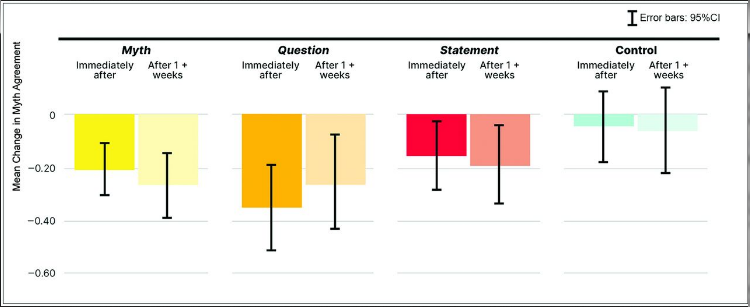
The researchers measured changes in agreement with myths and intention to vaccinate immediately after the intervention and at least 1 week later.
There was no evidence that repeating myths increased agreement with myths compared with the other debunking strategies or the control. Posing questions significantly decreased agreement with myths immediately after the intervention compared with the control. There was no evidence of a difference between other debunking strategies or the control at either time point, or on intention to vaccinate.
In a subgroup analysis of moderate- to low-vaccine-confidence participants, there was no evidence of significant differences between groups in the change in myth agreement from baseline, at either time point. There was no difference in intention to vaccinate between groups at either time point.
Analysis by individual myth suggests that some misperceptions about vaccines, such as the superiority of "natural" disease-acquired immunity and time-based safety concerns, are more persistent than other myths.
In short, this study's findings suggest that posing myths as questions may be an effective debunking strategy when paired with corrective text. It also shows that repeating vaccination myths is not necessarily harmful. The researchers caution that any repetition of myths should be done judiciously and be accompanied by corrective text, because familiarity may still lead to myths being misremembered as facts. Furthermore, repeating new or obscure misinformation may unintentionally help disseminate it to broader audiences - e.g., via social media platforms. "Experiments with vaccination misinformation specifically would be worthwhile conducting, as would further investigations of the relationship between novel vaccine misinformation and social media amplification."
Pediatrics October 2021, e2020049304; DOI: https://doi.org/10.1542/peds.2020-049304.
- Log in to post comments