










































#Antivaccination on Instagram: A Computational Analysis of Hashtag Activism through Photos and Public Responses
Hankuk University of Foreign Studies (Kim, Song); Korea University (Lee)
"[A]ctivism via hashtags can foster confirmation bias, and concern has been increasing about its possible harm to the society - for example, the breakdown of herd immunity."
A hashtag is a brief keyword prefixed by the symbol # (hash) included in social media posts in order for them to be easily searched for. Hashtag activism occurs when individual users devise tags that manifest their belief on an issue concisely and attach them to their social media posts; similarly, users or activists who support or approve of their belief use the same tag to show their endorsement. Hashtags may worsen the tendency of networking only with likeminded users or paying attention only to posts with similar viewpoints (confirmation bias). This research analysed Instagram photos with antivaccination hashtags as an example of hashtag activism through photos. In addition, the researchers examined how the photo features were related to public response, which was manifested via engagement and comment sentiment.
Data were gathered from June 13 to 20 2019, using the following hashtags for searching: #antivaccination, #antivaccine, #antivax, #antivaxmemes, #antivaxxer, #informedchoice, #informedconsent, #vaccineinjuryawareness, and #vaxxed. After removing duplicates, 96,302 photos in total were used for computational analysis, and 513,694 comments and 12,579,345 likes accompanying the photos were collected and analysed.
The major findings are as follows:
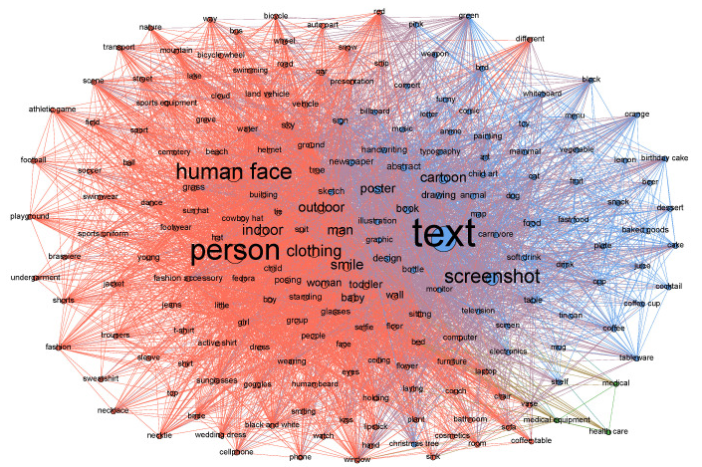
- The photos that were categorised into the category of "text" took the largest share (more than half) among Instagram photos with antivaccination hashtags. This indicates that, while antivaccination posts were uploaded on the photo-centric platform, the photos manifested their idea mainly through the text imprinted on them. Texts imprinted on photos usually draw attention more easily due to their large size and variety in colour and font.
- The primary means of delivering messages in antivaccination Instagram posts was found to be imprinting key messages persuading people not to vaccinate through words imprinted on the photos, including remarks from professionals, and providing the source of more information in the post text with hashtags of antivaccine intention. Citing remarks from professionals on the photo-imprinted text can be an effective strategy of persuasion, because it can make the content look more convincing. Including the source of detailed information in the post text separately can also make it easier to reach the source via hyperlinks.
- Concerning public responses, engagement and comment sentiment appeared to be separate domains, revealing different responses. The more words that were imprinted on photos, the higher the level of engagement the photos induced, but the less positive comments they had. Moreover, the predictability of photo features was different in terms of engagement and comment sentiment: The former was predictable by photo features with acceptable accuracy, while the latter was not. These results suggest that messages can be designed differently depending on whether they aim to obtain more likes and comments or to induce more positive responses from the public.
- Some of the low-level features (pixel and visual features, as contrasted with high-level (content-level) features) showed significant correlations with public responses. The features whose high values made the colours of photos splendid were negatively associated with engagement, but those whose high values make photos look bright were positively correlated with engagement. The opposite was noted regarding comment sentiment: The features whose high values would make the colours of photos splendid were positively associated with comment sentiment, but those whose high values made photos look bright were negatively correlated with comment sentiment. These results suggest that photos with particular low-level characteristics can appeal more to the public.
In conclusion: "Concerning antivaccination movements, it needs to be noted that it can be considered as disinformation based on conspiracy theories, hoaxes, and rumors. It is not only an example of confirmation bias in social media but also disorienting public opinion or generating noise. Thus, it should be warned equally against the side-effects of social media that enable connections among only like-minded people and social activities based on anti-social norms. The combination of these two threats would cause serious harm to individuals' health as well as to society at large. In this regard, future studies will have to explore the motivation, context, and personal experiences concerning why social media users are engaged in these confirmation biases in general and the antivaccination movement in particular. Additionally, we can investigate in future studies how the word difference (e.g., scientific vs. emotional words...) in social media posts would influence the response from the public."
International Journal of Environmental Research and Public Health 2020, 17, 7550; doi:10.3390/ijerph17207550.
- Log in to post comments