










































Engaging Influencers: Building Trust
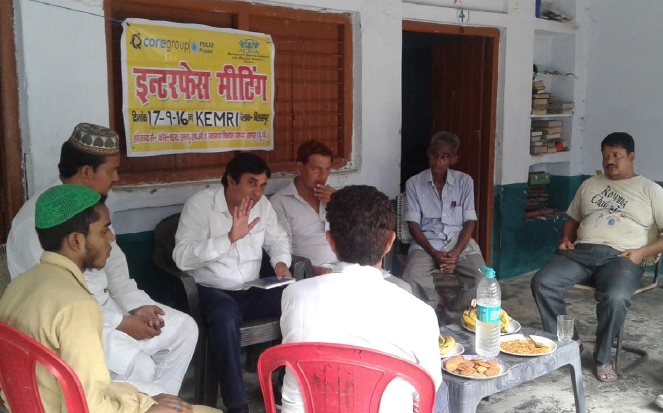
India's quest to eradicate polio from the country was complicated by, among other factors, misinformation about the polio vaccine that led elders and local leaders to fail to support - or even to discourage participation in - immunisation programmes. This chapter from the document Influencing Change (see Related Summaries, below) details the key elements of one of the CORE Group Polio Project (CGPP)'s central social and behaviour change strategies: identifying and involving members of the community who had social, political, and economic influence in their community. They sanctioned behaviours and actions, were a source of credible information, and would therefore be able to apply social pressure to motivate their community members to change their resistant attitudes towards polio.
The CGPP team used their existing networks to identify influencers in the community. These influencers were not a homogenous group and comprised the following categories of individuals, who were respected and had a mass reach in their communities: local political leaders, local religious leaders, local ration suppliers and dealers, local healthcare providers and traditional healers, shop owners, family-based influencers, government community workers, schoolteachers, brick kiln owners, and other occupation-based leaders.
Initially, the involvement of influencers only produced short-lived results, as the resistance was broken only for one round of immunisation. Realising that this may be due to the fact that the influencers themselves were not convinced of the reasons and benefits of immunisation, efforts were made to involve influential leaders in supporting community mobilisers during group meetings and house visits. Some of these efforts entailed:
- Community mobilisers would map and identify influencers in the community who could work with them as their allies and help build positive perceptions, attitudes, and behaviours before every Pulse Polio round. In some cases, influencers outside the community were also identified and approached.
- Meetings were held with the identified influencers to motivate and sensitise them to join the immunisation efforts. They were shown the film "Science of Polio" to provide information about the virus and its prevention in order to allay any concerns.
- The selected influencers received training on the importance of polio immunisation and were provided with a small booklet for their reference and for answering questions raised by the community about polio vaccination. In some cases, the literacy levels of influencers posed a challenge, which prompted the CGPP communication team to develop pictorial aids for influencers.
- Interface meetings were conducted prior to each polio round, during which resistant families in the village were identified, and attendees took responsibility to talk to them and persuade them to get their children immunised at the next round.
- Some of the influencers provided logistical support and a venue for the vaccination teams to hold their meetings, and for setting up vaccination booths. In some communities, influencers were invited to inaugurate and address polio booth day activities.
- With the support from the Shahi Imam, CGPP relied on the help of Imams, Maulanas, and Aalimahs to support immunisation efforts in communities with majority Muslim populations. The social standing of these religious leaders and scholars enabled them to bring people together, dispel myths and misconceptions around vaccinations, and promote positive changes. Religious leaders would speak in favour of immunisation in their sermons, from the pulpit (minbar) and in other religious and social gatherings. Announcements of vaccination drives/days were made by Imams from mosque loudspeakers, providing information about booth venues and timings. Another avenue to reach the community was through the religious group meetings called Ijtemas, which were held separately for men and women.
CGPP explains that long-term involvement of influencers was a major challenge. To motivate and sustain the influencers, meetings were therefore held regularly to reward their participation and achievements. They were given certificates of appreciation and were also involved in district task force and community-level planning meetings.
Reportedly:
- Involvement and support of influencers helped to build positive perceptions, attitudes, and behaviours, and provided credibility to the polio programme. Their participation demonstrated that the goal of polio eradication was not imposed from the outside, but was owned by the community.
- As per recorded social mobilisation activities undertaken by CGPP partners in Uttar Pradesh (UP) over a year (October 2011-September 2012), more than 15,000 mosque announcements were made during supplementary immunisation activities (SIAs) about polio immunisation and when and where children can be vaccinated. Over 8,000 meetings were held with influencers during the same period.
- Households resistant to polio vaccination ("X" houses, where not all eligible children were vaccinated) reduced significantly in areas covered by CMCs. In a review by Singhal (2013), local influencers who accompanied mobilisers and vaccination teams during house-to-house activities more than doubled over a 2-year period (from 37% in January 2006 to 85% in February 2008). The mean percent of "X" households that were converted to "P" (all eligible children vaccinated) during the vaccination campaign was higher in CMC areas, on average, than in non-CMC areas (see Figure 10).
According to CGPP, as the role of influencers played an important part in allaying the fears and resistance of communities and families, this approach should be replicated or adapted in other settings. Key CGPP staff were asked about their insights around involving influencers for those wanting to use this particular strategy. Rina Dey, Behaviour Change Communication (BCC) Advisor, stressed the importance of involving the community in identifying the influencers. To identify household-level influencers, the programme needs to not only know their community very well, but also to have the trust of and access to households/women, before proceeding. Manoj Choudhary, Monitoring and Evaluation (M&E) Advisor, said, "instead of involving the influencers on a regular basis, they should be engaged when there is absolute need. Otherwise, their influence may wane and people may not listen to them after some time".
Editor's note: This is Chapter 5 in the document Influencing Change: Documentation of CORE Group's Engagement in India's Polio Eradication Programme, which is a collaborative effort of the CGPP and The Communication Initiative. Please see Related Summaries, below, to access it in its entirety.
Image credit: CGPP
- Log in to post comments