










































The Expanded Program on Immunization in the English- and Dutch-Speaking Caribbean (1977-2016): Reasons for Its Success
Pan American Health Organization, or PAHO (Lewis-Bell, Irons); Ministry of Health, Barbados (Ferdinand); Ministry of Health, Bermuda (Jackson); University of the West Indies (Figueroa)
"Strong political will, reflected in financial, policy, and legislative support; a cadre of well-trained, competent, and committed staff; and collaboration with civil society to ensure the confidence and support of the community are essential in any health program."
This report describes the strategies that have helped the Expanded Program on Immunization (EPI) in the English- and Dutch-speaking Caribbean achieve high vaccine coverage data and the absence of vaccine-preventable diseases from the top leading causes of childhood mortality. The report was informed by a review of published/unpublished reports and written and verbal accounts of the experiences of Pan American Health Organization (PAHO) Immunization Advisors and national EPI managers.
As detailed here, the EPI was launched by the World Health Organization (WHO) in 1974 and expanded to the English- and Dutch-speaking Caribbean in September 1977. By 1980, it was fully established in the Caribbean Community (CARICOM) member/associate member countries, as well as Caribbean Epidemiology Centre (CAREC) member countries. September 1981 was the first annual meeting for the national EPI managers. Currently, all countries/territories of the English- and Dutch-speaking Caribbean and the Haiti and the French overseas territories are invited to participate - for example, by sharing their experiences and best practices. Peer exchanges across countries to build capacity and augment succession planning for EPI managers are also an integral part of the subregional programme.
More specifically, face-to-face annual meetings "allow for candid discussion among the managers about their program experiences, including innovative strategies/solutions, and challenges. Joint agreement on and planning of key activities for the upcoming year, including campaigns and coordinated approaches to the subregion's goals, such as the introduction of the inactivated polio and human papilloma virus (HPV) vaccines and the switch from the trivalent to the bivalent oral polio vaccine, are some of the positive actions realized through the annual meeting. Relationships established and strengthened throughout the year help provide support for managers, strengthen the program, and facilitate the provision of vaccines to/from countries experiencing over/undersupply to prevent wastage or stockouts. The use of social media platforms (e.g., WhatsApp) for sharing information, strategies, motivational messages, and encouragement in times of natural disasters or other hardship underscores the feeling of program solidarity."
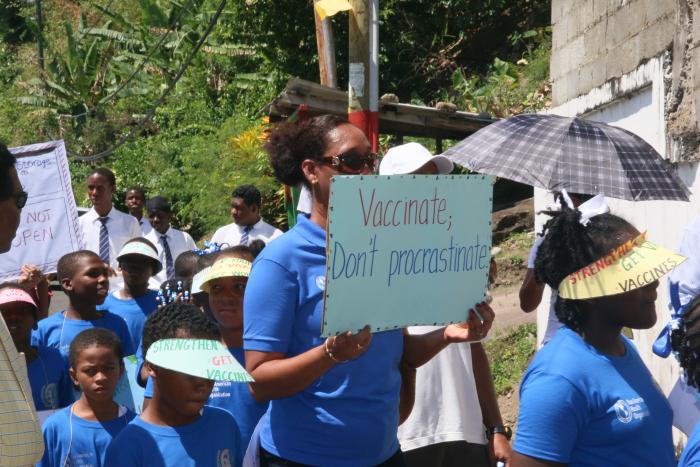
The review found that the English- and Dutch-speaking Caribbean has been instrumental in ensuring the expansion of vaccination benefits population-wide (e.g., actively vaccinating adult risk groups in preparation for and during mass gatherings such as the Cricket World Cup 2007), as well as legislation and awareness (e.g., a subregion-led resolution to the World Health Assembly in 2012 led to World Immunization Week). In fact, health promotion and education is an ongoing part of the immunisation programme and is used to promote the benefits of vaccination, encourage mothers to vaccinate their children at the optimum age, and disseminate information on vaccines. In addition to clinic-based follow-up and recall mechanisms for dropouts from the immunisation programme, vaccines are administered through home and school visits for older children and children who fail to respond to recall messages or at outreach activities such as health fairs.
On the matter of reaching children: "The diversity of the English- and Dutch-speaking Caribbean in terms of ethnicity, culture, religion, and terrain (which includes hills, rainforests, and plains) combined with its small population facilitated the testing of PAHO's elimination strategies for measles and rubella within a short timeframe. Lessons learned in the subregion about accessing hard-to-reach populations were refined and replicated in other countries in the Americas, which became the first region in the world to be certified as having eliminated rubella and CRS (in 2015) as well as measles (in 2016)."
The review finds that strong collaboration with ministries of education and children's services in the English- and Dutch-speaking Caribbean has also contributed to the success of the EPI programme. Through legislation in public health and education portfolios, more than 95% of countries in the subregion have mandatory vaccination requirements for school entry. This facilitates high vaccination coverage for children under 5 years old and promotes joint or synergistic activities for advocacy and social mobilisation. Support for vaccination has also been strengthened through early partnerships with the United Nations Children's Fund (UNICEF), Rotary International, Child Fund (formerly the Christian Children's Fund), and the Canadian Public Health Agency, as well as collaboration with medical and nursing associations and the faith-based community, especially for introduction of newer vaccines such as the conjugated pneumococcal and HPV vaccines.
CARICOM's member states and associate members have kept immunisation high on the agenda of health cooperation in the subregion: In 1988, the CARICOM Health Ministers passed a resolution to eliminate measles by 1995. By 1998, CARICOM had passed a similar resolution for rubella and congenital rubella syndrome CRS (elimination by the year 2000). "The countries in the subregion readily embraced these goals."
In addition to the collective effort, the report names some specific personnel and describes their contributions to the programme. For instance, the first PAHO Immunization Advisor for the English- and Dutch-speaking Caribbean developed a simple data visualisation tool known as the Immunization Coverage Monitoring Chart, which is still being used by all countries/territories in the subregion and was later adopted by WHO for global use. In addition, for the first 25 years of the programme, the former Immunization Chief at PAHO provided the subregion with strategic leadership, guidance, and facilitated innovation, which reportedly helped energise the country teams.
The use of specific strategies to motivate the health team and national EPI managers include incentives such as annual awards (plaques/trophies and certificates) for achievements in surveillance and immunisation coverage. Observation visits, participation in EPI evaluations in the countries, and dissemination of technical and educational materials help build capacity, especially for new EPI managers and surveillance officers. Succession planning for EPI managers (identifying candidates to assume responsibility pending retirements, promotions, or attrition) is also encouraged, and the chosen successor is invited to attend the EPI managers' meeting with the outgoing manager. In addition, efforts are made to keep healthcare workers abreast of the latest developments in the field of immunisation through in-country annual training workshops and the dissemination of educational materials and newsletters.
Finally, to promote immunisation as an integral component of universal health care and avoid the establishment of a vertical programme, all countries in the English- and Dutch-speaking Caribbean integrated vaccination in their primary healthcare systems. In addition, Vaccination Week in the Americas is used by about 50% of countries in the subregion to provide integrated services such as deworming, nutrition assessment, and counseling, as well as screening for chronic noncommunicable diseases.
In conclusion: "The English- and Dutch-speaking Caribbean is proud of its achievements and leadership with respect to the Immunization program, which has been a model for other programs."
Revista Panamericana de Salud Pública/Pan American Journal of Public Health (RPSP/PAJPH) 41. https://doi.org/10.26633/RPSP.2017.127. Image credit: PAHO
- Log in to post comments