










































Experience of the Central African Republic (CAR) in Conducting Vaccination Campaigns in Insecure Areas
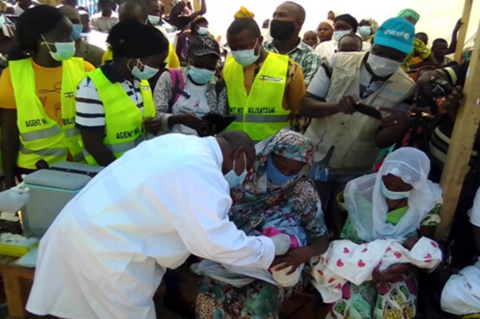
"I am very happy to see the polio vaccination campaign support team today in our locality....Now, through this community dialogue, we are enlightened on all vaccine-preventable diseases. I can better advise my community on how to do it, to ensure that every child has been vaccinated during each campaign." - Baleandji Maxime, a catechist from the Catholic church of Birao, CAR
Since May 2019, the Central African Republic (CAR) has faced an outbreak of circulating vaccine-derived poliovirus type 2 (cVDPV2). Batangafo and Bamingui-Bangoran were among the districts to report confirmed acute flaccid paralysis (AFP) cases. These two districts are highly insecure because they are largely occupied by armed groups. Despite this challenge, the Ministry of Health and Population and its technical and financial partners worked together to organise two rounds of response to the polio epidemic from November 13-15 2020 and from December 4-6 2020. The risk analysis allowed the Vakaga health district (which shares a border with Bamingui-Bangoran) to join Batangafo and Bamingui-Bangoran in the polio response campaign. Both rounds were carried out in this context of high insecurity, drawing on various communication strategies to achieve results.
Given the hostile security situation in the country - particularly in the three response districts - the following strategies were deployed:
- Advocacy at several levels: Liaision officers with the Centre for Humanitarian Dialogue (HD), an international non-governmental organisation (NGO), initiated contact with the armed groups and subsequently carried out missions with the central team composed of HD members and the Ministry of Health. This approach established and maintained a basis of discussion and negotiation with the local leaders of the armed groups. During operational planning meetings with the armed groups, the HD explained the campaign's objectives and strategies in order to engage them. Most of the discussions focused on the vaccination team requesting non-aggression and access to the response districts to vaccinate the children. Thereafter, advocacy activities were carried out with the administrative, religious, and traditional authorities at the commune level. Administrative authorities and armed groups met and held meetings together in order to identify common approaches for reaching all children during the vaccination campaign.
- Social mobilisation, with several stakeholders contributing to the campaign: Among these stakeholders is the Organization of Central African Women (OFCA), which demonstrated the importance of taking into account gender aspects during vaccination campaigns in these areas. The meetings of the social mobilisation committees at the sub-prefecture and commune levels enabled these organisations to fully participate in the campaign's development. For example, women social mobilisers, criers, and community supervisors were sought out. In some areas, women are the only people allowed onto their premises to vaccinate their children. In addition to OFCA, several other members of society contributed to social mobilisation, including economic operators, the association of motorcycle taxis, the association of traditional practitioners, and Central African youth.
- Community dialogues conducted in the various localities: Based on the results of the monitoring and lot quality assurance sampling (LQAS) of the previous campaigns, villages and neighbourhoods with insufficient vaccination coverage or with cases of vaccine refusal were identified to host these dialogues. The participants were representative of the different social strata. Neighbourhood or village leaders facilitated these dialogues with support from health workers. Discussions focused on how to prevent vaccine refusals and ensure that all areas covered by the campaign were visited.
- Launching ceremonies, which were presided over by ministers of the national government: For each campaign round, a launching ceremony was organised. Five ministers were therefore mobilised: three in the first-round ceremony in Batangafo and two in the second-round ceremony in N'Délé. In addition, ceremonies were held in the other districts, presided over by the prefects. These activities, a testament to the commitment of the Central African government, enabled the mobilisation of all stakeholders in the campaigns.
- Interpersonal communication involving several stakeholders, mainly social mobilisers: These stakeholders were chosen from their own village and approved in some cases by community leaders. For six days, these men and women traveled from household to household and settlement to settlement to raise awareness of the need to vaccinate children against polio. In addition, the leaders of the armed groups chose guides to take them to the most remote farming hamlets. This strategy provided parents and caregivers with more information about the reasons for the campaign, the group to be reached, and the campaign strategy, while also responding to their various questions and concerns.
- Mass communication carried out via radio stations and criers: This strategy allowed the population to be informed about the campaign quickly. The campaign area was covered by just four radio stations, giving the criers a significant role in informing parents during this campaign. Neighbourhood and group leaders chose the criers, who traveled through the neighbourhoods disseminating information with megaphones for the three days preceding the campaign. The gender aspect was also taken into account in this strategy.
Immunisation and Vaccines, Polio, Conflict, Gender
Context: The period October to December 2020 coincided with the final preparations for the country's presidential and legislative elections. The electoral process in these localities was hampered by various demands made by the armed groups. This situation made it very difficult to hold vaccination campaigns.
Qualitative results:
- Strong commitment from the leaders of the armed groups and community leaders: All the groups agreed that the children, regardless of gender, language, and religion, should be vaccinated. In some situations, they provided guides to chaperone the teams and supplied mobile logistics to help stakeholders travel.
- No abuse of the vaccination teams.
- Opening of barriers to allow free access to some previously unreached areas.
- Near non-existence or full resolution of cases of vaccine refusal. The few cases of vaccine refusal in the first round were all resolved. There were no refusals in the second round.
- According to the LQAS results, no districts were rejected in the two rounds.
Quantitative results:
- In the last two rounds in November and December, 98% and 99% of parents and caregivers, respectively, were informed before the vaccinators arrived, exceeding the target of 95%. Social mobilisers and criers were the main sources of the information.
- The communication activities have enabled 80,111 and 84,930 children to be reached and vaccinated in the first and second rounds of the campaign, respectively. Independent monitoring has shown that only 4% and 1% of children were missed in the two rounds of the campaign, respectively, meeting the target of less than 5%. In the second round in December, no children were missed due to vaccine refusal.
Lessons learned:
- The choice to engage members of armed groups as social mobilisers, volunteers, and criers made it possible to guide the teams in reaching all the villages and settlements for awareness. This is evidenced by the high level of parental information and the low rate of refusal. Partnerships with these stakeholders are undoubtedly critical to the success of communication activities.
- In some places, armed groups drew up mission orders for the benefit of vaccination and supervision teams, thus facilitating the removal of barriers to access. The involvement of the Central African government through field trips made by various ministers (representing four ministerial departments) is another key factor, as it encourages community involvement in the campaign activities.
- Gender mainstreaming in communication activities has been crucial. The involvement of women and girls in vaccination activities, especially in insecure areas, has yielded significant results. The choice of women as vaccination and mobilisation actors allowed access to certain households that cannot be accessed by men.
- The various communication activities implemented during these two rounds of the campaign generated a strong demand for routine vaccination from parents to protect their children.
Recommendations for applying these strategies in other districts of the country:
- Establish a framework for regular exchanges between vaccination stakeholders and HD.
- Continue influencer and rumour mapping.
- Maintain the collective approach of engagement with all actors at the level of the different localities.
- Maintain the commitment of the highest state authorities through the government.
The Ministry of Health (Minister's Office and Directorate of Primary Health Care); prefects and mayors; UNICEF, the World Health Organization (WHO); the United Nations Office for the Coordination of Humanitarian Affairs; the United Nations Multidimensional Integrated Stabilization Mission in the Central African Republic; Centre for Humanitarian Dialogue (HD); and the Organization of Central African Women (OFCA).
Global Polio C4D Newsletter | Issue 10, August 24 2021; and email from Abdoul Moubark Kabore to The Communication Initiative on August 27 2021. Image credit: Abdoul Moubark Kabore
- Log in to post comments