










































Factors Contributing to the Uptake of Childhood Vaccination in Galkayo District, Puntland, Somalia
Puntland University of Science and Technology (Abdullahi); Umeå University (Williams, Sahlèn, Kinsman); University of Newcastle (Williams); Somali and Swedish Researchers' Association, or SSRA (Bile); Karolinska Institutet (Kinsman)
"It is necessary to understand...not only the factors that drive trust, but also the local perceptions of risks and benefits within different community contexts."
National estimates of coverage for the 6 major vaccine-preventable childhood diseases in Somalia range from only 30-60%. Conducted in Galkayo District, Puntland state, Somalia, this qualitative study investigates limiting factors associated with childhood vaccination uptake from the perspective of both communities and healthcare workers.
In Putland state, 3 strategies are used to reach communities: (i) a facility-based approach that serves communities close to health centres; (ii) planned outreach vaccination sessions for remote rural communities; and (iii) immunisation activities for polio and measles vaccination campaigns, which supplements the routine Expanded Program on Immunization (EPI).
Qualitative information was collected through 6 focus group discussions (FGDs) with parents (n = 48) and 15 in-depth interviews (IDIs) with health workers between March and May 2017, in 3 settings in the Galkayo District. Central results:
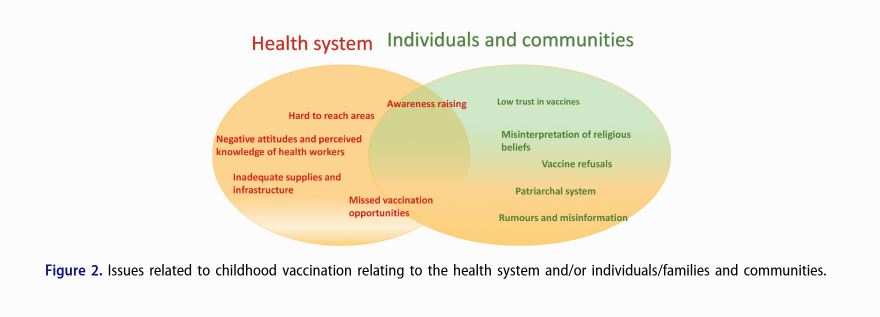
- From a health system perspective:
- Both health workers and parents expressed the view that current awareness raising activities are not sufficiently resourced to convince individuals in the community about the importance of vaccination.
- Poor road infrastructure and the nomadic nature of Somali families are barriers for accessing immunisation in Galkayo. The district is also prone to tribal conflicts, which can restrict the movement of health workers.
- There were claims that some health workers are not well enough trained to promote immunisation programmes, and that some even encourage negative perceptions of vaccines.
- Participants reported inadequate vaccine supplies and infrastructure, as well as missed vaccination opportunities.
- From the perspective of individuals and communities:
- There seemed to be low trust in vaccines - e.g., questions were raised about safety and quality control.
- Some religious sects in the district overtly oppose vaccination; in 2014, religious opposition to vaccination resulted in a measles outbreak in a small village near Bacadwayn.
- Almost half the health workers and many parents agreed that refusals to immunise are the single largest barrier.
- Participants noted that the majority of social mobilisers are female and that mothers (not fathers) are reached during mobilisation activities.
- Participants felt that the health system has failed to effectively engage with the community in dispelling misinformation and false rumours, such as that vaccines contain HIV or sterilisation agents.
Thus, "In spite of well-intended program efforts to increase advocacy, community engagement and health worker capacity...the findings reveal that...[v]accination uptake is hindered by community perceptions, beliefs and cultural norms." In particular, the Galkayo District is a Muslim patriarchal community in which men are the family decision-makers. Women are not permitted contact with non-related men, so the preponderance of female social mobilisers means that fathers are poorly informed about immunisation schedules, available vaccines, and vaccine-preventable diseases; research in Ethiopia showed that this leads to vaccine objection and refusal.
The researchers suggest that fathers' involvement may be boosted by highlighting their obligation to protect their children's health through vaccination. It is also important that men engage with the wider community in collaboratively working towards global vaccination targets. More broadly, the findings highlight the need for in-service training to enable health workers to improve communication with parents, particularly fathers, peripheral communities, and local religious leaders.
In conclusion: "In addition to ensuring that vaccines are supplied to health centres in a timely manner, there is a need to inform and lift community awareness, debunk negative attitudes and behaviors and improve local integration and coordination across services..."
Global Health Action, 13:1, 1803543, DOI: 10.1080/16549716.2020.1803543
- Log in to post comments