










































How to Counter the Anti-vaccine Rhetoric: Filling Information Voids and Building Resilience
University of Zurich
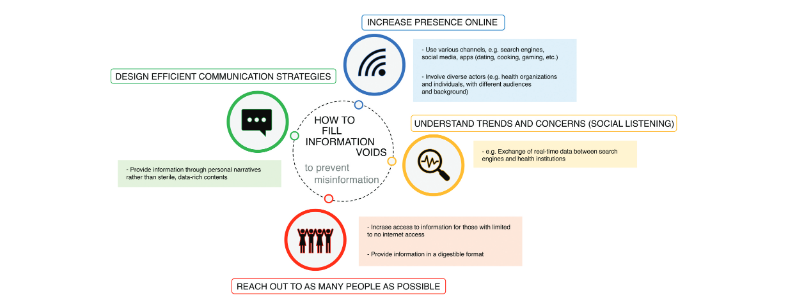
"The success of information campaigns can be promoted by (a) increasing presence online; (b) understanding real-time trends and concerns (social listening); (c) reaching out to as many people as possible; (d) designing comprehensible and efficient communication strategies."
Anti-vaccine sentiment is widespread, enabled in part by fake news and misinformation spread rapidly on social media. This article discusses strategies to mitigate negative effects of online anti-vaccine content on public health. It stresses the importance of filling information voids, examines trends and concerns that shape the vaccine debate, and shares strategies for building resilience to vaccine misinformation by strengthening public health and digital literacy.
The article begins by providing some statistics around vaccine hesitancy and vaccine refusal. It then explores the landscape of anti-vaccine sentiment online. For instance:
- The anti-vaccine community on platforms such as Twitter is split in two groups: a small fraction of influencers with many followers and a large group of profiles with a small number of followers. The latter group functions as an echo chamber for the content generated by the small fraction of influential profiles. Limiting their potential to influence other people can be achieved through various strategies: (i) banning their profiles on social media if they infringe misinformation policies; (ii) shadow banning their profiles to limit their outreach; and (iii) flagging their posts or tweets for potential misinformation using disclaimers. One undesirable implication of censorship is the consequent decline in public trust.
- Individuals and organisations who support the use of vaccines also engage in discussion on social media. Those with many followers can be defined as "vaccine influencers" and are often active communicators online. Health organisations could work with trusted amplifiers, providing guidance on (i) how to communicate more efficiently - for instance, by using people-centred and emotional messages about vaccines; (ii) how to make the most efficient use of social media to increase outreach; and (iii) how create a network of influencers able to help each other against haters and bots.
However, as argued here, any strategies that do not consider the root causes and the contingent factors that sustain vaccine hesitancy are doomed to fail. This is where social listening comes into play. This approach helps in understanding the nature of vaccine-hesitant individuals' doubts - what concerns they have and why, including whether they are aware of how vaccines work and so on. Assessing trends and concerns through real-time analysis of data (e.g., search trends and topics discussed online) is a first step. Gathering such evidence can then be used in determining how to fill information voids and provide accurate information through appropriate channels. A longer-term strategy needs to consider the causes of vaccine hesitancy through a precise dissection of the processes of belief formation and reinforcement, as well as the relevant factors (such as education, cultural background, critical thinking skills, etc.) that play a role in determining the success or failure of a disinformation campaign. This understanding will help inform the design of intervention tools that can increase public resilience to misinformation.
The authors propose that online presence needs to be increased; various channels of communication online need to be used, including search engines, social media, and other platforms, such as dating, cooking, or gaming apps. Further, they suggest that various actors need to be involved - from the World Health Organization (WHO) to local organisations and influencers. "The plurality of actors is important: the more people are involved in creating various type of contents, the more people will be able to access accurate information about vaccines." The idea is that the more diverse the pool of active organisations and influencers (in terms of cultural background, political orientation, or engagement in local communities), the more people will be reached by accurate and helpful health messages.
These personnel and organisations need to adopt comprehensible communication strategies and, as proposed here, should learn from disinformation campaigns by understanding the reasons for their success. Although scientific communication is data-driven and based on evidence, "There is a difference between a strategy which focuses on providing evidence for claims, and a strategy that focuses on communicating a desired evidence-based message (providing versus communicating evidence)....Instead of claiming vaccines are safe and support these assertions with data from clinical trials, the ideal communication strategy could illustrate a happy child after vaccination..."
One way to confront anti-vaccine sentiment is to present a simple and effective risk-benefit analysis, in which the known risks of vaccines are presented alongside the known benefits. Presenting a clear picture of vaccine-adverse events could enhance public trust in institutions, thereby competing with and reducing the circulation of misinformed risk-benefit estimates and analyses - and, ultimately, could reduce vaccine hesitancy. The article notes that communicating risk-benefit analyses should refer to relatable and understandable real-life examples.
Based on the existing literature and the need to identify long-term, resilience-building anti-misinformation strategies, the authors suggest identifying, categorising, and validating a minimum set of skills that underpin critical thinking in the context of scientific and vaccine misinformation. Local authorities may consider adding critical thinking to science curricula at school starting from a young age, specifically to build scientific and digital literacy.
In terms of ethical questions that may arise in such pursuits, the authors stress that resilience to misinformation can be built by providing tools to enhance information literacy, rather than by convincing people that vaccines are safe and effective. Ethical issues "can be overcome with the design of long-term approaches which aim to build the public's resilience to misinformation.
Human Vaccines & Immunotherapeutics, DOI: 10.1080/21645515.2022.2095825.
- Log in to post comments