










































Impacts of the Stimulate, Appreciate, Learn, and Transfer Community Engagement Approach to Increase Immunisation Coverage in Assam, India
National Council of Applied Economic Research (Pramanik); The George Institute for Global Health (Ghosh); Indian Institute Public Health (IIPH) - Shillong, Public Health Foundation of India (Goswami, Das, Albert); The Constellation (Forth, Nanda)
"Communities change themselves. We do not change communities."
In the context of the universal immunisation programme (UIP) in India, most interventions designed to address shortfalls in India's full immunisation coverage (FIC) are geared towards addressing supply-side challenges. But there is a growing body of literature indicating that community engagement approaches can potentially address demand-side barriers while also mobilising the community to advocate for better service delivery in places like the state of Assam, India, where full immunisation coverage is lower than the national level, and dropout rates of vaccines that require multiple doses are also higher than national figures. Participatory engagement of communities could help identify barriers to vaccination at the local level and thus might lead to sustainable solutions in a manner that a top-down approach cannot achieve. The evaluation tested the effectiveness of a community engagement intervention that sought to promote community ownership to increase uptake of vaccinations in Assam, India.
The intervention originated at the Constellation, a non-governmental organisation (NGO) whose experience in more than 60 countries has indicated that communities can and do respond to the challenges they face when they take ownership of those challenges. The Constellation refers to the methodology used to accompany the community as it takes the path to ownership of their challenge as the Community Life Competence Process (CLCP), a form of learning cycle where a community identifies a problem, takes action, and learns from the process. (See Related Summaries, below.) Based on the premise that communities can think and act for themselves and have the capacity to bring about change, CLCP is initiated in communities by trained facilitators who use a mental attitudinal approach called SALT: Simulate, Appreciate, Learn and Transfer. Through SALT, facilitators accompany the community as it divides an apparently insurmountable challenge into a set of specific and manageable steps.
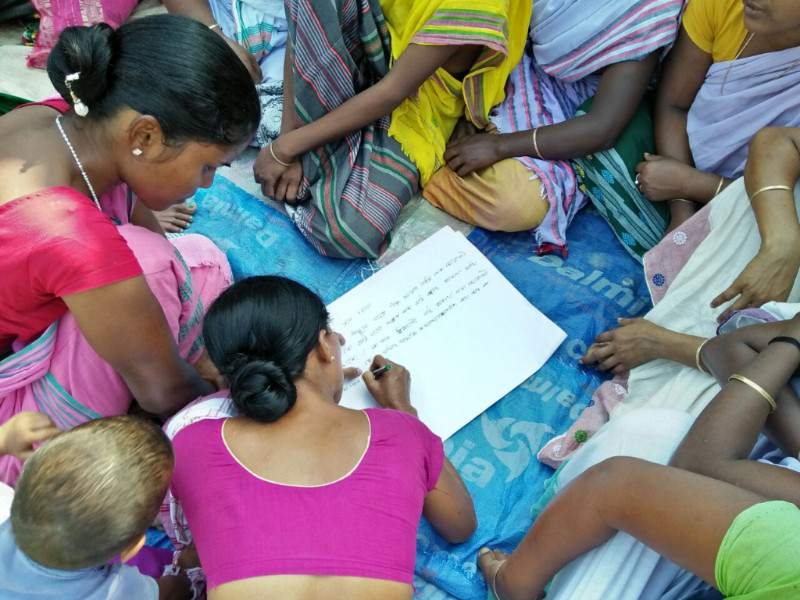
For this particular application of CLCP/SALT, Constellation engaged 2 local NGOs, - Voluntary Health Association of Assam (VHAA) in Kamrup (R) and Udalguri, and Centre for North East Studies and Policy Research (C-NES) in Bongaigaon - to implement the intervention. Through learning events and support visits, Constellation trained facilitators from these NGOs, who then initiated the process by visiting villagers' homes to engage with people, listen to their hopes and concerns, appreciate their strengths, and eventually bring the community together to discuss the common values they share. They then led the communities through a self-assessment framework and moderated the process by ensuring every voice was expressed in collective dream building (a dream of healthy children in the community, with immunisation as a key component). Based on the common vision, facilitators aided the communities in creating an action plan based on the premise of shared ownership. After implementing these action plans, the facilitators helped the communities assess their own performance, decide on a course of action using locally available resources, and establish parameters for gauging progress while reflecting on outcomes. At the end of the process, community members were encouraged to share what they have learned through the SALT process with each other through knowledge fairs in the 3 districts in April 2018, followed by a combined knowledge fair in Guwahati.
The study used a cluster randomisation design with 2 groups to evaluate the intervention in 3 districts (Bongaigaon, Kamrup rural, and Udalguri). The study sample comprised 180 villages, which were equally allocated across the 3 districts, resulting in 30 intervention and 30 control villages in each district. (The intervention group received the SALT intervention for about a year (March 2017-March 2018), along with routine immunisation (RI) services, whereas the control group received RI services alone.) From all sampled villages, a random sample of mothers from 15 households with children between 6 and 23 months of age was selected for the baseline survey.
In addition, at the end of the intervention phase, qualitative data were gathered in 22 intervention and 6 control villages through: 39 focus group discussions (FGDs) with parents (mothers and fathers separately) and grandmothers of children in the age group of 6-23 months; 33 key informant interviews (KIIs) with the District Programme Manager (DPM) and Block Community Mobilizer (BCM) of National Health Mission (NHM), Auxiliary Nurse Midwives (ANMs), Accredited Social Health Activists (ASHAs), and ASHA Supervisors; and 12 in-depth interviews (IDIs) with parents and grandmothers.
Process evaluation data indicate that, in 88 of the 90 villages, the entire intervention was completed before end of the intervention period (March 2018). Generally, 10-30 community members participated in the CLCP activities under the SALT intervention, but it was observed that there was no mechanism in place for tracking whether the same participants participated in all the activities under SALT. Other selected lessons learned from the process evaluation:
- Related to trainers: Simple and easy sessions are crucial; the Constellation team members used pictures/drawings to explain key concepts of the SALT approach and this was helpful.
- Related to bringing the community together: Humour and games were found to be useful in helping the team mix well with the community.
- Related to facilitators: The facilitators were required to unlearn their earlier community engagement experience, which mostly evolved around imparting knowledge and awareness among the community members, as SALT demanded the skills of listening and appreciating so as to help the community find links that opens up solutions, mutual hope, trust, and reciprocity.
- Related to time required: It was observed that due to the novelty of the SALT intervention, some communities found it difficult to grasp the whole concept behind it. According to facilitators, it took 4-6 months to build rapport with the community and help them feel comfortable enough to share their thoughts. In most cases, the community was not able to recall terms like "CLCP" or "SALT". However, when reference was made to dreams about their children and village, and charts were drawn for the various activities under the SALT intervention, they could recall the same.
- Expectation from SALT facilitators: It was observed that the community often expected more from the SALT facilitators than just enabling linkage to various departments or experts/programme personnel, as envisaged in SALT/CLCP. In one follow-up visit, the community asked the facilitators to explain in detail the immunisation schedule, and in Udalguri, the ASHA requested the facilitators to talk to health officials regarding issues in the community.
- Continued lack of awareness: During one of the monitoring visits, it was observed that even though the community took their children for immunisation, they were not aware of the immunisation schedule, the diseases prevented through immunisation, or the details given in the MCP (Mother and Child Protection) card.
Overall, the analyses suggest that the intervention did not have any effect on the primary or secondary outcomes. It had no effect on full immunisation in children between 12 and 23 months of age, as the adjusted odds ratio is close to 1 (odds ratio (OR) = 0.97, 95% confidence interval (CI) [0.70,1.34]). There were no effects on the coverage of the diphtheria, pertussis (whooping cough), and tetanus (DPT) vaccine either, with the odds of receiving all 3 doses among children between 6 and 23 months of age being similar across the intervention and control arms. In addition, none of the subgroup analyses based on various factors (e.g., district, gender of the child, birth order of the child, and village baseline full immunisation coverage) showed a significant effect of the intervention.
The qualitative data showed mixed results. While many mothers and grandmothers who participated in FDGs expressed awareness of the SALT process, they still represented a small fraction of the communities engaged in it. However, villagers who were aware of the SALT process reported benefits in both increasing immunisation awareness and utilisation and receiving additional benefits for the community outside the context of immunisation. On person said, "Now, the people have started giving importance to vaccination schedules, and even before the ASHA informs, people come forward enquiring about matters relating to child's health or immunization." Respondents also expressed that the SALT intervention has strengthened the unity and solidarity among them.
The researchers explain that the baseline assessment (June-August 2016) indicated that all study districts had significantly higher immunisation coverage compared to the earlier (November 2015 - March 2016) assessment by the fourth National Family Health Survey (NFHS-4). They postulate that one reason for the improvement in immunisation coverage in both intervention and control villages could be due to the widespread implementation of Mission Indradhanush, the flagship programme of the Government of India, across Assam during the study period. (This also means that some communities may not prioritise immunisation when there are other pressing issues prevalent in the community.) Given the high vaccination coverage in study districts at baseline, the SALT intervention might have been more effective had it been adapted to engage with marginalised and hard-to-reach populations in a targeted manner. However, had the researchers only implemented SALT among households with pregnant women, for example, the majority of the community members would have remained unexposed to the intervention and thus may not have developed community ownership of the issue of immunisation.
The researchers conclude that behaviour change in villages with vaccine hesitancy could take more time than what the intervention period involved and might require sustained effort. Furthermore, it may be worth adopting the SALT approach for situations where the intended group is smaller or where the issue is perceived as a priority by the community and emerges organically through discussions - for instance, in villages with high prevalence of vaccine hesitancy.
3ie website, November 9 2020. Image credit: Neog Ruchira
- Log in to post comments