










































Impact Evaluation of a Community Engagement Intervention in Improving Childhood Immunization Coverage: A Cluster Randomized Controlled Trial in Assam, India
Public Health Foundation of India (Pramanik, Ghosh, Albert); The Constellation (Nanda, de Rouw, Forth); Indian Institute of Public Health, Shillong, or IIPH-S (Albert)
This article pre-specifies study protocol for a cluster randomised controlled trial (cRCT) evaluating the impact of a community engagement intervention - stimulate, appreciate, learn, transfer (SALT) - in improving childhood immunisation uptake in Assam, India. The idea is that clarifying the objectives, rationale, and methodology of the study ahead of it increases confidence in the validity of the conclusions and can reduce publication bias.
Assam is a northeastern state of India with the second highest infant mortality rate in the country and full immunisation coverage, or FIC (55.3%) lower than the national level (65.2%). To improve immunisation coverage, most interventions that are part of the national immunisation programme in India address supply-side challenges. But there is growing evidence that addressing demand-side factors can potentially contribute to improvement in childhood vaccination coverage in low- and middle-income countries. Participatory engagement of communities can address demand-side barriers while also mobilising the community to advocate for better service delivery.
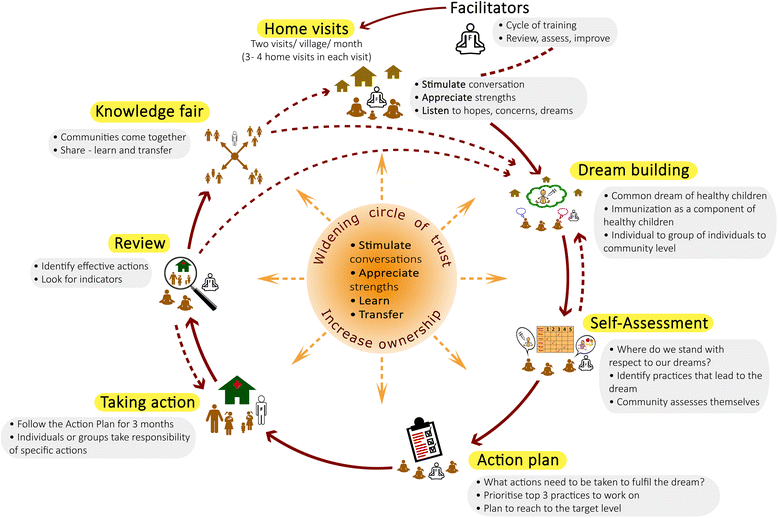
This community engagement intervention originated at the Constellation, a non-governmental organisation (NGO) registered in Belgium. In brief, SALT employs facilitated conversations to elicit community strengths, increase self-awareness, and stimulate self-confidence and action. The approach is based on the premise that communities can think and act for themselves, and that communities have the capacity to change themselves. In various steps of the intervention, the communities lead the way - they identify the challenges, take actions based on where they are and what they want to achieve, learn from their actions, and share their experience with other communities. Trained facilitators accompany the community on its path to ownership of the issue of immunisation and its solution. They stimulate the communities to leverage their own strengths to address their concerns, and accompany them through a systematic process of learning from action.
To go into the process in more depth:
- The intervention starts with home visits by trained facilitators to villages. Facilitators engage with people, listen to their hopes and concerns, appreciate their strengths, and eventually bring the community together to discuss the common values they share. SALT home visits are thought to be a crucial starting point, as they help build trust between the facilitators and the community and identify strengths available in the community.
- The next step is collective dream building, which starts from individuals and small groups and then involves the wider community. In the study's context, this is the dream of healthy children in the community, and immunisation is a component that can contribute to healthy children.
- A self-assessment exercise starts under the guidance of the facilitator in order to understand where the community stands today with respect to practices linked to their shared dream. The facilitators stimulate the conversation so that immunisation-related practices emerge during self-assessment. The self-assessment framework requires the community to assess itself on the set of practices defined by the community, where level 1 indicates a low level of competence and level 5 indicates a high level of competence. This is not about an "expert" coming from outside to assess the community and advise it of its weaknesses and its strengths.
- The community chooses 3 priority practices, relevant to their shared dream, where it feels that it can make progress within a stated timeframe (say, 2-3 months). The discussion evolves around what actions need to be taken in order to reach a next desired level from the current level agreed by the community during self-assessment. For each selected practice, the community itself comes up with certain number of actions, based on its strengths and resources, which would help them reach the target level within the specified period of time. Often, specific individuals or groups are identified from the community who take responsibility for each of the actions. To measure the effectiveness of action plan, some indicators are defined by the community members.
- This is followed by the action phase and the review process. The emphasis is that a plan is used to help take action, with actions taking precedence. Facilitators then bring communities together to share with and learn from each other in a "knowledge fair", when transfer of knowledge and experience takes place between communities. Depending on the progress and timeline allotted for the intervention, the community might revisit the dream and the various steps in the process.
Working with 240 villages in 3 districts of Assam - Bongaigaon, Kamrup rural, and Udalguri - the researchers assigned the intervention group to receive SALT intervention for about a year (March 2017-March 2018) along with routine immunisation (RI) services. The control group received RI services alone. (The article describes the sampling strategy: recruitment of clusters and participants, as well as the randomisation strategy and the strategies for minimising intervention-control contamination.) A cluster randomised design is appropriate here as opposed to individual or household level randomisation, as the intervention is being implemented at the community (village) level, the village being the unit of randomisation. The study uses a repeated cross sectional design where researchers track the same sampled villages but draw independent random samples of households (HHs) at baseline and endline. The baseline survey was done during June-August 2016, and the endline survey is planned to be conducted after the conclusion of the intervention, during June-August 2018.
The study will assess the intervention's impact on the following primary outcomes: FIC in children 12-23 months old and coverage rate of 3 doses of diphtheria-pertussis-tetanus (DPT)/Pentavalent in 6-23 month old children. As secondary objectives, the researchers will study the impact of the intervention on dropout rates between different doses of DPT and oral polio vaccine (OPV), timely immunisation, and inequities in immunisation coverage by gender, birth order, and various religious and caste groups. In addition, they will explore the intervention's effect on common childhood illnesses such as diarrhoea and acute lower respiratory infection. They will also measure other outcomes that fall on the causal pathway, including awareness of immunisation service provision in mothers, health service utilisation (antenatal check-up and institutional delivery), perception of adherence and completion of immunisation schedule in protecting children from diseases, beliefs regarding community engagement, action and practices in the context of child health, and community involvement and ownership.
The study includes a qualitative component to complement its quantitative surveys. Focus group discussions (FGDs) and key informant interviews (KIIs) were conducted at baseline in order to understand community perceptions regarding immunisation and perceptions on immunisation of different stakeholders, as welll as to gain an understanding of current community engagement. A more extensive qualitative data collection is planned for endline. FGDs and KIIs will be conducted in a sub-sample of villages in the intervention and control arms that will be representative of villages across the 4 strata identified in 3 districts. The goal is to examine if, how, and why the community mobilised to take ownership of child health and immunisation-related issues, the perceived benefits and challenges of SALT approach, the perceived improvements in child health with a focus on immunisation, and whether the community identifies SALT as a valuable, feasible, and sustainable approach to address community problems.
Among the issues explored in the article's discussion section is the fact that RCTs of complex interventions like SALT - participatory, interactive, prolonged, and involving multiple interrelated steps - are often criticised as being "black box", as it can be difficult to know why and how the intervention worked (or not). At the end of the study, the absence of an impact could be simply because SALT was ineffective in this particular context, or it could potentially be because of less-than-optimal implementation of the intervention. In order to be able to answer this, the researchers developed a process evaluation data collection plan for the entire duration of the intervention phase. The aim is to answer the following questions: 1) whether the intervention is implemented as intended, 2) whether the intervention incorporates the primary objective of the study (i.e., increasing immunisation coverage), 3) consistency of intervention delivery across communities in terms of the process of administering the intervention, 4) how the intervention was received by the HHs and communities across villages and districts, and 5) whether contextual factors influence the implementation of intervention.
BMC Public Health (2018) 18:534.
- Log in to post comments