










































Effect of Vaccine Reminder and Tracker Bracelets on Routine Childhood Immunization Coverage and Timeliness in Urban Pakistan (2017-18): A Randomized Controlled Trial
Interactive Research & Development (IRD) Global (Siddiqi, Khan, Chandir); IRD Pakistan (Ali, Munir, Shah, Chandir); Harvard Medical School (Khan, Chandir)
"There is...a programmatic and research gap regarding strategies to improve immunization coverage and timeliness in low-literacy communities through cost-effective, sustainable solutions that...focus on transforming caregivers from passive to active recipients of immunization services."
Evidence indicates that suboptimal immunisation coverage and timeliness is attributable not only to supply-side deficiencies, but also to demand-side problems such as caregiver complacency, forgetfulness, and unawareness of required number and timing of doses. Globally, a widely used method to communicate the vaccination schedule to caregivers is the paper-based immunisation card. Like immunisation cards, which require literacy, reminder-recall (R/R) interventions requiring mobile phone ownership fail to penetrate the lowest socioeconomic strata, thus widening the global immunisation equity gap. In Pakistan, one of the strategies deployed in response to caregivers' failure to visit immunisation centres on time is the implementation of door-to-door vaccination and awareness campaigns, but these are resource intensive. Thus, this study evaluated the effect of an alternative - silicone bracelets - in improving immunisation coverage in children under 2 years of age in a low-literacy, peri-urban community in Pakistan. The secondary outcome focused on caregiver feedback regarding the bracelet, including its value, ease of use, and visibility.
The researchers' hypothesis that the bracelet would improve immunisation uptake was based on the idea that the bracelet would serve as a visible and durable reminder as compared to other alternatives, and that it was easier to understand and interpret for uneducated caregivers.
The multicentre, three-arm parallel group, randomised control trial (RCT) was undertaken at four immunisation centres in Landhi Town, Karachi, Pakistan, where immunisations are provided by the government-run Expanded Programme on Immunization (EPI). As per the Pakistan Demographic and Health Survey (2017-18), 82% of all 12- to 23-month-old children in Sindh province had received the Bacille Calmette-Guérin (BCG) vaccine, and coverage for Pentavalent-3 and Measles-1 vaccine was 59% and 61%, respectively.
Participants in the study included 1,445 infants (482 in each of the intervention groups, and 481 in the control group) presenting to any of the four selected immunisation centres for BCG or Pentavalent-1 vaccination. Baseline characteristics among the three groups were similar.
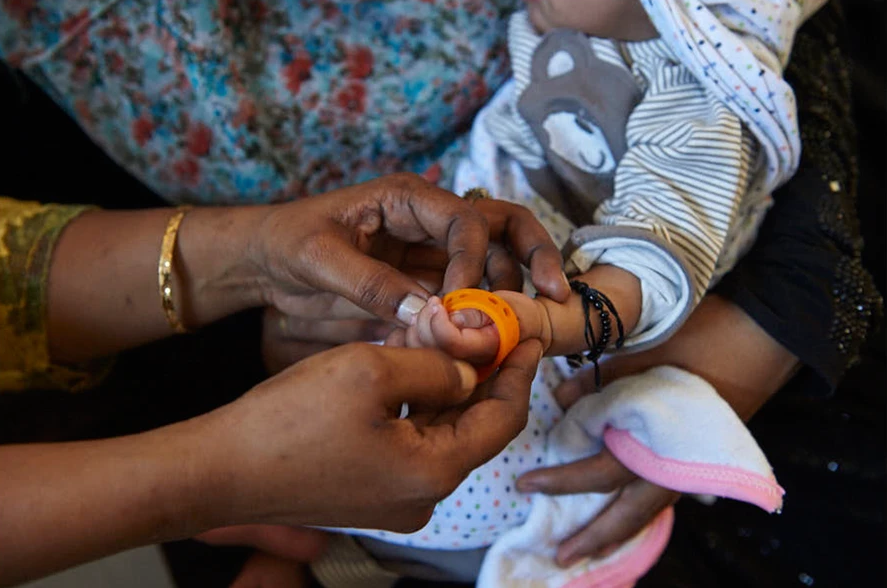
- Intervention Group A was provided with a bracelet developed by Alma Sana Inc. that was adapted to the Pakistani context through feedback from mothers and vaccinators. The bracelet featured the recommended age of the child denoted in weeks/months for receiving the vaccine, followed by symbols representing each of the vaccines due at that age. Each time the child came for vaccination with the bracelet, study staff perforated a hole in the particular symbol denoting the vaccine that the child had received on that visit and explained to the caregivers the number of vaccines the child still had to receive to complete the routine immunisation (RI) schedule.
- Intervention Group B was provided with a simple silicone bracelet that consisted of six symbols (five crescents and one star), with the rationale to motivate parents to make all six visits to the immunisation centre in order to reach the star symbol on the bracelet. Similar to Intervention Group A, each time the child visited the centre with the bracelet, study staff punched a hole to denote the child's visit and explained to the caregiver the need to complete all six immunisation visits. The bracelets were manufactured in two different sizes and colours (pink for girls and blue for boys).
- The control group participants received the standard of care, which included receiving the routine EPI vaccinations as per Pakistan's EPI schedule and the vaccinator recording the child's immunisation data on the EPI immunisation card provided to the caregivers.
From July 19 2017 to October 10 2017, 1,445 children were enrolled and followed for 12 months. The study found that up-to-date coverage for the Pentavalent-3 /Measles-1 vaccine at 12 months of age was 84.6%/72.0%, 85.4%/70.5%, and 83.0%/68.5% in Intervention Group A, Intervention Group B, and the control group respectively, but the differences were not statistically significant. In the multivariate analysis, neither the Alma Sana bracelet nor the star bracelet was significantly associated with Pentavalent-3 vaccination or Measles-1 vaccination.
The researchers suggest that it is worth investigating the reasons for the null impact of the study. A key assumption of their intended theory of change was that the bracelets would be a visually evident reminder, compared to commonly used alternatives such as immunisation cards that are not always within the caregivers' sight. However, the study found that almost half of the study participants only wore the bracelet before coming to the immunisation centre and only a negligible percentage of children wore the bracelet at all times, despite the study staff reiterating its importance at each follow-up visit. The most commonly cited reasons for not wearing the bracelet were that the caregivers were afraid that the child would lose it and that the bracelet was not of the appropriate size.
In addition to ensuring that the bracelets are size-adjustable, from a longer term perspective, adherence towards wearing the bracelet "constitutes a behavioral change process which is an important mediator for the observed health outcomes....[M]aking health-related behavior changes is a complex process...which may lead to an 'intention-behavior' gap...[Perhaps] the short duration of the study did not provide enough time to 'institutionalize' the use of the bracelets."
That said, the researchers point to the favourable feedback from parents. The proxy for measuring overall caregiver satisfaction with the bracelet included whether caregivers understood the purpose of the bracelet (84.6%), whether the bracelet reminded them regarding the upcoming vaccine (71.2%), and if they would recommend others to use the bracelet (79.0%). These findings may reflect the fact that health-seeking behaviour in Pakistan specifically and South Asia in general "frequently features faith healers and cultural wearables such as amulets, ta'wiz, and pendants that are commonly used for protection..., which may have led to little resistance from caregivers and facilitated the link between the bracelets and their intended health context."
Implications for future work and for similar interventions seeking to improve caregiver adherence to the RI schedule:
- Any similar novel innovation or tool should be accompanied by community mobilisation and engagement to emphasise its importance and utility. This suggestion is consistent with the literature on adherence and compliance of health-related behaviour whereby good communication strategies, counseling, and knowledge are important predictors of adherence.
- The delivery of the bracelets through trusted vaccinators or community health workers as opposed to "distant" study staff would give it more legitimacy and enable better compliance towards wearing the bracelet. This is in line with other findings that caregivers preferred delivery of R/R services by the government or through the established health network.
- It might be useful to: evaluate the impact of the bracelet in a purely rural community where literacy rates are much lower, introduce the bracelets even earlier on, and consider designing bracelets for mothers to be provided at the time of antenatal care visits, as studies have shown a positive association between mothers antenatal care visits and subsequent uptake of child immunisations.
BMC Public Health (2020) 20:1086 https://doi.org/10.1186/s12889-020-09088-4.
- Log in to post comments