










































Influencing Change: Documentation of CORE Group's Engagement in India's Polio Eradication Programme
During the 1970s and 1980s, India was one of the worst among the developing countries affected by polio, with an estimated 200,000 to 400,000 cases annually. On March 27 2014, the World Health Organization (WHO) declared India polio free. This publication documents the key strategies used by the CORE Group Polio Project (CGPP), working alongside the Indian government and other agencies, to contribute to the eradication of polio in India. Influencing Change is a collaborative effort of The Communication Initiative and CGPP, which is a multi-country, multi-partner initiative providing financial support and on-the-ground technical guidance to strengthen host country efforts to improve the health and well-being of children and women.
Located in Gurgaon, the CGPP India's secretariat consists of a team of consultant advisors who recognised that there was an urgent need to introduce a social mobilisation component to the programme that would be designed to reduce family and community resistance to the oral polio vaccine (OPV). To combine their efforts for a more coordinated and effective outreach, CGPP, the United Nations Children's Fund (UNICEF), and Rotary International started working together (with United States Agency for International Development (USAID) funding) as the Social Mobilisation Network (SMNet) in 2003.
CGPP undertook a variety of communication activities - with a particular focus on social mobilisation to promote social and behaviour change - as well as strong partnerships with government structures and local and international non-governmental organisations (NGOs). The social mobilisation strategy had 2 objectives: (i) to engage and convince communities, especially mothers/caregivers, about the benefits of vaccinating their children repeatedly for polio; and (ii) to ensure that families were motivated to vaccinate their children for other life-threatening diseases. Channels like interpersonal communication with mothers/caretakers and group meetings with religious and community leaders and other influential people were key to establishing proactive community dialogues about vaccination and to dealing with resistant families. Over the years, the SMNet evolved, and the communication package and interventions were also revised to sustain community participation.
The CGPP team identified 6 SMNet strategies as the most effective in reaching the population with OPV, especially in hard-to-reach areas. In this document, CGPP shares its experiences, challenges, and lessons learned by describing the process of each of these strategies as a guide for those who may want to design similar strategies for social mobilisation in other sites and settings. Each chapter describes the rationale, design, implementation, and achievements of the strategy and concludes with a statement from one or more CGPP team members reflecting on key lessons.
Following an introduction that reviews the history of the Global Polio Eradication Initiative (GPEI) in India and an overview of strategies implemented in India, Influencing Change includes the following chapters, which correspond to the 6 key strategies:
- Partnering with the Government: Collaborating to End Polio - details the design and implementation of the strategy adopted by CGPP to forge partnerships and strengthen collaboration with the Government. This partnership created an enabling environment to ensure people's participation in and ownership of the polio immunisation programme.
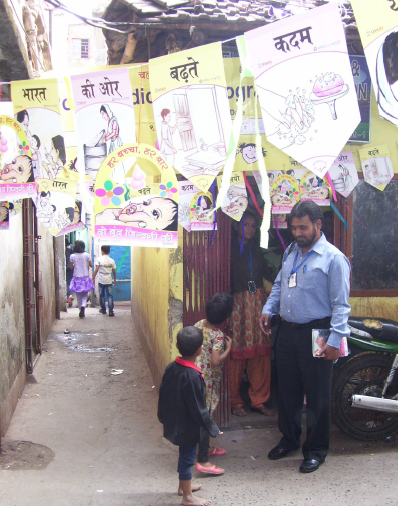
- Behaviour Change Communication Strategy: Innovative Messages and Indigenous Tools - provides a description of CGPP's individual- and community-level behaviour change approaches using creative and innovative communication activities and materials that reduced resistance and promoted vaccination awareness and safety.
- Empowering Women and Building Community Ownership: Community Mobilisation Coordinators - documents the process of how cadres of community mobilisers contributed to reducing community resistance to vaccination by visiting households, promoting government-run immunisation services, tracking missed children, and mobilising local opinion leaders to break community resistance and promote vaccination.
- Engaging Influencers: Building Trust - explores how a strong network of community, cultural, and religious leaders got involved in acting as a credible communication channel to help the CGPP team gain community support by responding effectively to fears and misconceptions.
- Messengers of Change: Involving Children in Polio Awareness - describes the process and achievements of harnessing the power of children as motivators.
- Making Inroads with Mobile Populations - details the process of designing strategic interventions for identifying and including transit areas and migrant communities.
Download a soft copy of Influencing Change at the URL; below; to request a hard copy, write to: rainydey27@gmail.com OR contact@coregroup.org
Publishers
106
Image credit: CGPP
- Log in to post comments