










































Interpersonal Communication for Immunization (IPC/I)
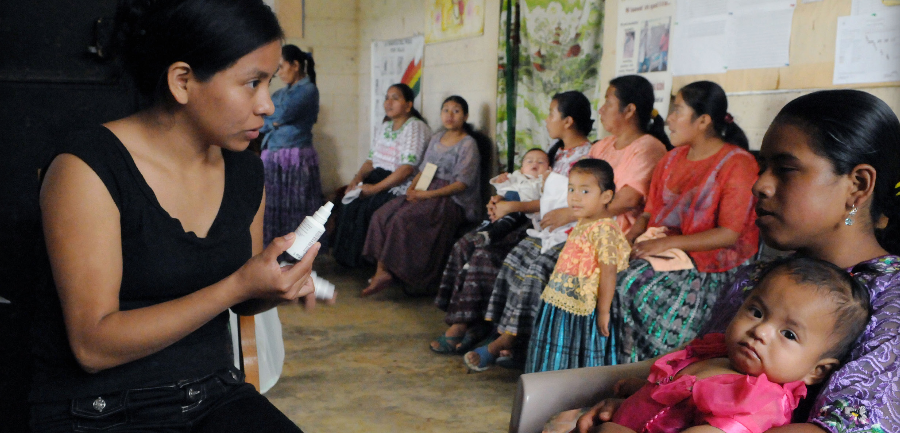
"As the most influential source of information about vaccine behavior, frontline workers need communication skills that go beyond being able to provide basic information about vaccines - they need to be able to engage in positive and meaningful communication with their clients."
The website ipc.unicef.org is part of a global package of tools and resources designed to support frontline workers (FLWs) in their immunisation work, with a focus on improving their capacity to effectively use interpersonal communication (IPC) to address barriers to immunisation uptake and completion. It presents a collection of IPC for immunisation (IPC/I) tools and materials, including the core package initially developed (see below), adaptations of the core package components that have been developed by other regions and countries, and case studies of the resources put into use.
It was developed through a human-centred design approach by the Johns Hopkins University Center for Communication Programs (CCP) for the United Nations Children's Fund (UNICEF), along with partners Bill & Melinda Gates Foundation, Centers for Disease Control and Prevention (CDC), Gavi: The Vaccine Alliance, World Health Organization (WHO), United States Agency for International Development (USAID), Emory University, International Pediatric Association (IPA), and John Snow, Inc.
These collaborators explain that community mobilisers, health educators, healthcare providers, community health workers, and community-based volunteers are all part of the frontline workforce and are a bridge between the communities they serve and the health services - including immunisation - they provide and promote. FLWs who engage in positive and meaningful IPC with their clients - such as asking relevant questions, encouraging participation, demonstrating empathy, emphasising the importance of timely vaccination, listening attentively, and responding to, showing respect for, and appreciating clients - can build trusted relationships with individuals and families, and these trusted relationships are crucial to accepting vaccination and completing the vaccination schedule.
The primary audience of the IPC/I website/package is FLWs who provide immunisation services, but a number of the materials are directed toward sub-national supervisors, UNICEF regional or country offices, national immunisation programme managers and implementers, and sub-national entities such as district health offices and educational institutions, which can adapt package elements to reflect country/local needs and realities.
All components within the IPC/I package were designed using adult- and peer-learning and participatory technologies - including experiential learning - using a suite of learning modalities for strengthening the capacity of the FLW in IPC/I. The package includes:
- Audio Job Aids - 8 short audio tracks that use a dialogue format to share key messages related to questions FLWs may encounter during their visits with caregivers. The aids are intended to be delivered via an interactive voice response (IVR) platform, to be easily accessible even by FLWs who only have a basic phone. Other distribution channels include the IPC/I mobile app, messaging services, and direct transfer to a mobile device. Sample topic: "What to do if a caregiver refuses immunization".
- Video Series - 7 videos presenting common challenges faced by FLWs in their immunisation work and strategies and skills FLWs can apply to practice better IPC when faced with challenges. Six of the animated films feature characters who represent different regions of the world to demonstrate that FLWs everywhere face similar challenges. The videos have dramatic storylines to keep the viewers interested and engaged while using modeling to build the IPC/I skills of FLWs. Sample topic: "Addressing Rumors or Myths and Role in Vaccine Safety Events".
- Adaptation Guidance & Needs Assessment - a 30-page guide reviewing key principles and steps to guide the process of adapting the package content, including conducting a needs assessment and tailoring the global package to individual or local needs and priorities.
- Facilitator's Guide - a 116-page guide designed to help FLWs acquire the knowledge, skills, and attitudes needed to communicate effectively with caregivers and communities about childhood immunisation. The information and exercises can be used in the context of pre-service training, training workshops, day-to-day supervision, supportive supervision visits, on-the-job training (including coaching, mentoring, and peer-to-peer mentoring), and self-study.
- Participant's Manual - a 100-page manual to be used with its companion Facilitator's Guide to improve IPC skills for immunisation. The full workshop outlined in this guide addresses the following topics: principles of IPC; exploring provider perspectives and barriers; problem solving; immunisation and vaccines; profiling types of caregivers; community engagement; addressing negative rumours, myths, and misconceptions; and action planning. This guide recommends the use of adult learning principles and methodologies, interactive approaches, learning by doing, blended learning, gaming, role plays and demonstrations, and the use of videos to model and assess verbal and nonverbal communication.
- Frequently Asked Questions - a 36-page resource developed to help FLWs respond to some of the most common questions with accurate information and using simple and concise language, which helps builds trust.
- Supportive Supervision Manual - an 80-page manual designed to help supervisors support FLWs to improve IPC in immunisation services. It takes into account common supervision practices, obstacles to supervision, and IPC/I-specific needs and information.
- Reference Cards - an 80-page document created to provide easy access to information on vaccines and vaccine-preventable diseases, covering topics such as "Guiding an interpersonal communication for immunization session". These cards can be used as self-learning tools, guides for conversations with caregivers and community members, or information resources for education and training.
- Monitoring & Evaluation (M&E) Framework - a 47-page document providing adaptable, actionable guidance to review, monitor, and measure the implementation, use, learning, and impact of the IPC/I Initiative and its components. It includes suggested indicators that can be used to determine the relevance, usage, and effectiveness of the IPC/I package, as well as possible data sources for those indicators.
Any of the materials and resources can be used and adapted as appropriate, and IPC/I programmes and practitioners are encouraged to share their experiences with the tools through Springboard, an online community of practice where social and behaviour change (SBC) professionals can connect with and learn from others working on similar topics or activities.
Also available is a freely downloadable, custom-built app, making the IPC/I resources available for instant use, updates, and reference:
English, with some adaptations of package components available in other languages, including Arabic, French, and Spanish. Click here to learn more.
Various (see above).
Johns Hopkins Center for Communication Programs Newsletter, May 2017, IPC/I website, and CCP Pakistan website - all accessed on August 9 2019; and email from Suleman Malik to The Communication Initiative on August 28 2019. Image credit: ©UNICEF/Markisz
- Log in to post comments