










































Involvement of Civil Society in India's Polio Eradication Program: Lessons Learned
CGPP/India
"These lessons from India can benefit other public health priorities that require civil society involvement, as most public health efforts do."
India achieved the status of a polio-free country in March 2014, but only after encountering significant people-driven challenges to the polio programme. This is when the United States Agency for International Development (USAID)-funded CORE Group Polio Project (CGPP)/India stepped in and started work in 1999. The project, a consortium of CORE Group member international non-governmental organisations (NGOs) and local NGOs, formed a bridge between communities and the government programme. This article, which is part of a series of articles detailing the work of the CGPP (accessible through Related Summaries, below), describes how CGPP/India developed tailor-made and novel approaches, centred around listening to families and communities who refused to participate in the polio eradication programme and strategically addressing their concerns.
In 1995, the Polio Eradication Initiative kicked off with country-wide National Immunization Days (NIDs). The effort seemed promising and even "people-owned", as women lined up with their babies at vaccination booths. However, once the immunisation data were examined, it became evident that children were being missed in large numbers, leading the government, in 1999, to take the step of sending vaccinators to each house to ensure that every child was reached. However, parents started shutting their doors on the vaccinators, refusing to allow their children to be vaccinated, and the enthusiasm of parents turned to reluctance in some states and strong resistance in others. For families living in places where health systems were weak, this top-down programme became viewed as coercive and as threatening as another similarly organised programme from years before: family planning. Rumours circulated in communities, and people started hiding their children, especially boys, fearing the vaccine would leave them impotent.
Uttar Pradesh was the state with maximum opposition to the polio eradication programme. The United Nations Children's Fund (UNICEF) and CGPP community mobilisers (described elsewhere in this series of articles) would approach households together for fear of being turned away, abused, or assaulted. In 2003, the CGPP and UNICEF jointly approached the Uttar Pradesh government with the proposal of forming a social mobilisation network (SMNet). Community mobilisation coordinators (CMCs), mostly women, were selected from the high-risk and most resistant communities and then trained in interpersonal communication, negotiation skills, and other behaviour change strategies. During home visits, the community mobilisers spent time with women, explaining the advantages of immunisation, dispelling untruths, and discussing other health and sanitation issues. Repeated visits built more trusting and welcoming relationships with the families and within the communities.
Keenly aware that each religious leader or priest had to be approached differently, CGPP mobilisers held meetings with small groups of both male and female religious teachers, where positive references and supportive religious texts were highlighted. Connections to religious leaders made it easier to approach keepers of mosques and request announcements advising families to take their children to the booths. Friday sermons also began to carry the message that the polio vaccine was safe and protected children from becoming crippled.
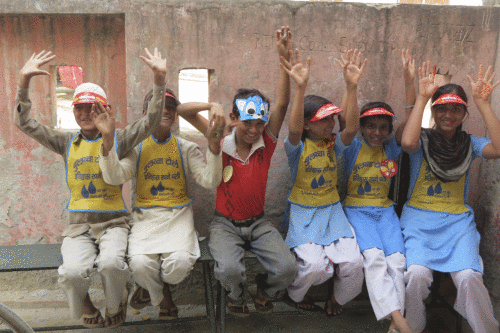
Children also took on the role of mobilisers, forming into groups called Bulawwa tolies. These children were seen as nonthreatening and became enthusiastic ambassadors of change, carrying positive vaccination messages through communities and even bringing babies to booths for vaccination. Schoolchildren held rallies and parades a day before the round. Teachers joined in mobilisation efforts: Many gave up their Sundays to work at booths, most of which were held in schools, and sometimes supervised the preparation of a mid-day meal to feed children who came to the booth.
Specific strategies were designed to reach those especially hard to track down. For example, shop owners, barbers, or others in the community who were likely the first to notice the appearance of new migrant families cooperated as informers. They were trained to notify mobilisers, who in turn made sure that the children received immunisation cards and vaccinations. Language barriers were common among nomads, so simple pictorial messages were used to convince these groups to vaccinate their children. Another challenging group to reach was children of brick kiln workers, whose parents did not get leave from work for vaccination days. Sensitisation workshops were held with the brick kiln owners, who then provided lists of eligible children to the community mobilisers.
Based on these experiences, which helped make India's polio eradication programme a success, the article shares a number of lessons learned. For example:
- "Program implementers must have their fingers on the pulse of the people and should operate with transparency. All queries and concerns must be addressed honestly and without delay...and...all adverse reports in the media need to be countered immediately before they spread deeper into the community."
- "All members of civil society need to be treated with respect and must be heard....Interpersonal communication training, particularly for frontline workers, was invaluable and allowed them to hear and react to the needs of their communities. Observing their body language, not engaging in counterproductive arguments, and treating families (especially resistant families) with respect - all these skills proved the key to success and took time to cultivate."
- "Monitoring and supportive supervision go hand-in-hand with success....[W]hen punishment turned to support and mentoring, the supervisors and those who were supervised became able to devise constructive strategies."
- "For many at-risk families, survival is the foremost priority, and government health services are not very accessible....Responding to their needs for information, questions, and concerns, particularly when related to the health and future of their children, should have been the first step."
- "A program of this complexity must be inclusive and not coercive. The new and stronger relationship and trust between civil society and the government need to be nurtured and not allowed to fade away."
- "The stakeholders learnt to base their strategies on data and modify them. Something that worked in one community might not work in another, and what worked today may not work tomorrow."
- "Truth and constant sharing of correct information were the keys to combatting anti-vaccine literature and other forms of misinformation. Sharing of appropriate data with community members helped to allay and disprove these claims."
- "Local media...must be treated with great respect and care because they are more important than national media for the program. Using them to spread correct information is invaluable....With support from polio partners such as UNICEF, Rotary International, and the WHO [World Health Organization], media sensitization workshops were organized from time to time in selected districts and at the state level..."
- "An increased emphasis on routine immunization must follow as a natural corollary, and this is the time to strike when doors are open and when people have started to believe in government health services."
- "Last, but not least, the most valuable lesson that all program partners learnt was to work together seamlessly....Roles need to be defined based on partner competencies: for example, technical agencies are best equipped to provide technical guidance, whereas community-based organizations are skilled in communication and behavior change."
In conclusion: "India's polio eradication program is a shining example of what can be achieved if civil society is brought into the inner circle of planning and policy making and if each partner's contribution is recognized and respected. The work must not stop here but needs to be continued with the same, if not even stronger, momentum and commitment toward the remaining public health challenges of our time."
American Journal of Tropical Medicine and Hygiene, 101(Suppl 4), 2019, pp. 15-20. https://doi.org/10.4269/ajtmh.18-0931. Image caption/credit: Children forming Bulawwa tolies to promote participation in immunisation campaigns. Credit: Rina Dey
- Log in to post comments