










































Involvement of School Teachers and Students in Polio Campaigns
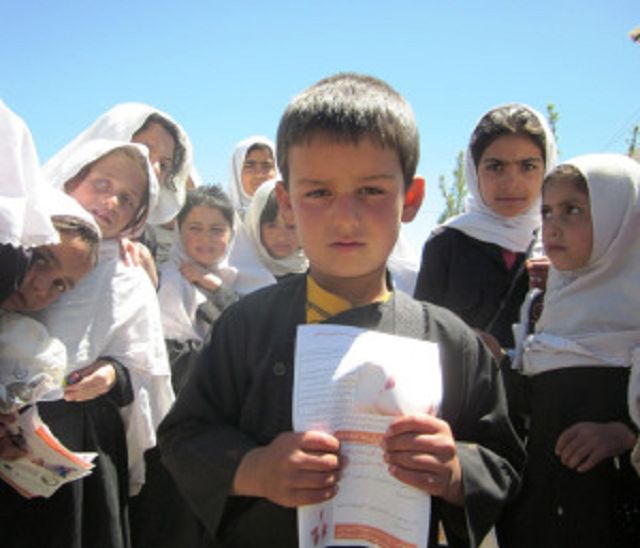
"Teachers and students shared the message of these leaflets in their communities, informed about the impairments of polio virus and motivated parents to vaccinate their children."
This blog entry explores the role of community participation - particularly in the school setting - in the effort to eradicate polio from Afghanistan, one of the three remaining endemic countries. It begins by describing the experience and efforts of the principal of the Tajrubawi High School in Poly-khost community of Gardez city. Mr. Abdul Shakoor Qadari had started his career as a polio vaccine volunteer 5 years prior. Before the April 2013 National Immunisation Day (NID), the United Nations Children's Fund (UNICEF) team visited his school seeking the involvement of his students and teachers in the polio campaign. Mr. Qadari facilitated the distribution of leaflets to the school community about the polio campaign. He told UNICEF that "teachers are often already known within their communities as effective mobilizers; they are also familiar with local social norms and values and as such are more easily able to influence changes in hygiene behavior. Enabling and empowering these school teachers in health related activities then, would surely be a sustainable way of retaining trained personnel at the local level to eradicate polio."
Another story told here to illustrate the strategy is that of Dr. Mohammad Wazir and Mr. Bhumi Bhandari from UNICEF, who visited 4 high schools in Gardez city, reaching around 14,000 students and more than 200 teachers, They provided information about the April NID and distributed around 9,000 leaflets to the students and teachers, who went on to share the message of these leaflets in their communities, informing about the impairments caused by the polio virus, and motivating parents to vaccinate their children. Dr. Wazir said he was happy to see his own children coming home with the polio campaign message and the leaflets which he had distributed in their school.
Furthermore, the Department of Education and UNICEF jointly organised a workshop about the importance of polio eradication, attended by 32 schoolteachers, including 21 female teachers. After the orientation, Ms. Nasarin Nuri, principal of Halimah Khazan Girls High School in Gardez city, said, "I am ready to be a part of this mission." She claims that she went on to motivate 40 teachers working in her school to disseminate the message of the campaign in their respective communities.
Sometimes the focus is exclusively on the involvement of youth outside of the school setting. UNICEF visited the Lincoln Learning Center in Gardez city and provided orientation for 30 young people about polio. The trained youths then visited their communities to raise awareness, supporting efforts to eradicate polio from their country by encouraging people to vaccinate their children. In addition, the coordinator of the centre felt that the orientation was successful in creating a fruitful space for shared learning and reflection and in promoting collaboration between centre members and other government and non-government stakeholders working to eradicate polio.
Reflecting on these examples of securing the rights of children and youth to participate in the polio eradication effort, the blog's author advocates for the development of more information, education, and communication (IEC) materials that these young people can use, like comic books, games, educational videos, picture-based behaviour change training materials, frequently-asked-questions handouts, and stickers. He suggests that fun classes could also be introduced in schools by using entertainment formats, colouring books, and class discussions to raise children's awareness about polio. Also, "polio heroes" could be selected from each school to help the vaccination teams going from door to door to vaccinate children against polio during NIDs.
Bhumi Bhandari's blogspot "Motherland: A small world of Bhumi Bhandari where you fall in love with words", accessed August 6 2013.
- Log in to post comments